The Cabinet Committee on Economic Affairs (CCEA) on Wednesday approved eight multi-tracking railway projects worth ₹20,804 crore across nine states, adding nearly 1,200 km to the rail network and aiming to ease congestion on some of the country’s busiest passenger and freight corridors.
The projects, approved by the CCEA at its meeting chaired by Prime Minister Narendra Modi, will cover 31 districts in West Bengal, Jharkhand, Odisha, Madhya Pradesh, Chhattisgarh, Tamil Nadu, Andhra Pradesh, Karnataka and Telangana. Together, they will improve rail connectivity to nearly 6,900 villages with a combined population of about 10.8 million.
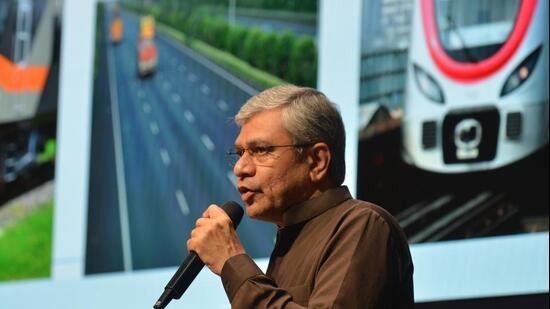
Union railways minister Ashwini Vaishnaw said that the expansion comes as the railways seek to increase line capacity on routes carrying large volumes of coal, cement, iron and steel, containers, automobiles, foodgrains, petroleum products and fertilisers.
{{/usCountry}}Union railways minister Ashwini Vaishnaw said that the expansion comes as the railways seek to increase line capacity on routes carrying large volumes of coal, cement, iron and steel, containers, automobiles, foodgrains, petroleum products and fertilisers.
{{/usCountry}}“It is much on the lines of the Golden Quadrilateral Project during the regime of former prime minister Atal Bihari Vajpayee. The government estimates the projects will create additional freight-handling capacity of around 74 million tonnes per annum (MTPA),” he said.
Also Read | Two months to Diwali and Lko-bound trains run out of berths
The first set of three projects, involving 656 km, has been sanctioned at an estimated cost of ₹10,783 crore. These include the fourth line between Kharagpur and Jharsuguda (Bagdehi), the fourth line between Katni and Pendra Road, and the third line between Bilaspur (Uslapur) and Pendra Road. Similarly, the second set comprises five projects covering about 540 km at an estimated cost of ₹10,021 crore. These include the third and fourth lines between Arakkonam and Renigunta (77 km), the third and fourth lines between Whitefield and Bangarapet (47 km), doubling of the Hosur-Omalur section (147 km), doubling of the Salem-Karur-Dindigul section (159 km), and multi-tracking of the Secunderabad (Ghatkesar)-Kazipet section (110 km).
“All eight projects are scheduled for completion by 2029-30. The additional tracks would improve operational efficiency, reduce bottlenecks and enhance the reliability of train services by allowing greater flexibility in scheduling passenger and freight trains. The projects have been planned under the PM Gati Shakti National Master Plan, with an emphasis on integrated planning and multi-modal connectivity,” the minister said.
The economic significance of the projects is particularly pronounced in mineral- and industrial-intensive regions. The Kharagpur-Jharsuguda, Katni-Pendra Road and Bilaspur-Pendra Road corridors are important for moving coal, cement, iron and steel, while the southern projects will strengthen routes carrying industrial goods, automobiles, containers and agricultural commodities.
Also Read | Dutch woman shares Delhi-Agra sleeper train experience, says ‘we expected much worse’
“The additional capacity is aimed at lowering logistics costs by shifting more freight to rail, while reducing dependence on road transportation. The government estimates that the projects in the eastern and central corridors alone could facilitate an additional 27 MTPA of freight, while the five southern projects could support another 47 MTPA,” Vaishanaw added.
Prime Minister Narendra Modi hailed the Cabinet’s decision, saying it will ensure stronger connectivity, faster passenger movement and lower logistics cost. “Lakhs of people to benefit. Today’s Cabinet decision ensures faster passenger movement, stronger connectivity and additional freight capacity,” he said in a post on X.
The projects will also boost tourism by improving access to a range of religious, heritage and ecological destinations. These include Tirupati, Kodaikanal, Sathyamangalam Wildlife Sanctuary, Yadagirigutta, Bhongir Fort, Bandhavgarh Tiger Reserve, Amarkantak, Achanakmar Tiger Reserve, Taratarini Temple and several other pilgrimage and tourist centres.
Beyond passenger mobility, the government has highlighted the environmental gains from the shift towards rail-based transportation. The approved projects will reduce oil consumption by around 20 crore litres and cut carbon dioxide emissions by nearly 104 crore kg — equivalent to the carbon absorption of about 45 million trees, according to government estimates.
The minister further said the projects would provide seamless movement of people, goods and services while strengthening economic activity in the regions through better connectivity. Increased rail capacity will also support employment and self-employment opportunities by improving access to markets and enabling faster movement of goods.
The approvals underline the government’s continuing emphasis on expanding rail capacity rather than relying only on new routes. Multi-tracking existing corridors allows the railways to handle more trains on established networks, particularly where rising passenger and freight demand has created capacity constraints.
With nearly 1,200 km of additional tracks planned across a wide geographical spread, the latest package represents one of the larger coordinated rail-capacity expansion pushes, linking industrial centres, mining belts, agricultural markets and major tourist destinations while strengthening the country’s freight and logistics network.