
 E-Paper



Mobile blackout, metro stations shut to control CAA protests in Delhi
The restrictions led to people going without mobile phone services for four hours in the city, a first, being forced to disembark three Metro stations before their destination and walking to offices in central Delhi.


Police enforced an unprecedented crackdown in large parts of the Capital on Thursday — ordering a prohibition on assembly, switching off mobile connectivity, shutting down Metro stations, and detaining people who defied the ban on demonstrations — to quell protests against a new citizenship law that has roiled India.
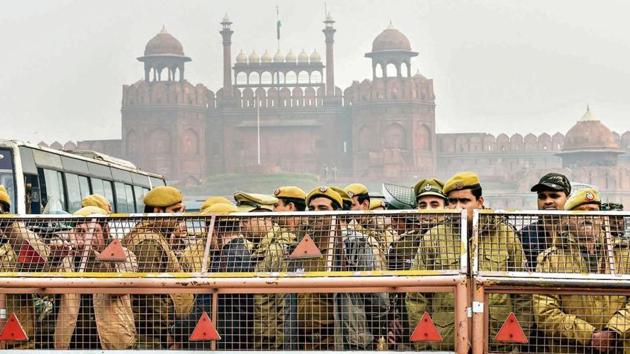
The restrictions led to people going without mobile phone services for four hours in the city, a first, being forced to disembark three Metro stations before their destination and walking to offices in central Delhi, and stuck for nine hours in the worst traffic snarl in Gurugram since 2016.
Thousands of people still swamped the streets on a grey misty morning and demanded the government roll back the Citizenship (Amendment) Act, or CAA, which opens an easy route to naturalisation for “persecuted minorities” from three Muslim-majority countries.
Within an hour of people gathering at 9am, columns of police personnel started bundling protesters into buses outside Red Fort and Mandi House, transporting scenes of crowd control measures familiar in the country’s restive frontier states to the heart of India’s Capital. Television visuals showed protesters being dragged into buses and dropped off in the outer fringes of the city.
Section 144, which prevents the assembly of four or more people, was clamped from Red Fort in north Delhi to Bahadur Shah Zafar Marg in the south; Seelampur in north-east Delhi to Mayur Vihar in the east; and the New Delhi area.
Many officers admitted that this was the first time in at least three decades — going back to the 1984 anti-Sikh riots — that prohibitory orders were issued for such a large area in Delhi.
At least 20 metro stations spanning the length and breadth of Delhi — from Vishwavidyalaya in the north to Central Secretariat in central Delhi and Munirka in the south — were shut down between 9am and 7pm. Even the arterial Rajiv Chowk station, which handles around 300,000 passengers daily, was closed for four hours.
Police also ordered four major service providers — Airtel, Vodaphone-Idea, Reliance Jio and MTNL — to switch off internet, messaging and voice call services in parts of north, central, north-east and south-east Delhi at 9am. This is the first time that the measure – currently enforced across some parts in five states, especially in Assam – was implemented in the city. Services were restored after 1pm.
According to an annual study of Freedom House, a US-based non-profit research organisation, India is the country with the worst record of government-mandated internet shutdowns in the world — including a four-month-long suspension of services in Kashmir since August.
Police barricaded the Delhi-Gurugram highway early on Thursday morning, triggering a major traffic jam that cost many commuters up to nine hours on the road and forced airlines to cancel 19 flights because both passengers and flight crew were stuck on the road.
Another 250 flights were affected. The ensuing jam was the worst since the so-called Guru Jam that lasted 20 hours in 2016 and forced authorities to implement major traffic and infrastructure changes.
Police said the restrictions were needed to prevent violence seen at two previous demonstrations in Seelampur and Jamia Nagar.
On Sunday, a mob torched buses in south Delhi and police using tear gas on protesters gathered near Jamia Millia Islamia. At least 21 people were injured and 20 vehicles damaged when a protest of around 2,000 people turned violent in Seelampur on Tuesday.
Delhi Police spokesperson, MS Randhawa, said the telecommunication services were temporarily suspended to prevent fake messages.
“We had inputs that some outsiders were spreading rumours to mobilise crowd. We are monitoring social media posts and will take action against rumour mongers,” he added.
But protesters, many of whom walked back or hitched rides to Jantar Mantar from outer Delhi, contended that the orders were aimed at muzzling dissent.
“It is shameful how the government wants to suppress any form of dissent. They want to turn the Capital into Kashmir,” said Jawaharlal Nehru University Students’ Union president Aishe Ghosh, who was at Jantar Mantar.
As evening fell, slogan-shouting at Jantar Mantar gave way to people drawing anti-government graffiti on the road, singing songs in support of the Constitution and fundamental rights, and even offering roses to the police.
Despite the restrictions and detentions, the protests were peaceful — a sharp contrast to similar demonstrations in other parts of the country, especially in Uttar Pradesh and Mangaluru where rampaging mobs torched vehicles, clashed with police and pelted stones. At least three people died across the country.
The government has shown no signs of backing down from the CAA, which represents a major campaign promise of the ruling Bharatiya Janata Party (BJP).
At an event, home minister Amit Shah blamed the unrest across India on “infiltrators” and “outsiders”.
“Some political parties are fuelling protests against CAA. They are inciting women, students and others in the name of religion,” the junior home minister, G Kishan Reddy, told reporters later in the day.
The Opposition called the day a second Emergency.
“This government has no right to shut down colleges, telephones & the Internet, to halt metro trains and to impose Section144 to suppress India’s voice & prevent peaceful protests. To do so is an insult to India’s soul,” said senior Congress leader Rahul Gandhi.
Delhi chief minister Arvind Kejriwal demanded the Centre withdraw the law. “Law & order situation is deteriorating across the country with each passing day, which is a cause of extreme worry…,” he said.
Last week, the government pushed through Parliament the CAA, which fast-tracks the process of citizenship for refugees from Hindu, Buddhist, Sikh, Parsi, Christian and Jain faiths who fled Afghanistan, Pakistan or Bangladesh because of religious persecution and entered India on or before December 31, 2014.
The Opposition and civil society say the law is unconstitutional because it links faith to citizenship and discriminatory because it omits Islam.
“If this legislation is blatantly discriminatory to my fellow Muslims and is used to intimidate them and harass them, all of us have to stand up against it. The CAA is completely illogical,” said noted historian Ramachandra Guha, who was picked up by police at a protest in Bengaluru and released later.
The protests first erupted across the North-east, where local people feel the law will trigger an influx of illegal Hindu migrants from Bangladesh, but soon spread to various parts of the country, including West Bengal. Clashes broke out in Delhi’s Jamia Millia Islamia on Sunday after police entered the university, allegedly lobbed tear gas shells into the library and thrashed students and other protesters.
Over 50 students were detained as mobs burnt down buses and pelted stones.
A second protest broke out in north-east Delhi’s Seelampur on Tuesday, where a mob assaulted policemen, pelted stones at them and shouted slogans.
The violence continued for over one-and-a-half hours as the police contingent, including Rapid Action Force personnel, fired more than 200 tear gas shells and 46 gas grenades and resorted to lathi charge to disperse the protesters.


