
 E-Paper



Centre asks states to act on rape law
In the three-page advisory issued late on Friday evening, the Centre directed that there should be compulsory registration of an FIR in case of a cognisable offence under the CrPC (criminal procedure code), and any failure of the police to adhere to rules does not augur well for the delivery of justice.

 Prefer HTon Google


The Union home ministry has issued a fresh advisory to states and Union Territories to ensure that investigations into crimes against women are completed within two months, and dying declarations are not discarded just because they were not recorded by a magistrate, a move that came shortly before the Central Bureau of Investigation (CBI) was handed the probe into the gang rape and murder of a 19-year-old woman in Hathras that has sparked national outrage.
In the three-page advisory issued late on Friday evening, the Centre directed that there should be compulsory registration of an FIR in case of a cognisable offence under the CrPC (criminal procedure code), and any failure of the police to adhere to rules does not augur well for the delivery of justice. For crimes that are not under the jurisdiction of a police station, a “Zero FIR” should be registered as per the law, the advisory said. A “Zero FIR” can be filed at any police station irrespective of the place of incident or jurisdiction.
The advisory said that officials who fail to file an FIR in relation with cognisable offences should be punished.
According to the declaration of the Hathras victim, she was raped and badly beaten up by four men on September 14. She was moved to Delhi’s Safdarjung hospital on September 28 in a serious condition and died early on September 29. At 2.30am the next day, the police cremated the body without the family’s consent in a field near the village.
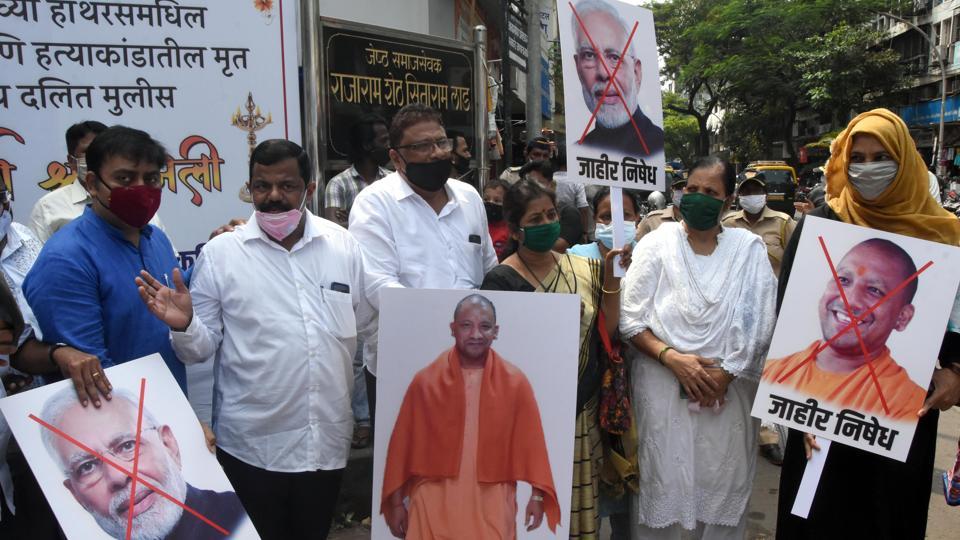
Opposition leaders and activists have held protests over the way the case was handled by the authorities, alleging negligence and delayed action in investigations. Five police officials have been suspended amid the outrage. On Saturday evening, the central government issued a notification for CBI to take over probe into the case, an official said. The home ministry told the states and UT administrations that the Section 173 of CrPC provides for completion of police investigation in relation to rape in two months and Section 164-A of CrPC provides that in rape or sexual assault investigation, the victim should be examined by a registered medical practitioner under consent within 24 hours from the time of receiving the information relating to the commission of such offence.
“The statement, written or verbal by a person, who is dead, shall be treated as relevant fact in the investigation when the statement is made by a person as to the cause” of the death or as to any of the circumstances of the transaction that resulted in the death, the advisory added.
The Centre referred to a Supreme Court verdict dated January 7 in which the apex court said that a dying declaration that satisfies all judicial scrutiny cannot be discarded merely because it is not recorded by a magistrate or because a police officer failed to obtain attestation by any person present at the time of making of the statement.
The advisory comes ahead of Monday’s hearing of the Lucknow bench of the Allahabad high court on the 19-year-old’s gang rape and her rushed cremation. The Supreme Court is also hearing a petition in the matter. At a hearing last week, an SC bench led by Chief Justice of India SA Bobde described the crime as a “horrible” and “extraordinary”one. A special investigation team constituted by the UP government has been investigating the matter. Asking states and UTs to ensure that strict probe is carried out in such cases, the home ministry also advised them to use the national database on sexual offenders for identifying and tracking repeat criminal. “The Government of India has taken steps to strengthen legislative provisions to deal with incidents of sexual offences against women and girls. It is requested that States and UTs, may suitably issue instructions to all concerned to ensure strict compliance with the provisions in the law,” it added. “even with stringent provisions in law and several capacity building measures undertaken, any failure of police to adhere to these mandatory requirements may not augur well for the delivery of criminal justice in the country...” it said.


