
 E-Paper



Govt sells tomatoes at discount rate of ₹90/kg
According to analysts, consumers will feel the pain of high grocery inflation at least until September

 Prefer HTon Google


The Centre on Friday begun selling tomatoes to the public at ₹90 a kilo amid spiralling prices, transporting them from farm hubs to cities, beginning with the national capital.
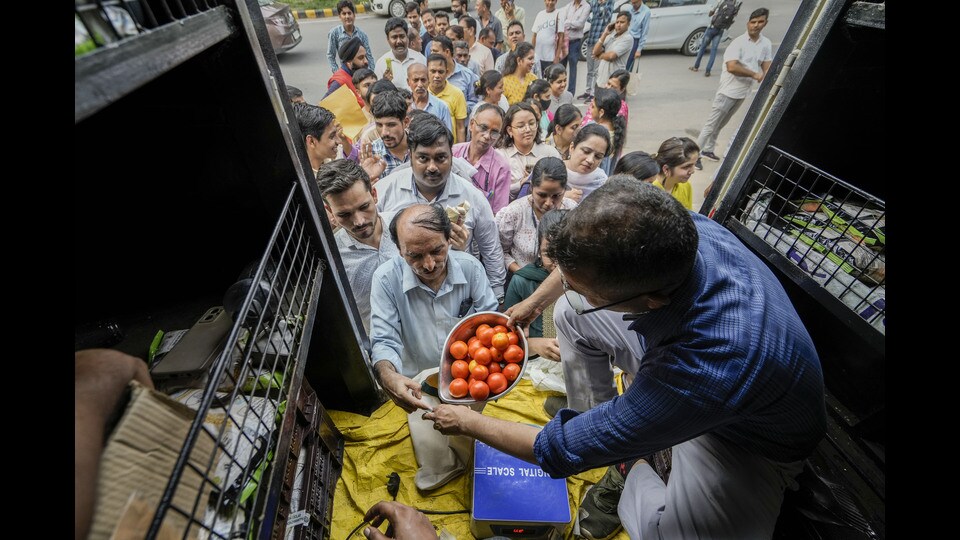
Yet, the base ingredient of most Indian dishes remained expensive at ₹220-50 a kg in key cities, outpacing the rise in the rates of other essential commodities that have also shot up due to supply-chain disruptions and crop damage amid torrential rains.
In Delhi and the larger national capital region, food trucks started discounted sales on Friday at Karol Bagh, Patel Nagar, Pusa Road, Nehru Place CGO, Sector78 Noida, Pari Chowk, Greater Noida and Rajnigandha Chowk, consumer affairs secretary Rohit Kumar Singh said, adding more tomatoes are being procured. Singh said that subsidised tomato sales were set to begin in Lucknow and Kanpur on Saturday.
Yet, shortages continue to persist. Nearly 17 tonnes of the vegetable arrived on Thursday night from Andhra Pradesh and Maharashtra by road with all requisite cargo clearances in advance and real-time inter-state coordination, Shubham Patil, an official of the National Cooperative Consumers’ Federation of India (NCCF) said.
NCCF had been mandated by the Centre to carry out the operations, along with NAFED, both state-backed agri-commodity trading institutions. Another 13 trucks are currently headed for north India.
According to NCCF managing director Anice Joseph Chandra, the selling price for the public has been fixed at all centres at ₹90 a kg, while the buying rate ranged between ₹120-130 per kg. The difference will be paid by the Union government.
Consumers will feel the pain of high grocery inflation at least until September, analysts said on Wednesday, as the knock-on effects of last year’s lower output of key staples and torrential rains this month hammered household budgets.
Food inflation, as measured by the consumer food price index, leapt to 4.49% in June, compared to a 2.96% climb in the previous month, official data showed on Wednesday. Overall retail inflation rose to a three-month high of 4.81% as a result.
The roots of the tomato crisis go back to last year’s extreme weather in states such as Maharashtra and Karnataka, followed by damage to crops this year too.
Hailstorms in March, April and May destroyed large swathes of tomato crop in Maharashtra, a major supplier during the monsoon months, said Sunil Chavan, Maharashtra’s agriculture commissioner.
Climate-change-induced extreme weather has contributed to the pressing shortage, experts said. In 2022, abrupt rainfall followed by extreme heat led to an explosion in the numbers of plant viruses transmitted by aphids that feed on tomato plants in both Maharashtra and Karnataka, said M Krishna Reddy, a former scientist at the Indian Institute of Horticulture Research, Bangalore, said. Such swings in weather in India are characteristic of climate change, the Intergovernmental Panel on Climate Change has repeatedly warned.


