
 E-Paper



Centre plans stringent steps to rein in sticky food inflation
Inflation of such magnitude is bad news politically and economically, especially a year before the national election

 Prefer HTon Google


The Centre is considering more stringent steps to control soaring food prices, as inflation in July saw a huge spike led by cereals and vegetables, Union food secretary Sanjeev Chopra has said.
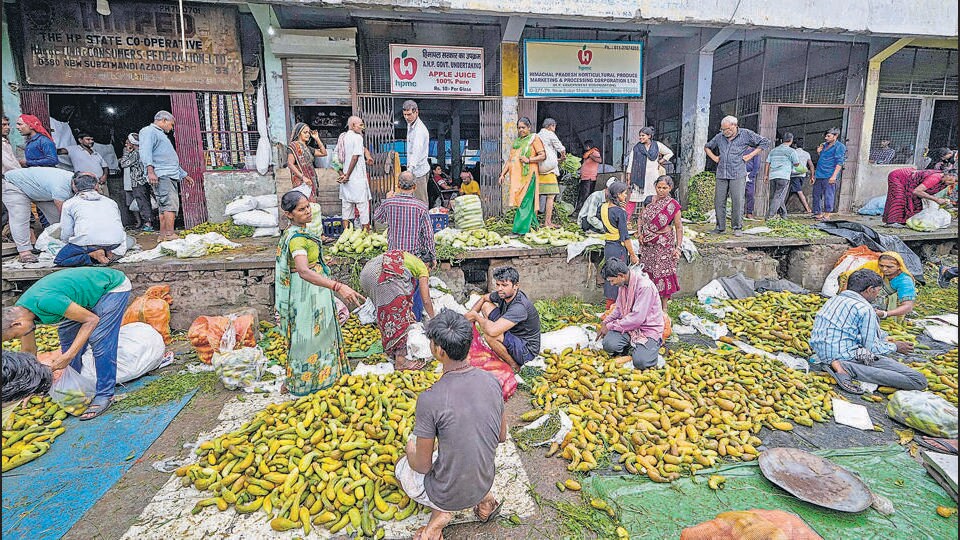
Battling high prices since April 2022, triggered by Russia’s invasion of Ukraine, the Union government has taken a range of steps to cool food prices, especially cereals, using virtually all measures from its inflation-control playbook, barring some extreme decisions, such as government-to-government cereal import. But with the climate crisis increasing the frequency and intensity of extreme weather events, 2023 looks as bad, if not worse, than 2022.
Read here: Govt seeks to free up ₹1 trillion to curb inflation before 2024 polls: Report
Officials maintain there is no need to import grains as there are sufficient domestic stocks, pointing to possible hoarding as reason for high prices of basic grains. “The government has umpteen options (to control prices) and all options are open,” Chopra said.
Yet, retail inflation spiked to 7.44% from a year ago in July 2023, a 15-month high, breaching the Reserve Bank of India’s tolerable limit of 4% on the back of runaway food prices, official data on Monday showed. Inflation of such magnitude is bad news politically and economically, especially a year before the national election. On Thursday, Bloomberg reported, citing unnamed people, that the government is looking to reallocate almost ₹1 trillion (1 lakh crore) from various schemes to fighting food and fuel inflation. On Thursday, HT reported that the government is likely to continue the provision of free grain under the National Food Security Act beyond 31 December this year, the original deadline for this scheme.
The government can do little to boost supplies of perishables, whose supplies have been disrupted by heavy rain and flooding (engendered by the climate crisis and experts expect these shocks to become more frequent, and sharper), although it has scrambled exports fromNepal and activated supply of tomatoes at concessional rates in at least 16 cities, and is releasing a stock of onions (the only vegetable it maintains stocks of) in anticipation of a surge there.
But as the July inflation data showed, vegetables are not the only problem.
Cereal inflation was 13% in July, and cereals account for 22.8% of the consumer price index basket.
The government has taken a slew of steps unseen in a decade to control prices of wheat and rice. Rice is a staple for nearly two-thirds of Indians.
On July 20, India fully halted rice exports, except the aromatic basmati variety, another key measure to control inflation despite there being adequate state-held stocks.
More stringent measures could be taken, the Union food secretary said. A high-level inter-ministerial committee on prices mandated to take key decisions, such as curbing or banning exports, is now meeting once a week to review inflation, from fortnightly meetings earlier, he said. The panel comprises the secretaries of food, agriculture, consumer affairs, commerce and home departments.
The immediate impact of this has been a surge in Asian and global rice prices. International rice prices rose 12% last week to the highest in a decade.
This extreme measure is the latest in a long line that goes back early 2022.
Read here: Cause and Effect | Climate crisis drives surge in food prices
Almost a month after the Ukraine conflict broke out on February 24 2022, India’s robust wheat crop fell prey to a heat wave as the country witnessed the hottest March on record. This led to a 1.8% fall in winter output from 109 million tonne to 107.7 million tonne.
Simultaneously, heavy export of wheat due to the Ukraine crisis, a major supplier of all types of grain and fertilizers, drew down India’s surplus. Prices soared nearly 20%, prompting the government to ban overseas sales of wheat in May 2022, the first major decision to control prices of the grain. In April 2020, the government had embarked on a scheme to distribute millions of tonne of free wheat as Covid relief, which had already pared the country’s wheat reserves, leading to a precarious situation.
But rice, more than wheat, presented a challenge.
As a dire global food crisis took hold, the export of 5% broken rice – an Asian benchmark – soared, pushing up domestic prices. “Countries desperate for food began importing broken rice from India,” said Anshul Singh, the proprietor of Santoshi Impex, a food trading firm.
During April-August 2022, the export of broken rice stood at 2.1 million tonnes, up from 1.5 million tonnes in the corresponding period of the previous year. When compared to a base period of April-August 2019, this represents a 4178% jump, data reviewed by HT show. Importers of broken rice included Djibouti, a country in the Horn of Africa, Indonesia, Senegal and even China, the food ministry’s data show.
Higher broken rice prices also pressured poultry breeders, who shifted to other grains such as maize. This led to a spike in maize prices.
To bolster domestic supplies, India banned the export of broken rice and imposed a 20% export duty on non-basmati varieties in September 2022. This led to a spurt in international prices since India is the world’s biggest rice exporter, with a 40% share.
Yet, cereal inflation continued to be in double digits; it has now been in the double digits for seven straight months to July.
The government has already invoked stock limits on cereal traders, an anti-hoarding measure. Stock limits are caps on quantities of cereals traders and supermarkets are allowed to stockpile. Recently, the Centre directed states to take legal action against traders not declaring stocks under the Essential Commodities Act, a law used to control commodity inflation, the food secretary said.
The government may further lower the quantities of stocks traders can hold so that supplies improve, thereby lowering prices. It could also lower the wheat import duty, which currently stands at 40% and even import cereals. “Nothing can be ruled out,” Chopra said.
To ordinary households paying high food prices, these steps make little sense. “Vegetables now cost as much as chicken. We have stopped buying tomatoes,” said Mintu Singh, a carpenter in Delhi.
The Ukraine crisis also triggered a global rally in prices of edible oil as the country is a major supplier of oilseeds. India relies on imports to meet two-thirds of its domestic demand of edible oil, whose high prices knocked households. This was exacerbated by a brief ban by Indonesia on overseas shipments of palm oil.
In April 2022, the Centre allowed duty-free import of 2 million tonnes each of crude sunflower and soybean oil till 2024-end. Since this reduced the cost of import, the Centre held several rounds of meetings with edible-oil processors to pass on the benefits of lower prices to consumers.
In June 2023, the Centre cut the basic import duty on refined soyabean oil and refined sunflower oil from 17.5% to 12.5%, a move that cooled prices. Inflation in oil and fat category in July 2023 declined by 16.80%. Import duties on the two items were last reduced from 32.5% to 17.5% in October, 2021, when international prices had soared to multi-year highs.
The fight to control cereal inflation has been two-pronged. One, the government has stopped exports, and two, it has been releasing stocks from state-held granaries. On August 8, the Centre announced it would release 5 million tonnes of additional wheat and 2.5 million tonnes of rice through auctions. The government has also decided to reduce the reserve price of rice, from ₹31 a kg to ₹29 a kg, to improve “offtake”, or quantities actually sold to traders.
The Centre has also imposed caps on the quantity of pigeon pea (tur) and black gram (urad) – two commonly consumed pulses varieties – that retail shops and traders are allowed to store, as there are signs of a potential price rise in lentils.
Read here: Gehlot launches free food packet scheme to benefit over 10.4 mn families
“The current risk to food inflation emanates from excess rain damage to vegetables. Looking at current production trends, pulses are in a vulnerable position,” Dharmakirti Joshi, chief economist at Crisil Ltd, wrote in a recent research note.
All told, a global commodity price spiral and increasing climate-changed induced adverse weather has resulted in stubbornly high food prices that have squeezed pockets of consumers in Asia’s third-largest economy. “All eyes are on the upcoming summer harvests, which should ease food prices,” Singh, the proprietor of Santoshi Impex, said.


