
 E-Paper



Centre must give stimulus, decentralise power, says Rahul Gandhi
Rahul Gandhi called for a transfer of Rs.7,500, or even Rs.5,000, to each of India’s 130 million poorest households.


Former Congress president Rahul Gandhi on Friday urged Prime Minister Narendra Modi to hold regular conversations with chief ministers “not as the boss but as a colleague” to fight the Covid-19 pandemic, and called for an economic package for all sections of society -- from the poorest to large industries -- because they are all interconnected parts of the economic engine that need to be kick-started to spur demand.
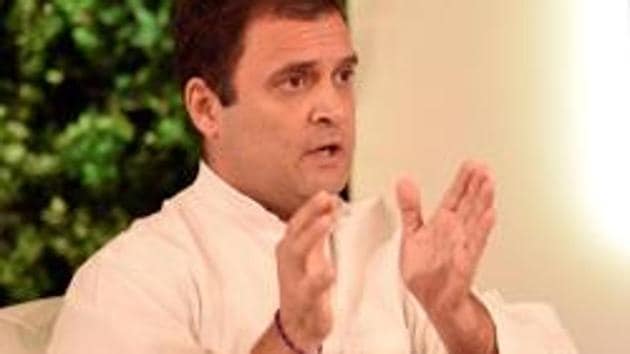
In his second press conference during the national lockdown (he first addressed the media on April 16), Gandhi listed eight key points that, he said, the government needed to look at immediately -- income support to the poorest households; jobs through the rural employment guarantee scheme; food security to people outside the public distribution system; income and purchase guarantees to the farmers; wage protection for MSMEs; credit and subsidies for big businesses; getting shopkeepers back to work; and helping migrant workers return home.
“You have to take care of big and small businesses alike because everything is connected. If you want to start the engine, you cannot think of starting just one part of the engine. You need to create demand, put money in the system, put money in poor people’s hands, help MSMEs and make sure you are protecting some of the larger players, because these are all interconnected,” Gandhi said during an hour-long video news conference.
The larger idea, he said, was to end fear psychosis surrounding Covid-19, and letting people draw confidence from how the disease is not deadly for 98-99% of the people. “People are very scared. The Prime Minister needs to dispel this fear and tell people this is a dangerous disease for just 1-2% of the population who are old and those who have diabetic and heart conditions,” Gandhi said.
In a more granular description of this plan, he called for a transfer of Rs.7,500, or even Rs.5,000, to each of India’s 130 million poorest households. “It is going to cost Rs 65,000 crore, and will transform the way people are thinking about the current pandemic,” he said.
About employment guarantee, Gandhi said that the 100 days of the wage employment under MGNREGA should be doubled to 200 days. For food security, he asked the government to ensure delivery of 10kg rice or wheat, 1kg pulses and 1kg sugar to every individual every month for six months; and for farmers, he asked the government to transfer Rs10,000 as Urgent Income Support to all PM-Kisan accounts, purchase all foodgrain at MSP, and remove GST on fertilizers, pesticides and agricultural equipment.
For entrepreneurs and industry, he suggested that government give a Rs 1 lakh crore wage protection and Rs 1 lakh crore credit guarantee schemes, along with a six-month interest subsidy on loans. He called for similar credit guarantees to big businesses to ensure the value chain is unaffected and layoffs are avoided.
Gandhi has been holding conversations with global and Indian thought leaders to discuss the Covid-19 crisis and its impact on the Indian economy. So far, he has spoken with Nobel laureate Abhijit Banerjee and former Reserve Bank of India (RBI) governor Raghuram Rajan.
Asked if these conversations and his active involvement meant he is coming back as the party chief, Gandhi said, “You please read my letter one year ago (when I stepped down). I wanted to give the people a glimpse of what the experts think about the present situation.”
Calling for decentralisation for a comprehensive fight against the disease, he said the battle needs to be taken to the district level. “If we fight this in the PMO only, we will lose. The Prime Minister must devolve power. If we centralise, there will be a calamity,” Gandhi said.
“The Prime Minister has to trust chief ministers who, in turn, have to trust district magistrates. The Centre should leave the call of categorising zones to them and not take decisions in Delhi... Forget about Congress-ruled states or BJP-ruled states. They are all Indian chief ministers and should be working together with the Prime Minister. If I was to advise the Prime Minister, even though it is not my place, definitely he should make calls to every chief minister in 1-2 days in a partnership-type call,” he added.
Gandhi also reiterated his party’s stand on the national lockdown, asking for an exit strategy, and asserting that the lockdown does not have an “on-off switch”. “You can’t switch it off and it’s gone... It requires number of things to happen. It requires a psychological change. The government needs to understand that.”
The ruling Bharatiya Janata Party (BJP) said Gandhi was speaking without the right facts. “The Prime Minister has been consulting chief ministers and subject experts in dealing with the situation... The ever youthful Congress leader, who is about to complete a half century, now at least should have some wisdom and practicality,” party spokesperson Sudanshu Trivedi said.
“It is very typical and characteristic of Gandhi to speak before media without studying facts. It’s not time to create controversy directly or indirectly. Instead it is time for cooperation and Gandhi should try to fight the biggest calamity in human history under the able guidance of our Prime Minister,” he added.
Political analyst Chandan Gowda of the Bengaluru-based Azim Premji University agreed with Gandhi that the Covid-19 containment effort should be collaborative, decentralised and all-encompassing. “Over-centralised decision-making violates the spirit of a federal polity too,” Gowda said.


