
 E-Paper



Centre unveils seven-pronged Prahaar counter-terror policy
The document said that India “does not link terrorism to any specific religion, ethnicity, nationality or civilisation”.

 Prefer HTon Google


The ministry of home affairs (MHA) on Monday released India’s first comprehensive national counterterrorism policy and strategy titled Prahaar, aiming to deal with all terrorist acts and denying access to funds, weapons and safe havens to terrorists, their financiers and supporters.
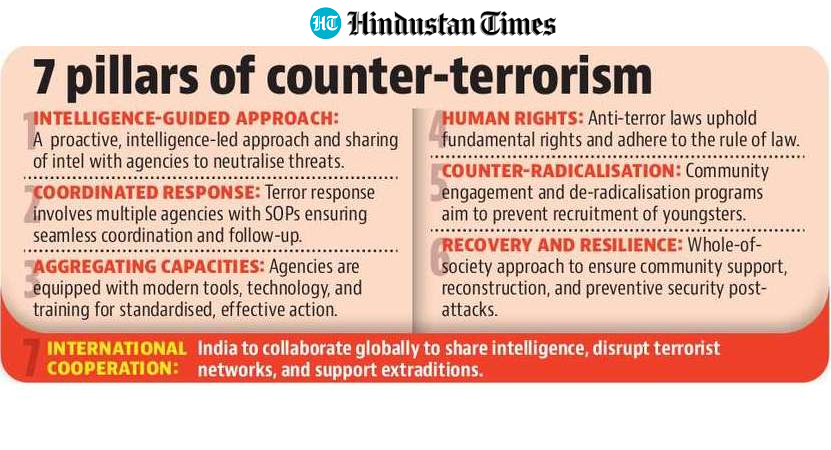
The seven-stage framework involves “intelligence guided” prevention of terror attacks, swift joint response by states and central forces, use of latest technology, thwarting radicalisation and recruitment of youngsters, coordinating with international partners, involving the society, and following human rights and rule-based processes.
Such a policy was envisaged sometime in 2021-2022, according to officials. It was first announced by Union home minister Amit Shah in November 2024.
An official, who didn’t want to be named, said the national counter-terrorism policy and strategy was “like a guidance document for all agencies and states/union territories (UTs) to deal with terrorism”.
The eight-page document was prepared in consultation with the Intelligence Bureau (IB), Research and Analysis Wing (R&AW), NATGRID, the National Investigation Agency (NIA), other central intelligence agencies, states/UTs’ anti-terror units, and other counter-terrorism experts.
“India remains committed to international cooperation and collaboration. To build consensus on the understanding of terrorism and the rights of victims of terrorism, India will continue to work for a comprehensive framework on international terrorism while pursuing its counter-terrorism policy and strategy ‘Prahaar’, which aims to criminalise all terrorist acts and deny access to funds, weapons and safe havens to the terrorists, their financiers and supporters,” the document said.
Asserting that India has always stood with the victims of terrorism, the document said that India “does not link terrorism to any specific religion, ethnicity, nationality or civilisation”.
Referring to the threat profile of India, the MHA document stated that the country was long affected by “sponsored terrorism from across the border, with jihadi terror outfits as well as their frontal organisations, continuing to plan, coordinate, facilitate and execute terror attacks in India”.
India, it said, has been the target of global terrorist groups such as al Qaeda and the Islamic State of Iraq and Syria (ISIS), which have been trying to incite violence in the country through sleeper cells.
Without naming Pakistan, the strategy document said, “There has been a history of sporadic instability in the immediate neighbourhood of India, which has often given rise to ungoverned spaces. Besides, few countries in the region have sometimes used terrorism as an instrument of State policy”.
The government policy said that terrorists’ handlers based on foreign soil are using the latest technologies, including drones for facilitating terror-related activities and attacks in Punjab and Jammu and Kashmir. Besides, referring to the Indian gangsters operating from various countries abroad, the Prahaar document said that, “The terrorist groups are engaging organised criminal networks for logistics and recruitment to execute and facilitate terror strikes in India.”
“The threat of state and non-state actors misusing drones and robotics for lethal purposes remains another area of concern, even as criminal hackers and nation states continue to target India through cyber-attacks,” it added.
Detailing the seven pillars of the counterterrorism policy, the document said that as a first, India followed a ‘pro-active’ and ‘intelligence-guided’ approach, in which primacy was accorded to intelligence gathering and its dissemination to executive agencies for the neutralisation of threat.
“Close partnerships for counterterror operations have been established between central agencies and state police forces through the Multi-Agency Centre (MAC) and the Joint Task Force (JTF) on intelligence in the Intelligence Bureau (IB),” the document said.
On the second pillar, which talks about response, the document stated that responding to a terror attack is a multi-stakeholder exercise involving various agencies at the central, state and district levels, with a standard operating procedure (SOP) issued by the home ministry for coordination at the apex level, including intelligence dissemination, analysis and follow-up action through the MAC platform.
The overall capacities of various law enforcement and counterterror agencies have been enhanced by identifying the resource gaps and suggesting necessary countermeasures, the document said.
The third pillar of the policy advocated aggregating capabilities such as acquisition of latest tools, technology and weaponry, besides training for new skills and tactics for counterterror agencies. “In a multi-agency environment, standardisation of processes and procedures ensure similar and synergistic responses and inter alia there is a move for having uniform anti-terrorism structure in the states. The overall capacities of various law enforcement and counterterrorism agencies have been enhanced by identifying the resource gaps and suggesting necessary countermeasures,” it added.
Human rights were designated as the fourth pillar. The document, while giving details of legal routes available to people for protection of their rights, said, “Indian laws, including anti-terrorism laws, give due importance to human rights. India adheres to the ‘rule of law’, where laws are just, applied evenly and protect fundamental rights.”
As the fifth pillar, the MHA document advocated attenuating the conditions conducive to terrorism. “Terrorist groups are continuously making efforts to recruit Indian youth and to thwart these efforts, Indian intelligence and law enforcement agencies have been continuously disrupting the designs of terrorist groups,” it said, adding that several steps were being taken to stop the radicalisation of youngsters, such as engagement of community and religious leaders, non-governmental organisations, moderate preachers, and de-radicalisation programmes, as well as addressing the issues of poverty and unemployment among vulnerable communities.
The sixth pillar of the strategy involves international cooperation. The document stated that bilateral and multilateral treaties and agency-to-agency cooperation in intelligence sharing resulted in the disruption and indictment of many terrorist and radical entities in India and abroad, the deportation of wanted fugitives, and support in the pursuit to designate wanted terrorists at the United Nations.
The last pillar advocated recovery and resilience through a whole-of-society approach.
“India follows a whole-of-society approach in countering terrorism. Public-private partnership has been a key component in our fight against terrorism. This partnership helps in faster recovery and resilience in case of a terror attack. The government engages a team of doctors, psychologists, lawyers and other members of civil society, including NGOs, religious and community leaders, to sensitise and reintegrate the affected community. The civil administration takes the lead in reconstruction and restoration efforts. The police administration strengthens preventive security measures in and around their area, that reassures the community and promotes their resilience,” the document stated.
Domestic counter terrorism legal regime needs to be amended from time to time to respond to the emerging challenges and there is a need for uniformity in the structure, resources, training, and methodologies of investigation of counter-terror units of states and UTs, the document also said.


