
 E-Paper



C’garh Maoist attack a retaliation to increased presence of forces: Officials
The 1,200 square km long Bastar-Sukma belt in Chhattisgarh is considered to be the stronghold of the current Maoist movement in the country.


The actions of the security forces who have opened 24 new ‘permanent camps’ in the Naxal hotbed of Bastar-Sukma region in the last four years, bringing approximately 600 square kilometres of area inside the deep forest under control, is what perhaps ‘irked’ the Maoist and Saturday’s attack was a sign of their desperation, people familiar with the development said.
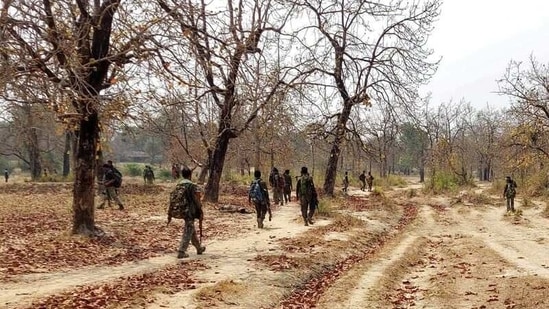
Twenty-two police and paramilitary personnel were killed and at least two dozen others injured in a gunfight with Maoists in Bastar region as the extremists ambushed the forces after possibly luring them to an area near the Bijapur-Sukma border on Saturday. One jawan was missing after the attack.
The 1,200 square km long Bastar-Sukma belt in Chhattisgarh is considered to be the stronghold of the current Maoist movement in the country.
While four camps of the Central Reserve Police Force (CRPF) were opened in Bijapur and Sukma in February 2021 alone, six others were set up in 2017, nine in 2018, one in 2019 and four in 2020. The areas where these new camps were operationalised include Galgam, Elarmagdu, Minapa, Mukram Nala, Bhadrimau, Punjer Nala, Pushpal, Vishrampuri, Netanar, Koleng Nala, Mugapadar, Palodi, Pamed and Tarrem among others, and are now under the control of the forces in Chhattisgarh.
Having a permanent base inside the forest – each camp has a strength of a company of around 100 personnel – allowed the CRPF, Chhattisgarh Police and specialized units to reduce travel time after operations and area domination exercises, one of the officers cited above said, preferring anonymity.
Besides the Bastar-Sukma belt, dozens of new “permanent camps” were set up in other Maoist hotbeds, including the 2,000 sq km AOB (Andhra-Odisha border) area, 4,500 sq km Abujmaad forest area and Jharkhand in the last four years, due to which the Maoists are ‘irked’, another officer said on the condition of anonymity.
“Having a permanent camp not only gives an edge as Maoists cannot ambush these easily because they are fully equipped and back-up is always (available) nearby, but they are key to civic authorities taking development work to the remote villages so that the government’s benefits can reach the last person. Maoists do not want development work to take place and let people live in isolation,” K Durga Prasad, former director general of CRPF, said.
Also Read | Drone shows tractor trolleys used to carry up to 20 dead Maoists: Officials
Experts on anti-Naxal operations believe the camps are not the sole reasons why the ‘red ultras’ are peeved but due to several factors, including a string of coordinated operations in the last four to five years, better intelligence sharing between agencies, disruption of their logistics chains like weapons, money and food items, a leadership crisis as well as massive crackdown on alleged ‘urban naxals’ that have played a role in waning their influence.
The number of districts from where Maoists’ violence is reported now range from 50 to 54 only, as compared to over 100 districts until a few years back. An internal study by CRPF ‘Countering Maoism – Way Ahead’, reviewed by HT, said that the ‘surrender of many senior Maoist leaders such as Tech Ramanna and Pahad Singh has affected the morale of the Maoists negatively’.
It added that the shrinking of the security vacuum areas is being witnessed, particularly in south Sukma where the forces have achieved a deeper penetration with longer stay in the zone without any contact with Maoists.
According to government data, there has been a 70 per cent decline in Maoist-related violence in the country – from 2,258 incidents in 2009 to 665 in 2020.
Prime Minister Narendra Modi, during the annual Director Generals/Inspector Generals (DGs/IGs) conference of Intelligence Bureau 2019, had asked agencies to monitor the internet-related activities of urban naxals as well as collect data of their trips abroad.
Last year, the National Investigation Agency chargesheeted several Left-leaning activists and academicians, including Shoma Sen, Surendra Gadling, Sudhir Dhawale, Rona Wilson, Arun Ferreira, Vernon Gonsalves, Sudha Bhardwaj and Varavara Rao for their alleged links with Maoists.


