E-Paper



Challenges for Congress as a new chief takes over
Given the state of the Congress, it is fighting nothing short of a battle for survival. If one were to take a slightly long-term view of the Congress’s political performance, one can argue that Kharge’s challenge is to solve a problem which, in many ways, Sonia and Rahul Gandhi could not resolve during their terms as the Congress president.

 Prefer HTon Google


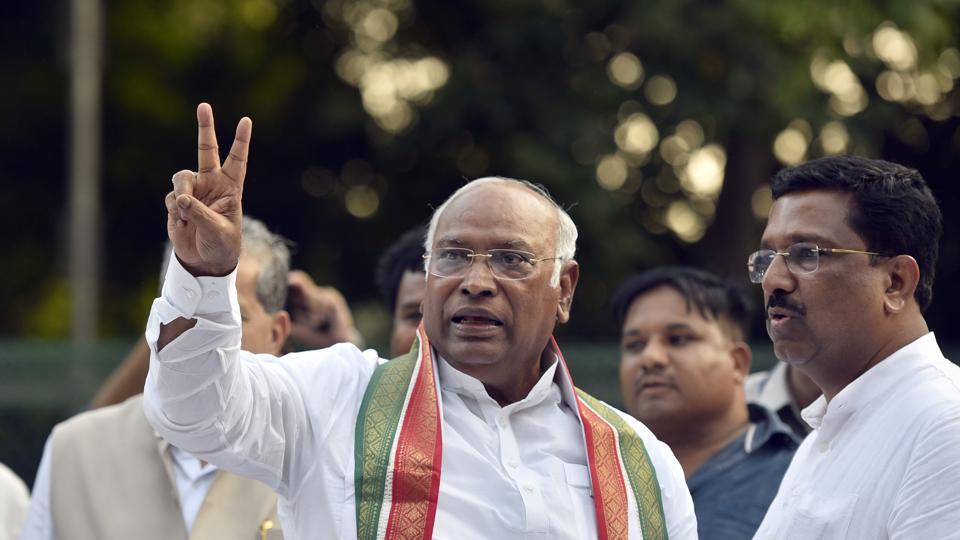
Mallikarjun Kharge is now officially the president of the Indian National Congress. In the normal course, he will have a three-year term . What is the biggest challenge facing Kharge as he takes over the leadership of India’s grand old party? Given the state of the Congress, it is fighting nothing short of a battle for survival. If one were to take a slightly long-term view of the Congress’s political performance, one can argue that Kharge’s challenge is to solve a problem which, in many ways, Sonia and Rahul Gandhi could not resolve during their terms as the Congress president. Simply speaking, this challenge is to find a new political identity and appeal for the Congress party. Here are three charts which explain this argument in detail.
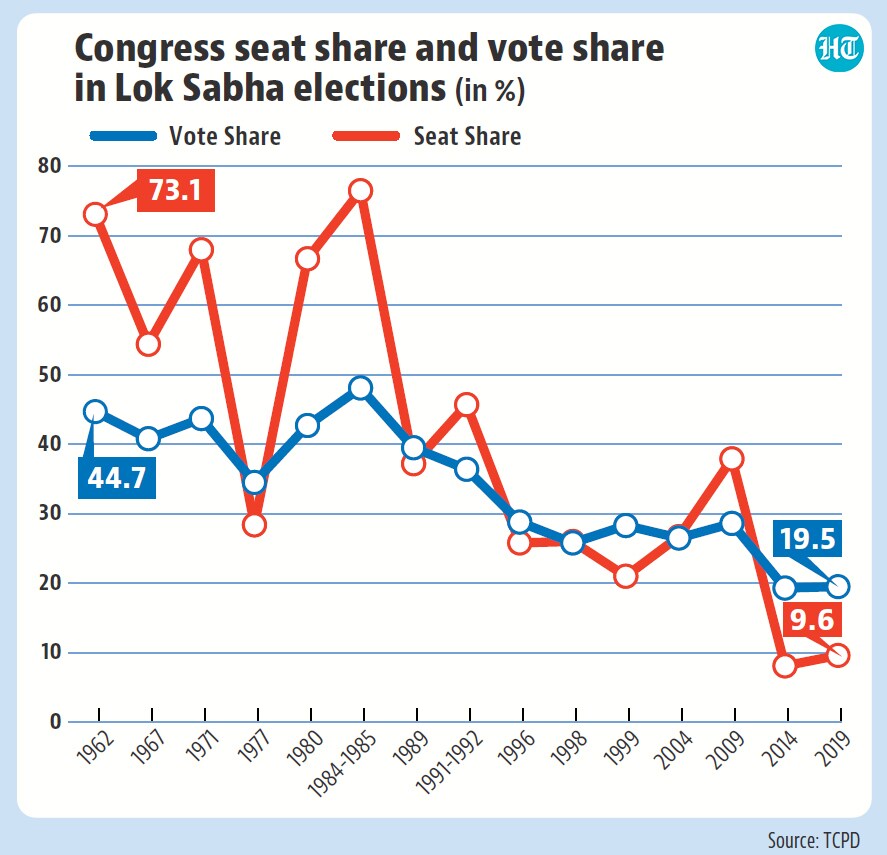
2004 and 2009 are aberrations in the Congress’s trajectory of long-term decline
Sonia Gandhi is seen as a Congress leader who revived the party and gave it two consecutive terms in power starting 2004. This underestimates the problems which the Congress was facing much before Sonia Gandhi took over the reins of the party in 1998. Many political scientists see India’s post-independence political evolution as a story of making and unmaking of various ‘party systems’. While the Congress was the national political hegemon in the first couple of decades after independence, its popularity started facing challenges from the 1960s onwards. It were these political challenges and the coming together of the anti-Congress opposition that culminated in the Emergency of 1975 and the election of the first non-Congress government in 1977. While Indira Gandhi did bounce back to power in 1980 and the Congress received its highest ever parliamentary majority after her assassination in 1984, its vote share came closer to 1977 levels starting the 1989 elections. Even the 2004 and 2009 election victories did not see a significant increase in vote share for the party. The situation of course, has become much worse in 2014 and 2019. However, the Congress’s current predicament cannot be understood without engaging with the fact that it was already a party with diminished national footprint when Sonia Gandhi took over the leadership in 1998.
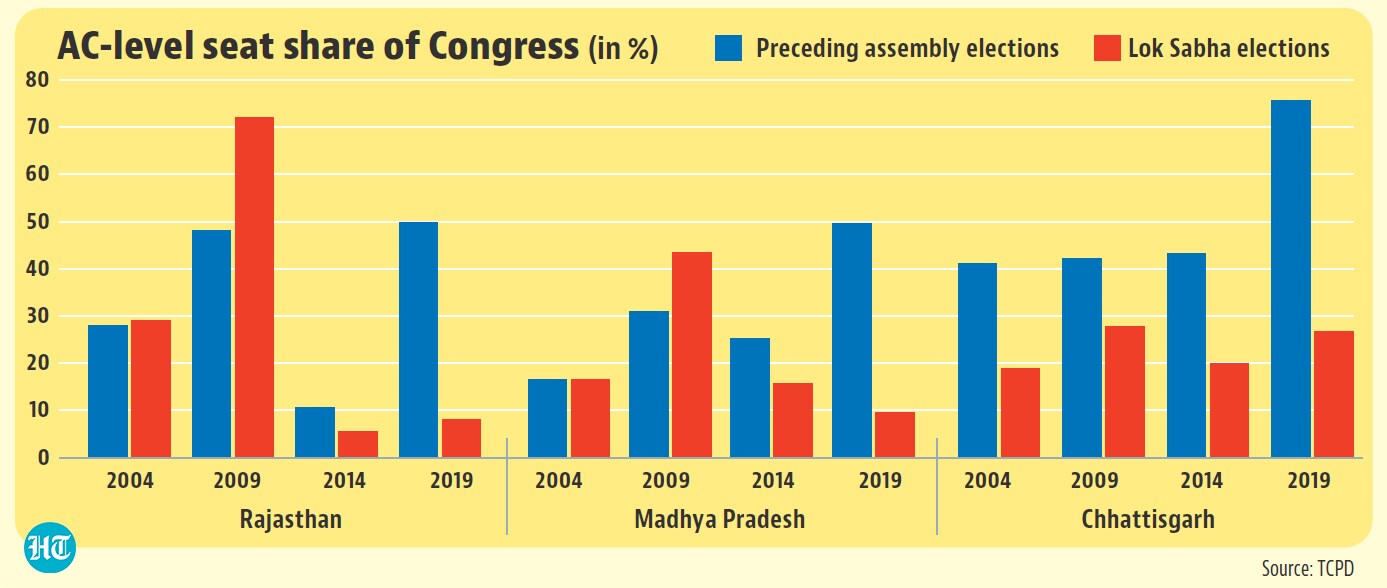
What post-2014 period did was to completely delink national and state level performances
This is what made Rahul Gandhi’s two-year term as the Congress president the most promising and the most disappointing at the same time. Just before he took over as the Congress president, Gandhi led a spirited Congress campaign in Gujarat and gave the BJP a massive scare. The Congress’s vote share and seat share in the state in 2017 was the highest in seven assembly elections and the BJP’s seat share in the 2017 elections was the lowest since 1995. The Congress formed a coalition government after the 2018 Karnataka elections despite facing anti-incumbency and a more united Bharatiya Janata Party (BJP) in the state. It then went on to defeat the BJP in Rajasthan, Madhya Pradesh and Chhattisgarh months before the 2019 general elections. All these results sparked hope that the Congress was indeed set for a revival, which, as the 2019 results showed, was not to be. The mismatch between the Congress’s assembly and Lok Sabha performance in these states, especially in Rajasthan, Madhya Pradesh and Chhattisgarh even in terms of direction of the trend was in breach of past trends for the party. The 2019 results buttressed the idea that the BJP enjoys a substantial vote premium in national elections under Narendra Modi and it has encouraged other anti-BJP parties to question the Congress’s claims of being the natural leader of the opposition camp in the country.
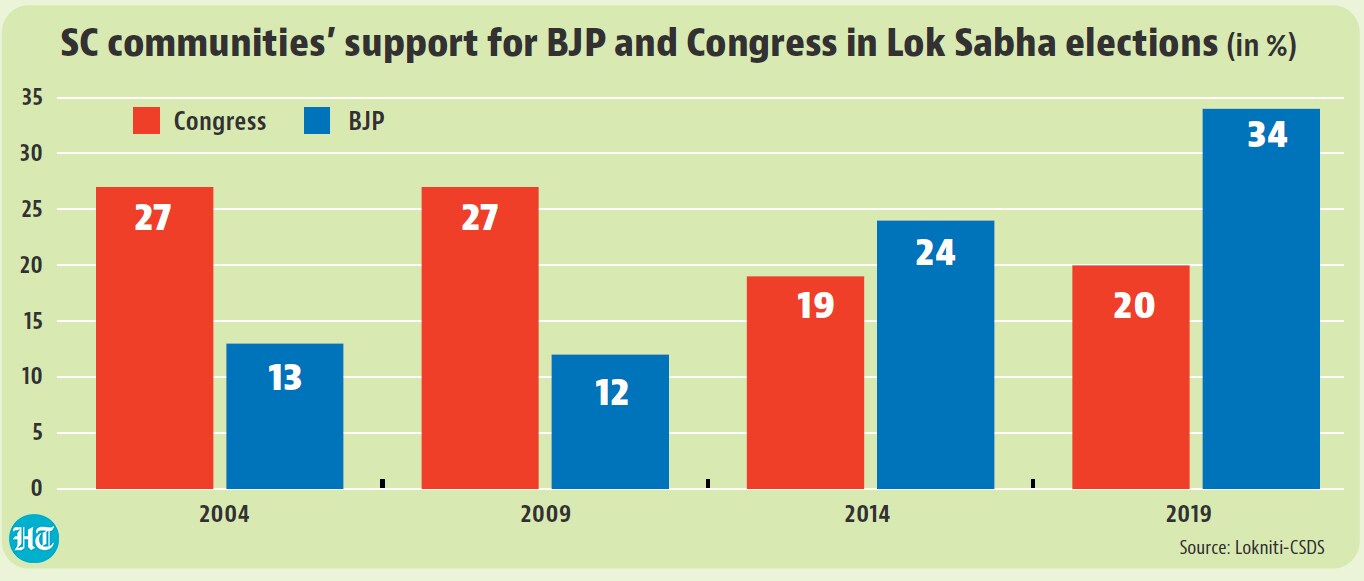
This is where the ideology/social appeal question comes in
In its diminishing evolution since the 1960s, the Congress has lost its support base to both the Bharatiya Janata Party (BJP) and various other parties which can be described as Mandal-based formations. Dravidian parties such as the Dravida Munnetra Kazhagam in Tamil Nadu predate the rise of Mandal in north India. Given this historical fact, there have always been two kinds of opinions about a possible way to revive the Congress’s fortunes. While the typical left-liberal response has been to reassert and actively propagate the Congress’s secular credentials along with redistributive economic policies, another view has been that the Congress’s problems are rooted in its refusal to be more inclusive of leadership from the socially oppressed castes, especially Other Backward Classes (OBCs). As only the second Dalit president of the Congress, Kharge’s election (whether or not it was intended) could help, but only if he champions this line and he manages to revive the Congress’s support base among the Scheduled Castes.
However, if the last Punjab elections are an example – the Congress replaced an upper caste Amrinder Singh with a Dalit Charanjit Singh Channi as the chief minister months before the elections and yet failed to win the state – reviving the Congress’s support base even among a specific caste group is going to take a lot more. This is where Kharge will have to deploy his decades of political experience as the new Congress president. The first test of this will come in his home state of Karnataka, where the Congress must set its own faction-ridden house in order to exploit anti-incumbency when the elections are held in April 2023.