
 E-Paper



Chandrayaan 2: Final manoeuvre in lunar orbit, lander rover separation tomorrow
This will be the final orbit in which the orbiter module of the spacecraft will stay for a year and conduct experiments to study the lunar terrain, the thin atmosphere around the moon, lunar ionosphere, and minerals on the moon.


Scientists from the Indian Space Research Organisation will conduct Chandrayaan 2’s final orbit lowering manoeuvre Sunday evening. The on-board propulsion system was fired at 06:21 pm for 52 seconds to lower the orbit to 119x127km.
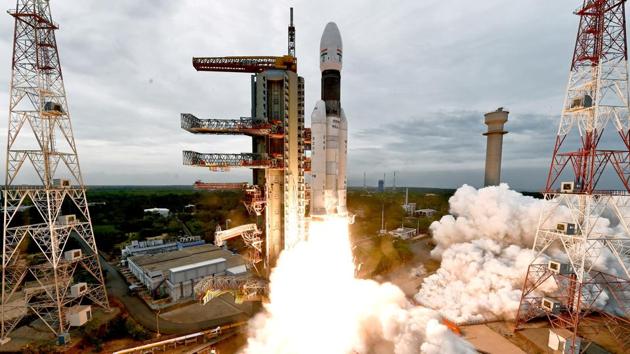
The separation of the lander rover will happen between 12:45-01:45pm on September 2.
This will be the final orbit in which the orbiter module of the spacecraft will stay for a year and conduct experiments to study the lunar terrain, the thin atmosphere around the moon, lunar ionosphere, and minerals on the moon.
The most challenging part of the mission will begin on Monday when the lander-rover will separate from the orbiter. After the separation, the propulsion system on-board the indigenously developed lander will be operated for the first time. So far, all the “burns” in the Earth and Moon orbit happened with the propulsion system of the orbiter.
Two more orbit lowering manoeuvre, including one to test the lander propulsion system, will be performed to bring the lander-rover into a 100x 30km orbit. This intermediate orbit was suggested by the group of eminent scientists that had suggested some corrections to the lander design and the orbit in 2018, resulting in the mission being pushed.
The powered descent to the surface of the moon will begin at 01:40 am on September 7. And, after “15 minutes of terror” the lander rover will reach the surface of the moon.
So far, only 37% of the lunar landings attempted have been successful, the ISRO chairperson K Sivan said.
The major concerns for the lunar landing will be the backflow of the lunar dust. During the design change of the lander, a fifth central engine was added to prevent the lunar dust from covering the lander. On reaching the altitude of 13 m, only the fifth engine would be switched on as the backflow of moon dust will blow away horizontally.
The second challenge would be selecting the site of the final landing autonomously by the lander-rover. The lander-rover will compare photographs taken by its cameras to those stored on-board and select a high plain between two craters allowing it access to the shadowed areas for experiments and the sunlit area for its solar panels.
The inclination of the landing site also has to be less than 12 degrees to prevent the lander from toppling over.
A successful landing will make India the fourth country in the world after the USA, the erstwhile USSR, and China to soft-land on the moon. This will also be the first mission to land on the South Pole of the moon.


