
 E-Paper



China fires missiles in live drills near Taiwan
Tension around self-ruled Taiwan soared to unprecedented levels on Thursday as China’s People’s Liberation Army (PLA) launched ballistic missiles as part of live-fire drills encircling the island from six directions, blocking it from the air and sea for hours.


Tension around self-ruled Taiwan soared to unprecedented levels on Thursday as China’s People’s Liberation Army (PLA) launched ballistic missiles as part of live-fire drills encircling the island from six directions, blocking it from the air and sea for hours.
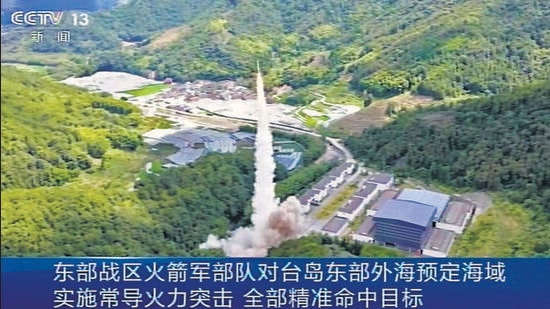
China’s military didn’t release specific details about its biggest ever military drills in the Taiwan Strait, but reports from Taipei said PLA’s nuclear-capable Dongfeng was among the missiles fired during the exercises that are a response to US House Speaker Nancy Pelosi’s brief but controversial visit to the island this week.
The PLA’s drills began on Tuesday night and intensified on Thursday afternoon as Beijing continued to fume over Pelosi’s trip. Sixteen ballistic missiles were fired, and at least four of them apparently overflew Taiwan, something experts said was unprecedented in PLA drills around the island and amounted to a significant escalation. The last time a missile drill on such a scale was carried out was in 1996.
Five of the Chinese missiles were believed to have landed within Japan’s exclusive economic zone, Japanese defence minister Nobuo Kishi said, adding that Tokyo delivered a diplomatic protest to Beijing. Taiwanese officials said the drills violated UN rules, invaded its space and threatened free air and sea navigation.
Also read: ‘Taiwan will not provoke but…’: President Tsai Ing-wen as China fires missiles
Pelosi, who left Taiwan on Wednesday, pledged solidarity with the island while speaking alongside President Tsai Ing-wen, and said her trip was aimed at making it clear that the US will “not abandon” Taiwan. China accused the US of “playing with fire” and announced the drills in retaliation.
China claims democratic Taiwan as its territory and hasn’t ruled out using force to merge it with the mainland. A Chinese state media report said the drills were part of a “rehearsal” for the reunification process. The exercises are focused on “blockade, sea target assault, strike on ground targets, and airspace control”, according to state media.
Besides the missile launches, Taiwan’s defence ministry announced on Thursday evening that 22 Chinese combat jets entered the island’s air defence identification zone. Reports from Taiwan said its armed forces were on full alert and had upgraded their combat readiness.
China’s state broadcaster CCTV announced that the drills will end at 0400 GMT on Sunday. The exercises, led by the navy and air force, include live firing in waters and in airspace surrounding Taiwan, the report said.
“The exercises involved troops from the Navy, Air Force, Rocket Force, Strategic Support Force and Logistic Support Force under the Eastern Theatre Command,” state-run Xinhua news agency reported.
State-run tabloid Global Times added: “Video clips taken by netizens soon circulated on social media showing that long-range rockets were fired from Pingtan, eastern China’s Fujian province, only 125 kilometres away from the island of Taiwan.”
The PLA and China’s state media didn’t reveal how many warships or combat jets were participating in the exercises or the strength of artillery and ground forces deployed. An aircraft carrier group, with at least one nuclear-powered submarine, has been sent to waters around Taiwan for the first carrier deterrence exercise, an expert affiliated with PLA told state media.
The PLA announced that “relevant sea and airspace control off the eastern coast of Taiwan” were lifted after the missile drill was completed at 7.30 GMT.
In Beijing, foreign ministry spokesperson Hua Chunying said China will no longer arrange a meeting between the Chinese and Japanese foreign ministers on the margins of the Association of Southeast Asian Nations (ASEAN) events in Cambodia.
The Chinese side was irked by the joint statement issued by G7 states, including Japan, about Taiwan, Hua told a regular ministry briefing, adding Tokyo has no right to make irresponsible remarks on the issue.
Also read: One year later, no further headway on LAC disengagement in India-China talks
Chinese foreign minister Wang Yi described Pelosi’s visit to Taiwan as a “manic, irresponsible and highly irrational” act, according to state broadcaster CCTV. Wang, speaking at the Asean meeting in Cambodia, said China made the utmost diplomatic effort to avert crisis but will never let its core interests be compromised.
Chinese President Xi Jinping is facing pressure from nationalists to mount a strong response to Pelosi’s visit, especially after Beijing was unable to deter the trip.
US secretary of state Antony Blinken said Washington had engaged Chinese counterparts in recent days at “every level of government” to convey a message of restraint after Pelosi’s trip. “We, and countries around the world, believe that escalation serves no one and could have unintended consequences that serve no one’s interests,” he said on the sidelines of the Asean meet.
Separately, Asean foreign ministers urged “maximum restraint” in a statement released at their annual meeting in Cambodia. Without naming China, Taiwan or the US, they expressed concern that developments “could destabilise the region and eventually could lead to miscalculation, serious confrontation, open conflicts and unpredictable consequences among major powers”.


