E-Paper



Gujarat begins to recover as cyclone ‘Biparjoy’ weakens; Amit Shah lauds it as ‘major achievement’
Shah surveyed affected regions, including Jakhau and Mandvi, and praised coordinated efforts of central and state personnel over “very severe” cyclonic storm.

 Prefer HTon Google


Coastal towns of Gujarat that were in the trajectory of cyclone Biparjoy began returning to normal life on Saturday, with businesses reopening and people back on the streets, a little over 48 hours after the storm tore through with winds of up to 140km/hr, a recovery that Union home minister Amit Shah lauded as a major achievement.
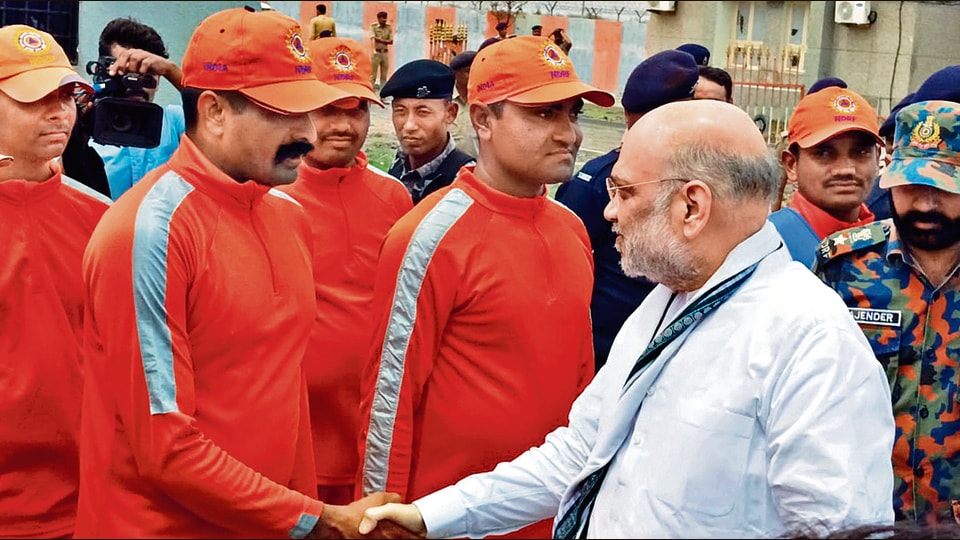
Shah surveyed the affected regions, including Jakhau and Mandvi, and said the lack of any fatalities was a testament to coordinated efforts of central and state personnel.
Also Read | Cyclone Biparjoy: Rajasthan receives heavy rainfall; will intensify, says IMD
At a press conference later, the minister said 108,208 civilians were moved to safety, 760 babies were delivered under the supervision of medical teams, and 73,000 animals were relocated to secure locations in a mammoth preparation for the storm that arrived as a “very severe” cyclonic storm.
“It is a matter of deep satisfaction for us that the cyclone that landed on the coast at a speed of 140 kilometres per hour could not claim a single human life. I congratulate the Gujarat government right from the chief minister to the panchayats and the chief secretary for this remarkable feat,” he said.
Also Read | Delhi gets rain relief due to cyclone Biparjoy; these states are next. List here
In Bhuj city, shops reopened for the first time since the cyclone hit and an increasing number of neighbourhoods had power supply restored.
Shah said out of 3,400 villages with power cuts, 1,600 had supply restored and the rest will be covered by June 20. “Currently, 1,133 teams are working on electricity restoration, with 413 more teams joining on Sunday,” Shah added.
The cyclone made landfall at Jakhau, where the ports remained largely unscathed but some boats — the most crucial source of income for fishermen communities — were left unmoored or flooded with water.
Manorama Mohanty, director of India Metrological Department Ahmedabad, confirmed that the landfall occurred approximately 10 kilometres north of Jakhau port, with wind speeds reaching a maximum of 130-140 kmph.
While no one was known to have been killed following the landfall around 6.30pm on Thursday, the strong winds and heavy rains that began days ago claimed the lives of two people on Wednesday.
“Fortunately, the cyclone has not caused significant harm to our jetty operations in Jakhau. However, a thorough assessment is yet to be conducted regarding the impact on the salt production,” said Vinod Joshi, port officer at GML, which operates a jetty in Jakhau.
Boats secured in the fishing harbour remained secured but some of those outside had been flung from the water channel to the embankments.
“These boats provide us with our livelihood, enabling us to earn a monthly income of ₹10,000-15,000 after accounting for all expenses,” said 60-year-old fisherman Harun Vagher, who was removing water from his displaced boat at the time.
Some communities and settlements remained flooded on Saturday while a historic bridge along the Naliya-Bhuj highway, a lifeline for villagers around it, collapsed.
The Prime Minister and the chief minister were closely involved in supervising the preparations.
“The Gujarat government ensured that the NDMA (National Disaster Management Authority) guidelines were followed in letter and spirit by deploying state and central ministers, MPs, MLAs, and senior officials in every tehsil and one secretary in every district and activating all the departments. Only 47 persons were injured and none of these injuries are grievous enough to cause permanent disability. Till now 234 animal lives were lost,” Shah said.