
 E-Paper



Congress battles a war of narratives in Kerala
Cacophony defines the Congress in Kerala – a sharp contrast to the discipline of the Communist Party of India (Marxist)

 Prefer HTon Google


Cacophony defines the Congress in Kerala – a sharp contrast to the discipline of the Communist Party of India (Marxist), where democratic centralism allows concentration of power at the top. In the Congress, every person is an opinion, or a faction.
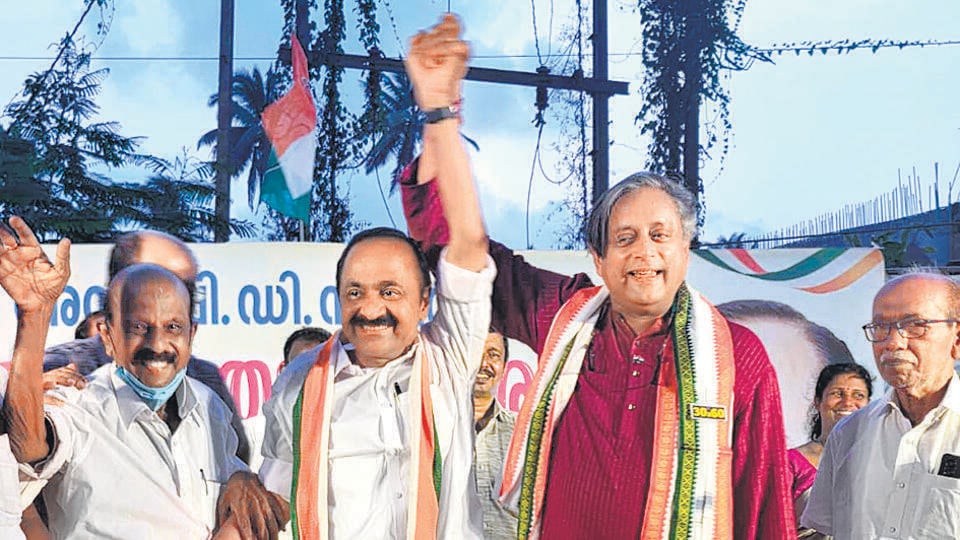
This assembly election – Kerala votes today – is an existential battle for the Congress and the United Democratic Front it heads. On the one hand, it faces a formidable challenge from the CPI(M)-led Left Democratic Front that seeks a Congress-mukt (free) Kerala; on the other hand, it must fend off a rising Bharatiya Janata Party that eyes the party’s Hindu voters in its pursuit of building a pan-Indian Hindu electorate and a Congress-mukt Bharat. An embattled Congress has sought to survive this double-barreled attack by alleging a deal between the two parties. The D-word (deal) has been a part of the Congress campaign, with leader of the Opposition VD Satheesan raising it everywhere.
In his personal bastion, Paravur, which he has won in every election this century, Satheesan appears to face little challenge. One evening in Karimbadam, Paravur, this reporter saw Satheesan’s campaign arrive. A band played Sare Jahan Se Achha, as the leader arrived in an open jeep at the local market, where he explained the five guarantees that the Congress promised. The five Indira Guarantees – free travel in public state transport buses, higher welfare pension ( ₹3,000), ( ₹5 lakh) support for young budding entrepreneurs, a separate department for the elderly, and the ₹25-lakh Oommen Chandy family health insurance scheme – offer a positive spin to the Congress campaign. Satheesan, 61, has been an aggressive campaigner. He has declared that he will undergo political exile if the UDF fails to secure a significant win. But in a party where seniority carries weight, there is no guarantee that he will be chief minister if the UDF gets elected. With multiple claimants for the post – senior leader Ramesh Chennithala and KC Venugopal (though he is not in the electoral fray) among them — the UDF campaign has been quiet about who its CM face is, unlike the LDF, whose campaign is centred on its captain, CM Pinarayi Vijayan.
Kalpetta Narayanan, a writer now associated with the Congress, has a different take on this chaos. “Sushaktamaya ekadhipatyamanu appurathu, ashakthamaya janadhpathyamanivide”, which, translated with context, indicates that the Left offers a robust dictatorship while the Congress thrives on a flexible democracy.
Nothing exemplifies Narayanan’s playful description of the Congress as its relationship with senior leader Shashi Tharoor. Until recently, many state leaders were making snide remarks about Tharoor’s politics. However, the Thiruvananthapuram MP has re-emerged as among the party’s most sought-after campaigners. In Ranni, a constituency hugging the Western Ghats in south-east Kerala, local resident Binny Sahithy called the former Union minister a “Gen Z icon”. The size and enthusiasm of the crowd that waited in the heat with candidate Pazhakulam Madhu to receive Tharoor, who was running late by an hour, were revealing. A visibly happy Tharoor said that he was pleased and gratified with the appreciation he has received from Congress candidates. Over a week, he covered at least 60 constituencies, often clocking 250-300 kms a day, holding road shows, addressing street corner meetings, and even press conferences. In simple functional Malayalam, he makes a case for the Congress-UDF candidate, appealing particularly to the youth. “A simple message is a positive message,” Tharoor explained. The ultimate acknowledgement came from Satheesan in Paravur. “I give the assurance that we will make use of Shashi Tharoor’s knowledge and expertise,” he said, with Tharoor standing beside him.
The Congress-UDF workers recognise that another loss – the LDF broke the Kerala pattern of alternating between fronts in office in 2021 – could be disastrous for the party. The general election and local bodies poll results have instilled hope, though few risk predicting a wave or sweep in the party’s favour. UDF workers this time have been putting in extra effort to do squad work, undertake house visits, and hit the streets. Multiple Muslim League leaders in northern Kerala confessed that they were surprised by the enthusiasm shown by Congress workers in campaigning for League candidates. John Samuel, head of the state Congress publicity wing, said that the party revamped its booth, ward, and mandalam committees after the 2021 loss. The Congress’s performance in state polls has been declining since 2001, when it won 62 seats. In the subsequent four elections, it came down to 24, 38, 22, and 21, whereas the CPI(M) raised its tally to 65, 45, 58, and 62 seats, respectively. With the exit of the Kerala Congress (M), the UDF is now a relatively weaker alliance: the Muslim League provides ballast in the Malabar region, but Revolutionary Socialist Party, Communist Marxist Party, and Revolutionary Marxist Party have limited influence.
The UDF is confident it has won back Muslim and Christian voters who were moving away from the party. The campaigning of Rahul Gandhi and Priyanka Gandhi Vadra (both have been part of electoral politics in the state, representing the Wayanad Lok Sabha constituency) has buoyed the party’s secular, centre-left credentials. CPI(M) general secretary MA Baby, however, alleged that the Congress’s secular posture emanated more from its grievance at losing power than from any ideological conviction.
But the real test for the Congress would be in managing the different social constituencies that it once patronised. The expansion of the CPI(M) as a mass party since the 1970s, the rise of the Bharatiya Janata Party, the absence of pan-state, pan-community leaders after the fading of K Karunakaran, AK Antony and Oommen Chandy, and the shrinking of its national footprint, has tested the Congress’s ability to offer itself as a party of governance in Kerala. The CPI(M) has tried to make the most of this crisis by offering Pinarayi Vijayan as a strong and decisive administrator, a contrast to the Congress leadership that is perceived as a prisoner of communal and caste interest groups. This narrative has many takers in the state.
A visible change in the UDF campaign is its crop of powerful campaigners – Satheesan, Tharoor, and Lok Sabha MP Shafi Parambil among them. Parambil has the image of a rockstar in northern Kerala, with his road shows a big hit among the youth and women. He also fills a vacuum in Congress of popular leaders from the Muslim community. In contrast, the CPI(M) has invested solely in Vijayan and, only in the last phase of the campaign, brought in younger faces.
As voters troop across to the polling booths, the Congress and the UDF will have their fingers crossed. A win would be a lifeline to the party – and the alliance – as it battles a war of narratives and seeks to reinvent itself as a party of social democracy.


