
 E-Paper



Containment zones boost Chennai’s efforts to efforts to flatten Covid-19 curve
The Tamil Nadu government’s graded relaxation for commercial and industrial units across the state does not apply to any containment area.


Tin sheets cordon off both ends of the West Madha Church street in North Chennai’s Royapuram, where a social work graduate student lives with her parents. Her lane is one of 357 containment zones in the city and 711 in Tamil Nadu’s 36 districts. “Last week there was a positive case discovered 2-3 houses down the street above the neighbourhood supermarket,” the 21-year-old told HT. “After that these tin sheets came up overnight. It is when the virus was next door that fear and anxiety gripped the area,” she said.
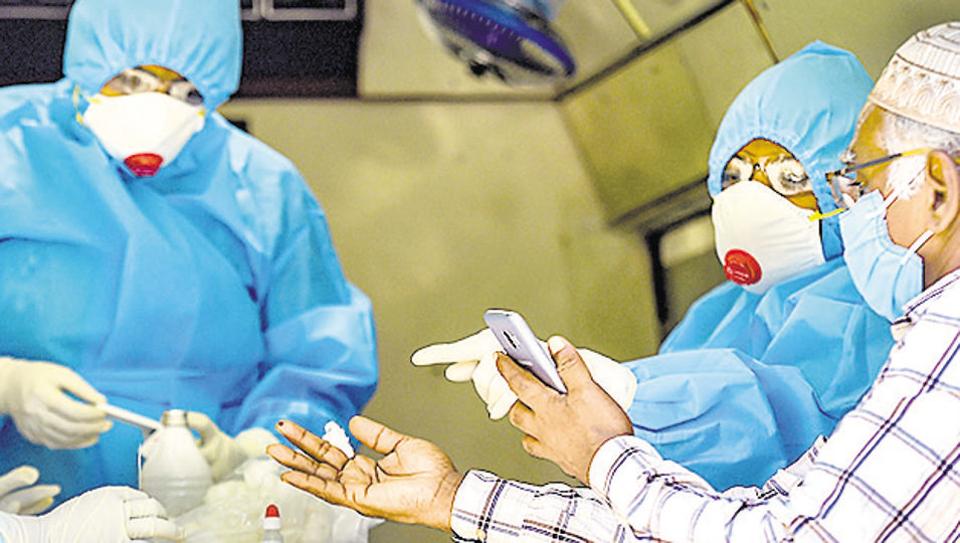
The first containment zone in North Chennai came up as early as April 2 after which the corporation has been learning on the job, officials said. “Initially our containment zones were defined in a very expansive manner,” said a senior official. Drones with speakers flew overhead to check if people were congregating on roof tops and to make announcements. “Then we realised that this is counterproductive. If we close down a large area, then it will be impossible to monitor. It made more sense to define a more compact containment zone and enforce containment of a smaller group of families,” the official said.
Now, on average, each containment zone monitors 150 families. One case is enough to contain an area. The transformation from a neighbourhood into a containment zone is swift. First, the person who tested positive is taken to hospital, then all his family and direct contacts are traced, tested and quarantined and third, in consultation with the police, the area is cordoned off. “We have registers outside containment zones which records how many people come in and go out every day. Movement is severely restricted for emergency cases only. We are working to ensure groceries and vegetables are supplied every day outside the barricades,” said the official.
Click here for full Covid-19 coverage.
Furthermore, zonal classification of districts are based on hotspot analysis set down by the Centre. Red zones or hotspot districts are demarcated on the basis of active cases; green zones are districts with either zero confirmed cases till date or no confirmed case in the last 21 days; while the orange zones are districts that are neither red nor green. As of May 5, Tamil Nadu has 12 districts are in the red zone, while 25 are in the orange zone. Krishnagiri, which was a green zone, was redesignated an orange zone after one positive case was reported on Wednesday.
Though the first case in the city was reported on March 7, TN created a containment zone plan after a religious conference of the Tablighi Jamaat held in New Delhi in mid-March was declared a hotspot. By April 1, the state had rolled out a detailed plan to track the attendees, their family members, and their primary contacts to test them for Covid-19. Health workers conducted door-to-door surveillance of the attendees’ families across several districts and authorities were instructed to cordon off a radius of 7-8 km around the attendees’ homes. In all, 1480 attendees and their contacts were traced and tested. Since the beginning of the week, Chennai’s wholesale fruit and vegetable market, Koyembedu, has been shut as it was found to be a Covid-19 hotspot; officials fear that the number of people who will need to be tracked may well be more than those associated with the religious conference. Of the 508 positive cases on May 5, a large number were linked to the wholesale market.
The case of Chennai
The state which has been in continuous lockdown since the last week of March, saw its caseload grow by 2089 in April; Chennai alone accounted for 880 of those. Of the 15 containment zones in Chennai, six including zone 5 where the 21-year-old graduate student lives, is under the scanner of the Corporation. At a press conference last week, Corporation commissioner G Prakash said that northern Chennai, which accounts for a majority of the city’s cases, will see further containment efforts.
Over the weekend, the Tamil Nadu government announced a graded relaxation for commercial and industrial units across the state; this does not apply to any containment area. Offices were also allowed to resume work with 20 persons or 25% of the work force, whichever is lower. The government has begun to offer e-passes to allow people to move within districts, between districts and even travel outside the state specifically for marriages, funerals or medical emergencies. The government has also started a website in which migrants are expected to register their details, in order to return to their home states. Over 1.18 lakh people are reported to have registered already.
Yet, on the first workday of this week, crowds thronged various parts of Chennai. This was worrying, because physical distancing and other safeguards remain vital to preventing the spread of the virus. Officials said that they have found it tough to enforce the lockdown even inside containment zones. A senior corporation official who did not wish to be named told HT: “To be honest, we can’t say we have done a perfect job, but we are doing our best. In a way these containment zones are like imprisoning people in their homes. We try our best to explain to people that we don’t have an alternative.” Last week, protests broke out in parts of Royapuram, where residents gathered in large groups and argued with police personnel at a barricade to allow them to go out to purchase groceries.
Ali Basha, a 49-year-old who runs a tuition centre in Thiruvottiyur in North Chennai has been providing relief materials to families in his area since mid-April. “There was also a rumour doing the rounds in the early days of the lockdown that salty air from the sea breeze helps fight the virus. Since North Chennai is mainly on the coast, most people bought into this Whatsapp forward and didn’t really care much about the social distancing,” he said.
In other parts of North Chennai, residents that HT spoke to, said they found inner roads to get around police barricades in containment zones. “Only 40% of those who step out really need to. The rest are people who are just curious how the city looks under a lockdown. They show up with their mobile phones so they can video call friends or relatives and give them a glimpse on how the roads or marketplaces look,” Basha said.
Crowding around vegetable markets has also been a severe issue in the state prompting Chief Minister Edappadi K. Palaniswami to note early last week, “In corporations like Chennai, Coimbatore and Trichy, the problem lies in vegetable markets. No matter how much you tell people, they refuse to follow lockdown restrictions. They are playful.”
Turning green
This is not to say that other districts have not been able to reduce the spread of the pandemic-causing virus, Sars-Cov-2, during the lockdown. Erode in western Tamil Nadu, for instance, has slowly fought its way out of a red zone. The district currently has no active Covid-19 cases. Last month the district was in the news when two Thai nationals who were part of the New Delhi religious conference tested positive on March 21. “Every single case we had in Erode was asymptomatic,” Erode deputy director of Health Services Dr S Soundammal told HT.
The district has not seen a single positive case since April 15 entirely due to rigorous contact tracing in the initial days with testing and strict quarantining that followed. “Our last active case was recorded on April 14 after which we have not got a single case. This is despite 100-200 samples tested every day still,” said Soundammal. “Our happiest day was April 28 when the last of the four cases we had were discharged. That day we realised that we had not had a case for the previous fortnight.”
The district administration is now focused on containing crossovers from across the district borders, even though the state has begun to allow inter-district travel. “We have got lists of people who have crossed over into our district, some who had passes to travel, some who didn’t. Some people who have walked across the Cauvery river, or through forests. We have strictly closed borders and maintained records and enforced a 14-day quarantine for anyone coming from outside,” said Soundammal. “For it to be a complete success story it will take time. We are in the middle of the journey,” she said.
Flattening the curve or reducing the spread of the infection now means that a district has to find its way back to being a green zone. One way to do that is to curtail people from red zones mixing with people from other zones. However, former city health officer of Chennai and senior epidemiologist Dr P Kuganantham noted that epidemiologists are not worried about the increasing number of positive cases. “The first step to arrest the spread of the epidemic is identifying more number of cases,” he said.
The more a state tests, the more the numbers would increase. Official data from May 1 shows that Chennai has tested 5225 samples per million population while the state has tested 1685 samples per million population till now.
“People are alarmed about increasing number of cases but they don’t understand one important point, positivity and illness are two different things. Testing positive amongst the younger and middle age groups is not going to harm them unless they suffer from any co-morbid conditions. It is only bad if elderly people with co-morbidities are going to be infected,” he said. “This lockdown has has postponed or delayed outbursts of the epidemic, and given more chance for elderly people to be isolated.”


