E-Paper



COP hosts call on countries to align NDCs with 1.5 degree C goal
The three countries – which together formed the COP Presidentcies’ Troika – unveiled a plan to ensure the next round of NDCs to be submitted by the countries are 1.5°C aligned

 Prefer HTon Google


New Delhi: The hosts of the United Nations (UN) climate conferences – the United Arab Emirates (COP28), Azerbaijan (COP29) and Brazil (COP30) – on Wednesday announced to cut emissions in line with limiting global warming to 1.5 degrees Celsius-aligned nationally-determined contributions (NDCs) under the Paris Agreement by early 2025.
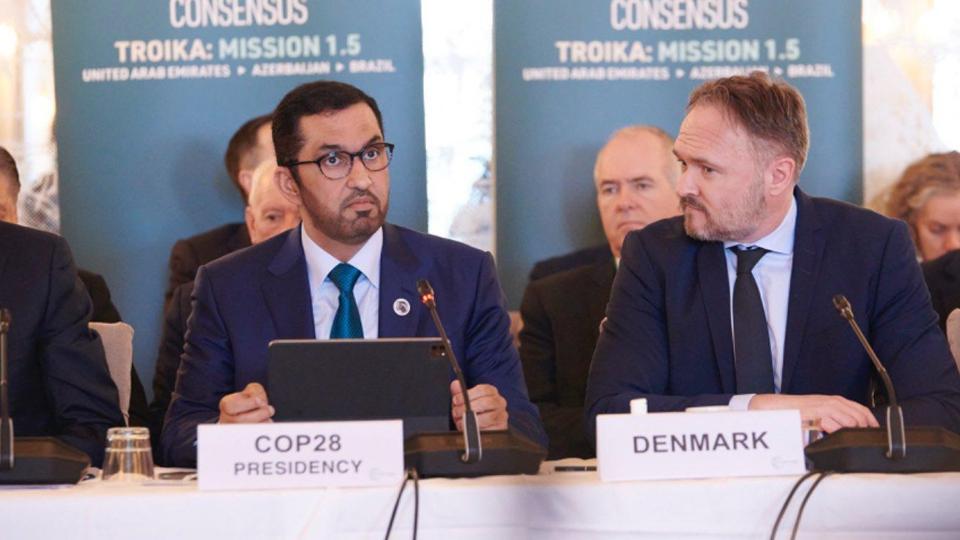
The three countries – which together formed the COP Presidentcies’ Troika – unveiled a plan to ensure the next round of NDCs to be submitted by the countries are 1.5°C aligned. The plan was shared at Copenhagen at the first climate ministerial since COP28 on Wednesday.
The Troika in this regard issued a letter to all 198 United Nations Framework Convention on Climate Change (UNFCCC) members, advocating “strongly for early submissions of high ambition NDCs, that decisively take forward the UAE Consensus.”
HT reported on December 14 that history was made in Dubai when 196 countries agreed to transition away from fossil fuels, in a just, orderly and equitable manner, accelerating action in this critical decade, so as to achieve net zero emissions by 2050, although experts said it doesn’t do enough on almost all fronts – climate targets, funding, phasing out fossil fuels, and holding historical polluters accountable.
“NDCs should be economy-wide, cover all greenhouse gases, including methane and include policies which deliver emission reductions of 60 per cent compared to 2019 levels, before 2035,” said Al Jaber, COP28 President and group chief executive officer of state oil giant Abu Dhabi National Oil Corporation (ADNOC).
Jaber urged members to “follow the science” and ensure energy transition pathways are “just, orderly and responsible” at a panel with COP29 President-Designate Mukhtar Babayev and André Corrêado Lago, Secretary for Climate, Energy and Environment for COP30 host Brazil.
He said that all the members should “follow this unprecedented agreement with unprecedented action” across the climate agenda, from mitigation to adaptation to finance. This should be underscored with “urgency, determination and full inclusivity”.
“The UAE Consensus was a victory for multilateralism and proof of the power of inclusivity, which showed that positivity and solidarity can overcome pessimism and polarization. An agreement is only as good as its implementation,” Jaber highlighted.
How parties from the Global South respond to this call depends on the outcome of finance talks at COP29 in Baku, Azerbaijan where climate finance is the key agenda.
In February, Simon Stiell, executive secretary of the UNFCCC called on countries to deliver trillions in climate finance. Stiell, who delivered a lecture at ADA University in Azerbaijan’s Baku on Friday, said at least $2.4 trillion is needed every year for energy transition in developing countries (excluding China).
The COP28 President issued an open invitation to all parties to attend the UAE Climate Finance Forum in Abu Dhabi in June last year, which will work towards realising “a climate finance architecture that unlocks the trillions needed for transformational green growth,” Stiell said.
“COP 28 set an expectation that the world would transition away from fossil fuels. The ministers’ meeting in Copenhagen has to pave the way for COP29 and work out how to turn those words into action. The future will be one free of fossil fuels and we need to develop a roadmap to get there as fast as possible and to kick those who want to drag us into the past out of the way,” added Stiell.
The sobering revelation from the State of Global Climate report confirming 2023 as the hottest year on record by a clear margin, serves as a stark reminder that the cost of the existing fossil fuel system is far higher in lost lives than the costs of transition.
“This year, we need bold leadership to accelerate away from these deadly fuels. Ministers must commit to clear national targets on fossil fuel exit and how they are supporting the transition globally. Many of the Ministers attending have already endorsed the call for a Fossil Fuel Treaty to complement the Paris Agreement. The impacts of the climate crisis show we need all hands on deck and all possible approaches to confront the climate emergency,” said Alex Rafalowicz, director of the Fossil Fuel Treaty initiative.
“A Fossil Fuel Treaty offers the needed framework for international cooperation that can actually go beyond words by addressing the root cause of climate change and transitioning away from fossil fuels in a just and equitable way for every region and community across the world,” Rafalowicz added.