
 E-Paper



Covid-19: States coordinating on migrant workers, Nizamuddin event
Coronavirus update: During daily coordination meetings between state functionaries and ministers, the mass movement of these migrant workers, some of whom have walked for hundreds of kilometers after the lockdown started on March 25, has been identified as the most critical area requiring immediate attention.


State governments have increased their coordination to share details about migrant workers and those with travel and contact history with Tablighi Jamaat, an Islamic missionary movement that held a congregation at Nizamuddin in Delhi mid-March.
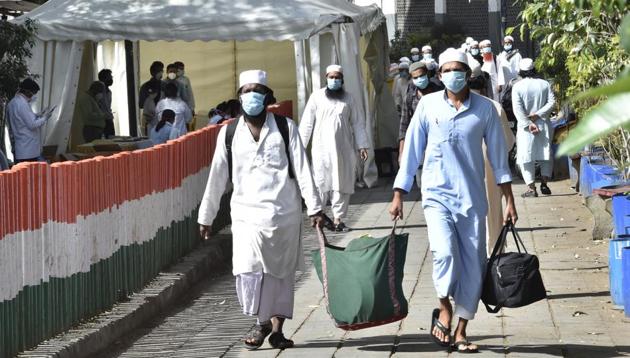
Nizamuddin has since become the coronavirus disease (Covid-19) hotspot, claiming nine lives and infecting at least 24 people across the country.
The states are also trying to ensure safe transportation, screening, monitoring and providing food and healthcare for tens of thousands of migrant workers during the ongoing 21-day nationwide lockdown to tackle the pandemic.
The labourers’ plight has emerged as a big challenge, said government functionaries aware of the details.
During daily coordination meetings between state functionaries and ministers, the mass movement of these migrant workers, some of whom have walked for hundreds of kilometers after the lockdown started on March 25, has been identified as the most critical area requiring immediate attention.
“Almost all states have made arrangements to look after these workers, but the situation is still quite fluid. Many state governments are coordinating to take care of the workers such as sharing details on how to help them,” said a Union minister requesting anonymity.
On Tuesday, Punjab chief minister Amarinder Singh spoke to his counterpart in Bihar, Nitish Kumar, to apprise him of the arrangements being made by his government to look after the migrant labourers from the latter’s state. Singh told Kumar to reassure the families of these workers that they are being looked after well during the lockdown.
People, who had begun their journey on foot, are still in transit or reaching their native places, despite the fact that states have been instructed to stop all movement of people beyond their boundaries. In such cases, states have been asked to take proactive steps to screen and monitor them.
“In Uttar Pradesh, approximately three lakh migrant workers arrived over the last few days. They have all been screened and kept under watch for 14 days. Over 7,000 gram panchayats have been alerted to report cases of those who arrived earlier and managed to reach their homes,” said a senior functionary of the UP government.
States have also started to share details on the number of people who came in contact with members of the Tablighi Jaamat’s congregation at Nizamuddin from foreign countries such as Malaysia, Indonesia, Saudi Arabia, and Kyrgyzstan.
“We’ve told the states to exchange information on whereabouts of the people who attended the congregation or were in touch with the members of the Jaamat. States have started helplines to report these cases and are also making appeals to people to voluntarily come forward for screening,” said a member of Parliament from the Bharatiya Janata Party.
Trade unions have urged the central government to reset the process of offering relief to the migrant workers stranded across the country. They have suggested direct cash transfers, ensure jobs and wages are not cut and healthcare needs are met at native places of the workers.
K Saji Narayanan, president of the Bharatiya Mazdoor Sangh (BMS), said, “The workers are facing several problems. For instance, they are not accustomed to the food being provided to them. In some states, they are being forced to live in shelters that have no civic amenities. Besides, the anxiety of being away from home and not earning their wages are getting the better of them.”
The BMS, an affiliate of the Rashtriya Swayamsevak Sangh (RSS), which has a network of over 6,000 registered trade unions, on Monday wrote to Union finance minister Nirmala Sitharaman and urged her ministry to pay at least Rs 5,000 to each labourer’s family immediately, open new bank accounts for those in the unorganised and informal sector and allow the workers to run their own kitchens.
Sukumar Damle, secretary, All India Trade Union Congress (AITUC), said the government must ensure that there is compliance with its orders on the ground. He said the workers are bearing the brunt because of a lack of coordination between the state administrations and the police.
Sachin Jain, of Vikas Samvaad, a Madhya Pradesh-based non-governmental organisation working with the migrant workers, flagged the need to involve civil society groups to reach out to the distressed workers.
He said the government does not have a plan to deal with workers in an emergency and is relying on the police to overcome “the unprecedented humanitarian crisis”.
“The police are overworked and stressed. Besides, they don’t have the capacity to address the workers’ issues. No wonder, workers are walking up to 500 kilometers to reach their native places amid this unprecedented humanitarian crisis,” he added.


