
 E-Paper





Follow the latest breaking news, major developments and agenda-setting stories from India and around the world with the newsdesk at Hindustan Times. Operating round the clock, the desk brings together experienced editors, reporters and correspondents to deliver fast, accurate and contextual reporting across subjects that influence public policy, governance, business, society and international affairs. The HT News Desk covers politics, elections, government policies, the economy, business and markets, science and technology, the environment, law and order, infrastructure, education, climate issues and geopolitics, while closely tracking developments across states, institutions and global capitals. The team also leads coverage of major breaking news events, policy announcements, court proceedings, natural disasters, public emergencies and significant international developments. Reports published by the newsdesk are based on information gathered from reporters on the ground, official statements, government agencies, court records, regulatory filings, recognised institutions and other authoritative sources. Stories undergo editorial scrutiny and verification processes to ensure accuracy, fairness and relevance, and are updated as events evolve and additional information becomes available. Whether covering a key political decision in New Delhi, an economic policy shift affecting millions, a landmark court ruling or a major global event, the HT News Desk aims to provide readers with reliable, fact-based journalism that delivers not only the latest developments but also the context and analysis needed to understand their wider implications.
Curbs reimposed amid ‘call for march’ in Jammu Kashmir
Roads leading to UNMOGIP at Sonwar were blocked and barricaded by security forces .


Srinagar Restrictions were reimposed in Srinagar and other parts of Kashmir valley on Friday after authorities feared large-scale protests after Friday prayers and rumours swirled about a big march to the office of UN Military Observers Group in India and Pakistan (UNMOGIP).
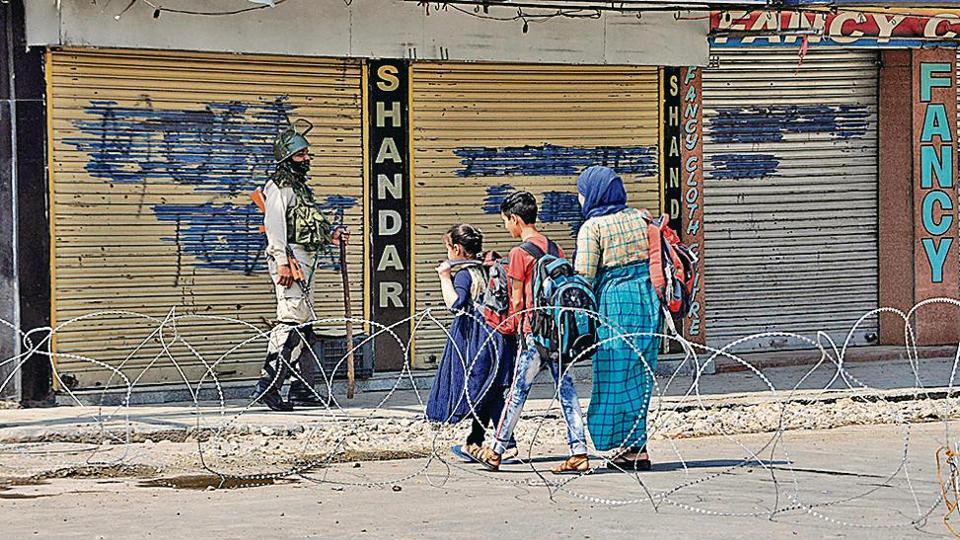
Roads leading to UNMOGIP at Sonwar were blocked and barricaded by security forces . “Nobody is allowed to go towards UN office,” said a policeman at Dalgate where concertina wires were laid to block the road.
There were no formal calls from any separatist organisation for the march, nor any statements to the effect in local newspapers. Majority of the separatists and their workers are either in jails or under house detention. On Thursday, there were reports that pamphlets urging people to march towards the UN office were distributed in the hot spot of Soura. This couldn’t be independently verified.
From early morning Friday, vehicles of the administration went around, making announcements in the city regarding the restrictions, which were lifted, in part, and in a few places only on Monday. .
“The announcements asked people not to move out and offer their prayers in Mohalla mosques,” said Adil Ahmad.
Since Monday, the administration had eased restrictions in areas falling under the jurisdiction of 50 police stations of the total 111 police stations across Kashmir.
After the easing of restrictions, the Panthachowk-Sonwar-Dalgate-M.A Road axis had seen an increase in movement of private vehicles,. Roadside fruit and vegetable carts and snack sellers have also made a reappearance. .
On Friday, Kashmir’s major mosque Jamia Masjid at Nawhatta was closed on account of the restrictions, marking the third consecutive Friday when prayers were not held in the grand mosque where separatist leader Mirwaiz Umar Farooq is the chief priest.
“We were not even allowed to click pictures of the Jamia Masjid. Although we had movement passes, a security official asked us to get permission for clicking photographs,” said Faisal Khan, a photojournalist with a local daily.
People coming in from north Kashmir stated that the security forces were restricting the movement of people and vehicles into the Handwara and Bandipora areas.
Public transport was off the roads and markets and businesses were closed in most parts of the valley.
Kashmir was put under a lockdown on August 5 after parliament passed laws and resolutions to bifurcate the state into two union territories, and remove the region’s special status. The restrictions were eased earlier this week, but many were reimposed, in part, on Friday.


