
 E-Paper



Cyber crimes registered 11.8% increase last year: NCRB
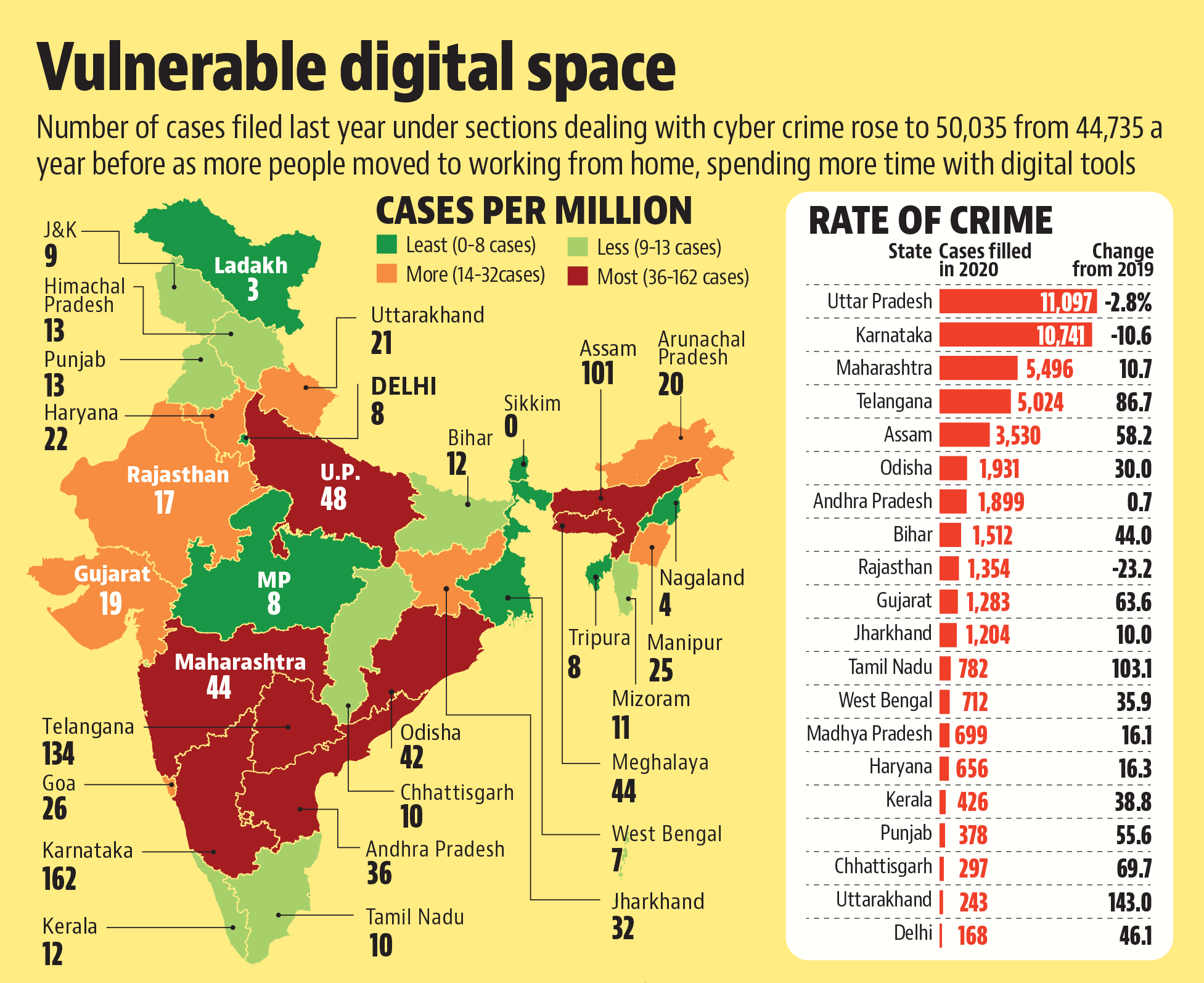
Most of the increase in cyber crimes came from states such as Telangana and Maharashtra while cases from the top 20 major cities rose by only 0.8%, suggesting more people were being targeted in smaller cities.


Cases of cyber crime recorded an 11.8% increase in 2020, a year when most rates of serious crimes fell, the Crime in India 2020 report shows.

Released late on Tuesday by the National Crime Records Bureau (NCRB), the report quantifies for the first time the unusual trends in crime and law and order in a year when much of the country was in a lockdown for over two months.
HT reported on Wednesday that overall, the number of cognizable cases rose by 28% but if Covid-related violations were removed, the number of new cases dropped compared to 2019. Some of the stark reductions were in cases of kidnapping and abduction, which fell by 19.3%, crime against women (down by 8.3%), crime against children (down by 13.2%) and crime against senior citizens (down by 10.8%). The murder cases increased by one percent.
But in case of complaints filed under sections dealing with cyber crime, the number of cases registered last year rose to 50,035 from 44,735 a year before. This ties in with trends seen across the world as more people moved to working and studying from home, spending more time with digital tools.
Most of the increase came from states such as Telangana, Assam, Bihar, Odisha, Jharkhand and Maharashtra while cases from the top 20 major cities rose by only 0.8%, suggesting more people were being targeted in smaller cities.
The total rate of cyber crime per 100,000 people increased from 3.3 to 3.7 in 2020.
“The picture provided by NCRB on cyber crime is very limited,” said Pawan Duggal, an independent expert in cyber security, who has been watching this space for more than two decades. He added that cyber frauds have increased in several countries during pandemic.
“The ground reality is overwhelming. Every second person would have been targeted by a cyber fraudster. The actual cyber fraud is much higher. The Covid pandemic has turned cyber fraud as a cottage industry, which was once known to be run from Jamtara in Jharkhand, to several other parts of the country,” he added.
To be sure, cyber crime sections include several types of crimes that are either carried out using or primarily target computer systems or assets linked to the internet, such as internet banking and email accounts.
Duggal’s allusion was to financial frauds that target citizens by fooling them into sharing sensitive credentials like one-time password (OTP). State police departments have identified several hotbeds of including Bharatpur in Rajasthan, Deoghar in Jharkhand, Gwalior-Chambal region in Madhya Pradesh, Palgar in Maharashtra and Noida in Uttar Pradesh.
Officials in Rajasthan said police opened a dedicated cyber police post in Bharatpur on Rajasthan-Uttar Pradesh border, where police from at least 22 states have visited since January 2021. About 40% of cyber fraud cases reported from Hyderabad was traced to Bharatpur.
Bharatpur superintendent of police, Devdendra Kumar Bishnoi admitted that many cyber frauds gangs are operating from Pahadi and Kaman areas of the district. “The area of operation of these people are southern states as they believe that police from those states would not come here tracking them. And that is true to some extent. They do not commit local crime,” he said.
On average police, from two states come to Bharatpur every week looking for cyber criminals.
Police officers said several cases of cyber fraud committed by people living in Bharatpur’s neighbouring districts of Agra and Meerut in Uttar Pradesh, Nuh in Haryana and Gwalior-Chambal belt in Madhya Pradesh have also been reported.
Cyber fraud gangs have also been seen to be increasingly active in Maharashtra and are targeting people in several southern states, said Hyderabad Assistant Commissioner of Police (Cybercrime) KVM Prasad.
In Jamtara district of Jharkhand, often considered as the epicentre for cyber fraud, close to 150 people were arrested and police of 20 states visited the district in 2020. Local officials now say efforts are being made to wean youth away from such crime, including by opening a library in each panchayat to help them prepare for various government job recruitment tests. “We tried our bit to take youth away from negative activities. But, can’t say it worked fully,” said then district deputy collector Faiz Ahmed Mumtaz.
Jharkhand police officers said that cyber fraud has spread from Jamtara to neighbouring Deoghar, from where close to 100 cases have been reported in the last nine months. “We have also made several arrests from this primarily rural district but it appears that many educated young people have found cyber fraud as easy way to make money,” said a Deoghar police officer, who was willing to be not quoted.
The spurt in such crimes is now prompting several states to setup dedicated units. Rajasthan has decided to have a cyber police station in every district, Kerala is forming a new cyber police battalion, Telangana has a dedicated cyber crime investigation department, Delhi Police has set up a separate wing for cyber crimes and have a cyber fraud detection unit in every district, and Karnataka has made cyber crime detection training mandatory police personnel in the state.
The home ministry now has a dedicated portal for reporting cyber crime ---cybercrime.gov.in. Close to 200,000 complaints have been lodged since the portal was launched in January 2020. The department in November, 2020 asked all states to registers FIRs on complaints received through this portal. Cases were registered in 5,000 of close to 2,00,000 complaints received through the portal in 2020, MHA had said in January 2021.
Duggal said the home ministry needs to look at revamping laws to check rising cyber fraud. “In most cases, the person would be out of jail in a few years, if not months. Penalty is not a deterrent. We need more stringent provisions in the Information Technology Act, which was last amended in 2008,” he said.
(With inputs from Sachin Saini in Jaipur, Srinivasa Rao Apparasu in Hyderabad and Vishal Kant in Ranchi)


