E-Paper



Heaviest July rain in 21 years floods Delhi
Delhi experienced its heaviest rainfall for a July day in 21 years, causing chaos on the streets. The India Meteorological Department issued a red alert, and the Delhi Traffic Police reported waterlogging at 56 locations and fallen trees blocking several stretches. The heavy rain was a result of monsoon winds interacting with a western disturbance. The city's lack of preparedness for the monsoon season is concerning, especially as it aims to become a world-class city. More rain is expected in the coming days.

 Prefer HTon Google


The Capital received its heaviest deluge for a July day in 21 years on Saturday when 126.1mm of rain was recorded between 8.30am and 5.30pm, bringing chaos to the Capital’s streets and prompting the India Meteorological Department to issue a red alert in the afternoon.
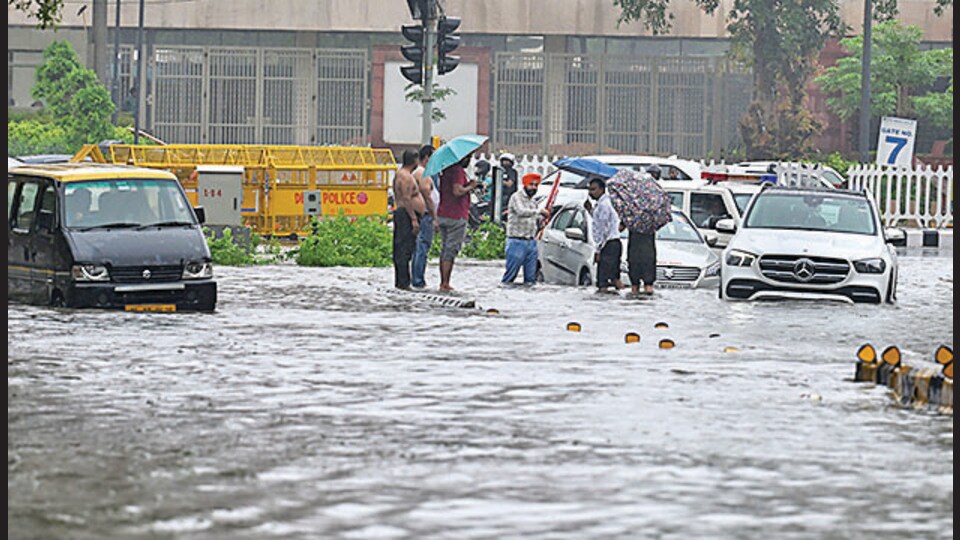
The Delhi Traffic Police issued a situation alert at 3.30pm saying there was waterlogging at 56 locations that disrupted traffic, fallen trees that partially or completely blocked seven stretches, and major underpasses and low-lying stretches, such as under the Minto Bridge, the Pragati Maidan tunnel and the Kalindi Kunj underpass were flooded.
Saturday’s rain --- classified in the ‘very heavy’ category --- was the consequence of monsoon winds interacting with a western disturbance, IMD officials said, which triggered precipitation across much of north-west India.
“If a 24-hour period was considered, then this is the highest single day rainfall at Safdarjung in July since 133.4mm was recorded on July 10, 2003. With Saturday’s rain coming in just nine hours, it is possible that even this figure gets eclipsed by 8:30 am on Sunday morning,” said a Met department official. IMD’s 24-hour period is from 8:30 am until 8:30 am the next day and the IMD says more rain is likely in early hours of Sunday and overnight.
The chaos the rain led to in the Capital serves as a worrying reminder of the city’s lack of preparedness to tackle the monsoon. The lack is particularly stark as it comes at a time when authorities and agencies are focused on decking Delhi up for the G20 summit due in September. That the situation was not worse for citizens on Saturday was only due to it being a weekend. Delhi needs its civic infrastructure and maintenance to justify its ambition of becoming a world class city.
Safdarjung, representative of Delhi’s weather, had recorded 3.4mm of rainfall in a 24-hour period till 8:30 am on Saturday morning. In the next nine hours, however, it received 126.1mm of rain. The most rain across Delhi was seen at the Ridge station in north Delhi, where 128mm was recorded in these nine hours, while while Lodhi road recorded 118.2mm. The stations of Delhi University (86mm), Pitampura (83mm) and Pusa (67.5mm) received ‘heavy rain, while moderate spells of 29.6mm at Ayanagar and 17.8mm at Palam were also recorded during this period.
“A western disturbance is likely to exhibit very slow movement during the next 24-36 hours. The monsoon trough is running to the south of its normal position extending up to lower tropospheric levels with an embedded cyclonic circulation over southwest Rajasthan,” the IMD update on Saturday read.
Officials said the beginning of next week is likely to remain rainy. “There are chances that parts of Delhi received moderate rain on Sunday. Light to moderate rain is again possible on Monday and Tuesday, with the monsoon trough likely to remain close to Delhi NCR,” the official added.
Very heavy rain spells are fairly rare for the capital, with usually just one such day being recorded in the entire year. The last such spell came on July 1, 2022, when 117.2mm of rain was recorded. In the same year, only two more ‘heavy rain’ days were recorded.
Private forecasters hinted that at least for July, northwest India is currently showing signs of normal monsoon rain recording. “Most parts of northwest India have already achieved the normal rainfall mark for the month, and the forecast shows that similar intensity rain is likely to continue for another two to three days,” said Mahesh Palawat, vice-president (meteorology and climate change), Skymet Weather.
In the Capital, the first eight days of the month have brought 164.1mm of rain and by the time the month is over, the long-period average for July at 209.7mm is likely to be surpassed. To be sure, this has been the case in recent years with the city recording more than average amount of rain in 2022 (286.3mm), 2021 (507.1mm) and 2020 (236.9mm).
Delhi’s maximum on Saturday stood at 28.7 degrees Celsius, which is eight degrees below normal. The minimum was 25 degrees Celsius, three degrees below normal. In comparison, the maximum and minimum were 35 and 26.7 degrees Celsius respectively on Friday. Forecasts show the maximum will hover around 30 degrees on Sunday and the minimum will be around 24 degrees.