
 E-Paper



Delhi records 2nd cleanest air post-Diwali since 2015. Here's the reason
Strong, sustained winds swept through Delhi, rapidly dispersing dense smoke layer and bringing AQI down to 339 by 4pm Friday, further improving to 323 by 7pm.

 Prefer HTon Google


Delhi's air quality has been the second cleanest post-Diwali since 2015, maintaining a “very poor” Air Quality Index (AQI) instead of deteriorating to “severe". This stability is credited to “strong wind ventilation", with speeds reaching 16 kilometres per hour.
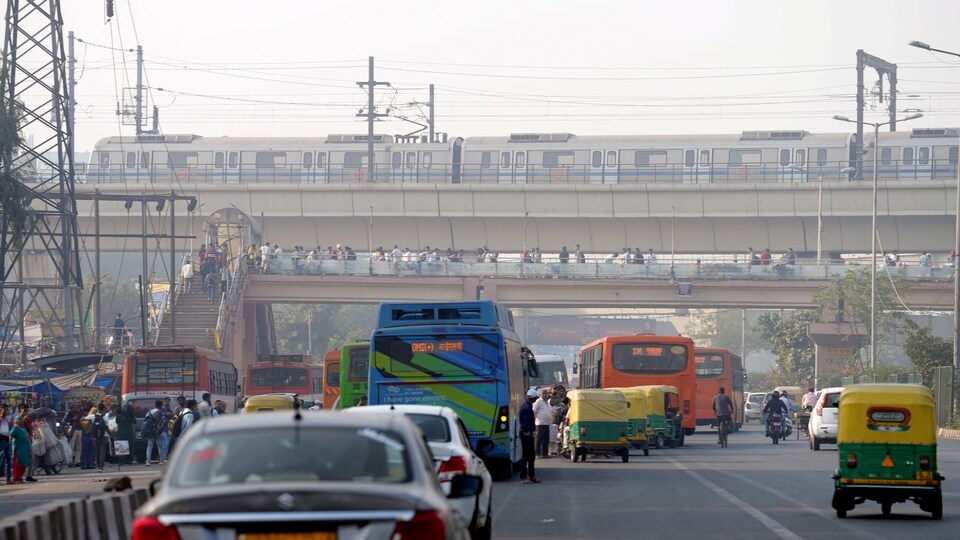
While the 24-hour air quality index (AQI) climbed steadily through Thursday night — from 328 in the early evening to 338 at midnight, reaching 362 by 9am Friday — the city experienced an unexpected respite. Strong, sustained winds swept through Delhi, rapidly dispersing the dense smoke layer and bringing the AQI down to 339 by 4pm Friday, further improving to 323 by 7pm.
The use of fireworks, an increase in stubble burning, and emissions from various local sources that release toxic gases pushed the city’s air quality into the upper range of “very poor” late Thursday night and into Friday morning.
Mahesh Palawat, vice president at Skymet meteorology, explained this complex interaction between temperature and pollution: “Higher temperature keeps mixing height high and allows pollutants to move and disperse freely. Low temperature slows down wind speed and also traps pollutants closer to the surface through a phenomena called inversion.”
He noted that while winter months typically see the mixing height drop to a mere 200-300 metres, Thursday maintained mixing height of 2,100 metres.
“Even though the air quality on Diwali was in the very poor category — hitting severe levels during midnight — these conditions dissipated quickly the next day to reach moderate levels by the afternoon. This is mainly because of relatively warm conditions with reasonable wind speed and natural ventilation. The deep calm winter inversion conditions are yet to set in. Despite this, the month of October has also seen more poor and very poor days than previous years, even when the contribution of farm fires has been just around 1-3%, indicating a very high impact of local and regional pollution,” Anumita Roychowdhury, executive director, Research and Advocacy at the Centre for Science and Environment (CSE) told The Times of India.
Air quality on Diwali day and the next day
On Thursday, while some parts of south Delhi limited the use of firecrackers, most of the city compensated with increased activity. The contribution of stubble burning to the city's PM2.5 levels also rose significantly, with its share reaching 27.61% on Diwali day, up from 8.4% on Wednesday and 1.8% on Tuesday, TOI reported.
Friday morning started hazy, but conditions improved as the winds picked up and the sun emerged. The weather department reported wind speeds of 12-16 km/h until midnight on Diwali, which fell to 3-7 kilometres per hour toward midnight but increased again on Friday morning, aiding in the ventilation and dispersal of pollutants.
Although the post-Diwali AQI for 2024 is the second cleanest since 2015, there is concern over hourly spikes in PM2.5 levels in certain areas, which reportedly exceeded the national permissible limits by more than 30 times.


