
 E-Paper



Election In Pincodes: Ghaziabad votes amid bad air, in shadow of a trash mound
Ahead of the Lok Sabha polls, HT looks at some key constituencies across India which encapsulate the issues shaping the elections

 Prefer HTon Google


Ghaziabad The lane just off the main road is caked with hay and framed by open sewage lines. The sun beats down on flat-walled buildings that are struggling to keep their posture. Most of their windows are shut. At the far end, a metal wall cuts off the road, but being less than 10 feet high, it is dwarfed by a towering mass of filth. This is the infamous Ghazipur landfill.
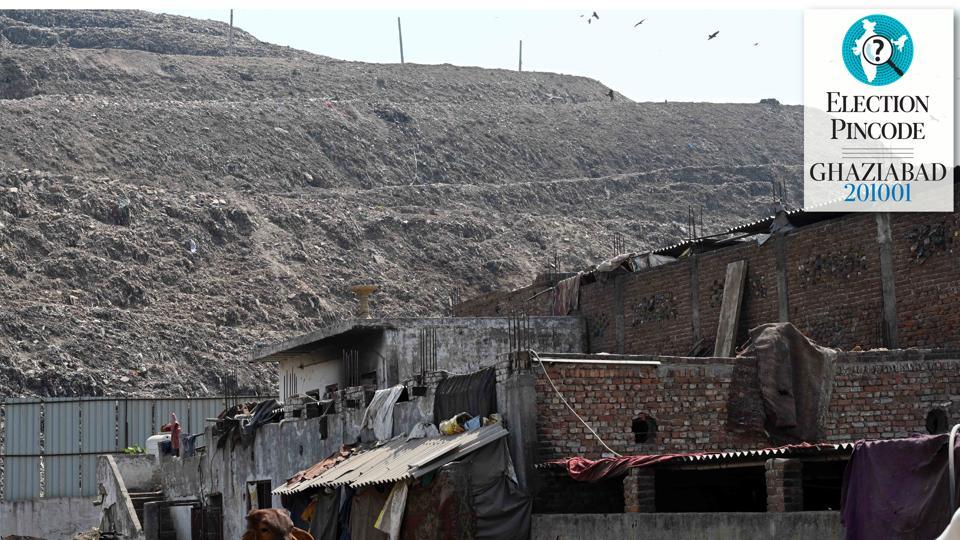
Surender Sharma zips down the street on his bicycle, stopping at the foot of the cramped lane that leads to his home – a shanty with a tin panel for a roof and a worn tarpaulin sheet for a door. Off his bicycle’s handle hangs a plastic bag of medicines. His chest has felt tight for two weeks, he says. “But I haven’t ever breathed freely.” The 49-year-old was born in a slum at the foot of the landfill.
A pair of jet-black sunglasses, usually prescribed to patients after cataract surgeries, sit awkwardly on his face. “I also have an eye infection,” he says, pointing to a vial of eye drops. Sitting on the edge of a sewage line in front of the slum, Feroz Khan cuts him off. “It’s not just you. All of us have eye infections all the time,” says the 24-year-old, who lives near Jama Masjid and runs a dairy in Ghazipur. “And it’s not only our eyes,” Khan adds, pointing to two more people with bloodshot eyes standing by him. “Our skin, our hair -- all of it is ruined.”
At the fringe of Delhi’s border with Ghaziabad, the Ghazipur landfill throttles life around it, casting a toxic shadow for miles around. Doctors have, for decades, underscored the harms of living in such a toxic setting – respiratory, digestive, skin and eye illnesses in the short term, as Sharma and Khan have experienced, and a raft of crippling ailments, including cancer, in the longer term.
But from the cheek-by-jowl slums around the waste mountain to the gated colonies of Indirapuram that form the Ghaziabad constituency, Ghazipur is just the most visible identifier of an existence orchestrated by pollution – of the air, the water, and soil – and the surprising lack of public and political will to change the status quo.
Top of the chartsA heavily industrialised city packed with over 27,000 factories and manufacturing units that spit out hazardous fumes and waste, Ghaziabad is a permanent fixture on national and global air pollution rankings.
The 2023 World Air Quality Report by Swiss firm IQAir ranked Ghaziabad as the 35th most polluted city in the world, with an average PM2.5 (a microscopic pollutant that enters and settles in the lungs) concentration of 76.1μg/m³, 15 times above global safe standards. In November, this number spiralled to 191μg/m³, the equivalent of constantly breathing air thick with smoke from a dozen cigarettes.
But much like the rest of the National Capital Region (NCR), the city’s travails with pollution are compounded by neighbouring towns. Apart from sharing a border with Delhi, the vast Ghaziabad parliamentary constituency spans five assembly segments – Ghaziabad, Loni, Muradnagar, Sahibabad (which together form Ghaziabad district) and Hapur. In many cases, the smaller towns don’t even have adequate monitoring systems to measure the toxins its inhabitants are inhaling.

But on April 26, when Ghaziabad’s 2.6 million people vote in the Lok Sabha elections, none of this will likely make an impact. “Why will a political party bother?” asks Rakesh Singh, 52, a resident of Khoda in Ghaziabad. “ On the way to the main road, I have to ride my motorcycle through unpaved streets that kick up clouds of dust. I travel to the dairy farms in Ghazipur to get milk every other day. Who knows how contaminated the produce is?”.
“Parties are only concerned with national issues. Nobody’s interested in addressing such local problems, whether it’s a general election or a civic one,” says his wife, asking not to be named.
By the waysideThe Ghaziabad constituency was carved out of the expansive Hapur segment in 2008. In the elections since, the Bharatiya Janata Party (BJP) has held a vice-like grip on the seat. In 2009, now defence minister Rajnath Singh won the contest by nearly 60,000 votes. The party’s margin swelled to 550,000 in 2014, when General (retd) VK Singh eased past the Congress’s Raj Babbar. He nearly equalled that winning margin in 2019, defeating the Samajwadi Party’s Suresh Bansal by around half a million votes.
In such a seemingly lopsided contest, complex issues such as pollution – which neither have one source nor just one stakeholder, and which doesn’t bring immediate political returns – are often overlooked. Politicians admit that this is true.
Sanjeev Sharma, the BJP’s Ghaziabad district president, says that pollution is much less of a voting issue than it should be. “We need a fix. Everybody in the administration is on the same page about this,” he said. “The issue comes up in meetings very often. Bureaucrats, MLAs, ministers, all raise the issue, but arriving at a consensus is a major hurdle.”
The Congress agrees. The party’s district president Bijender Yadav stresses that “a clean environment has always been a key feature of the Congress’s developmental agenda”.
“We will carve out more parks, plant more trees across the region and crack down on polluting units in Ghaziabad,” Yadav says.
But Sanjeev Sharma is not too worried, because he knows that pollution won’t remotely move the vote-count needle. “No matter who the candidate is, we’re confident of sweeping this constituency by more than 500,000 votes.”
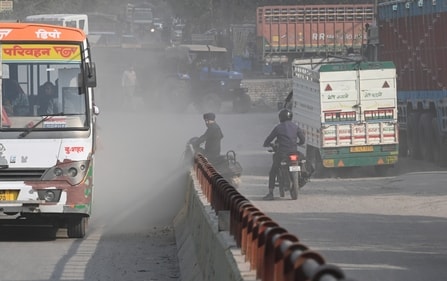
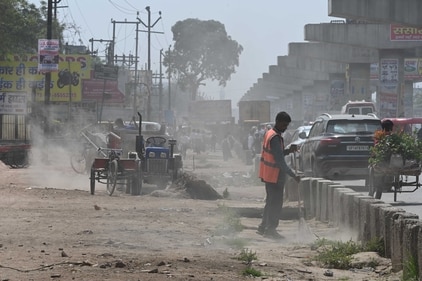
From dust to dustA dollop of dust coats National Highway 709B in Loni. The corridor slices through the town of around half a million people and bridges Saharanpur in Uttar Pradesh with Akshardham in Delhi. Known locally as Saharanpur Road, the highway is the backbone of the town’s economy. Street vendors, shops, offices and malls crowd either side of the sepia-stained street. Yet, even on an afternoon when the town’s local air quality index (AQI) monitors read in the respectable 160s, plumes of dust blur one’s vision.
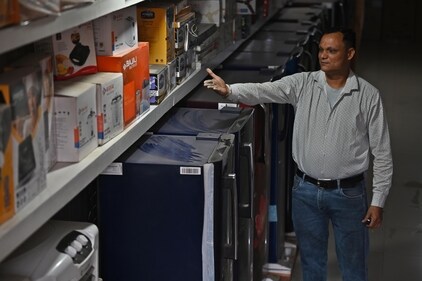
Bablu Mishra, 40, who runs an electronics store along the highway, points to a line of dusty washing machines, refrigerators and coolers. “And this is what it looks like when we cleaned every unit two hours ago,” he says. “Customers walk in and walk out instantly when they see the dust. They think we’re selling old products. Just think – would you ever buy anything so dirty for a special occasion?”.
Neither Mishra nor his neighbours have much choice. “I’ve lived here for all 26 years of my life. This town has always been dusty and will remain dusty,” said Sunny, who asked to be identified by a single name and who owns a mobile phone store a few shops away from Mishra’s.
Officials at the Uttar Pradesh Pollution Control Board (UPPCB) believe much of Loni’s difficulties are down to the construction of the Delhi-Dehradun highway, which started in December 2021. “Controlling dust along this stretch is the National Highway Authority of India’s (NHAI) responsibility. In November 2023, we fined them ₹25 lakh for letting pollution spiral out of control,” says Vikas Misra, UPPCB’s regional officer in Ghaziabad.
The air is just as unforgiving in urban Ghaziabad, for a similar reason. Vikas Singh, 42, a resident of Lajpat Nagar colony, says the near-constant construction work in the city, coupled with the zig-zags of unpaved streets keep the air foul all year. “There isn’t a single local officer I haven’t approached for a fix to the air pollution. Forget the political parties. Even the bureaucrats don’t care.”
Thick with industriesPolluting industries are another part of the puzzle. Factories with grey chimneys puff out dark smoke into the Ghaziabad sky at Vijay Nagar industrial area, flanked by residential properties and commercial units. “We’re resigned to breathing such air now, because we have to live with it. But ask anybody in Ghaziabad how long their AC lasts. A couple of years at best,” says Kaveri Pandit, a 24-year-old resident of Crossings Republik.
Rakesh Singh from Khoda concurs. “It isn’t just an inconvenience – it’s also a major recurring expense. And if the air does this to an AC, you can only imagine what it’s doing to our bodies.”
The Central Pollution Control Board (CPCB) classifies industrial units into four categories based on the severity of their emissions – red, orange, green and white. Industries categorised red are, at least on paper, subject to the highest thresholds of pollution control measures and monitoring. According to a June 2023 report by UPPCB, 426 units in Ghaziabad were in the red zone. And even as authorities insisted that each of these units were subject to stringent checks, data from 2023 also showed that the city was able to only exact 27% of the fines imposed on its polluting units.
Taken together – the landfill, the peri-urban areas choking with infrastructure dust, the urban heartland struggling to manage traffic and construction work, and the industrial areas spewing smoke into the air – Ghaziabad presents a microcosm of the hydra-headed problem that pollution poses in urban India. And it also shows how feeble the official response is in addressing this.
“We have to fend off pollution at every step of our lives. But the administrative and civic apathy whenever we raise a concern is even worse. It’s better to take matters into our own hands and sort it out on a local level,” says Vikas Misra.
The expert view is that Ghaziabad’s troubles germinated with poor planning. “Allowing industrial units to proliferate in and around residential areas massively increases people’s exposure to pollution, whether of the air or water,” says Anumita Roychowdhury, executive director, (research and advocacy) at the Centre for Science and Environment.
“Such industrialisation also promotes development that will only suit these industries. Ghaziabad has, for instance, grown while facilitating the movement of private vehicles – wider roads, more flyovers, more underpasses – but not of pedestrians, or even public transport,” she adds.
What’s left unsaid is that many of these polluting activities are key sources of income for large chunks of the population, creating barriers in generating public pressure for action. A 2023 paper by Shikhar Singh and Tariq Thatchill also pointed to two other reasons behind air pollution not becoming an election issue – sensitivity to personal costs from any climate mitigation steps, and hyper partisanship that allows voters to selectively blame politicians for health crises. A complex interplay of these factors is how these issues evade one election after another.
Back at Ghazipur, Surender Sharma is only too aware of this, as he takes off his thick glasses to squeeze eye drops out of a green bottle. Khan, standing by his side, is irate. “This was once a park. We used to play here. It was the only patch of green in this place, so they thought it best to turn it into another dumping ground,” he says.
But Sharma is calm. “We will all live and die in this squalor. And elections won’t change that.”
This is the second in a series of election reports from the field that look at national and local issues through an electoral lens.


