E-Paper



Encroachment on 13% of Assam forest land, shows government data
Encroachments have been reported over 13% of forest land in Assam; 2% of forest land in Delhi and 1% of such land in Andhra Pradesh, the Union environment ministry informed the Lok Sabha


Encroachments have been reported over 13% of forest land in Assam; 2% of forest land in Delhi and 1% of such land in Andhra Pradesh, the Union environment ministry informed the Lok Sabha on Monday.
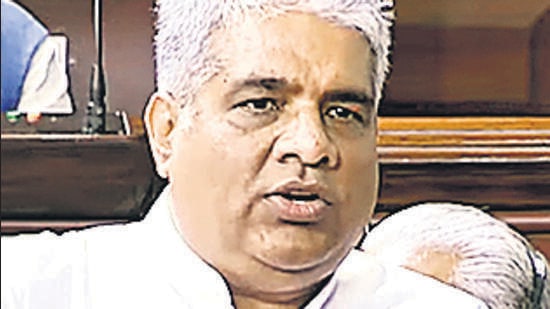
In response to a question by Bharatiya Janata Party (BJP) MP Sanganna Amarappa on the extent of encroachment of forest land by private entities, including industries, hospitals and educational institutions, over the last three years, State-wise and year-wise, Union environment minister Bhupender Yadav shared details shared by state governments.
“The data of encroachment on forest land by private entities including industries, hospitals and educational institutions, are not maintained at the level of this Ministry. As per the information received from States/UTs, the details of the forest area under encroachment in the country are given in Annexure I…” Yadav said in his response.
According to the Annexure he was referring to, encroachments have been reported across large areas of several states — Assam with 377,532.63 hectares (ha); Andhra Pradesh with 34,358.33 ha; Delhi 384.38 ha; Madhya Pradesh 54,173.28 ha; Odisha 33,154.19 ha; Arunachal Pradesh 53,450.43 ha, among others.
According to the Forest Survey of India, the total forest land in Assam in 2,832,700 ha while Delhi’s total forest land is 19,544 ha.
“Protection and management of forests is primarily the responsibility of concerned State/UT. The actions to remove encroachment are taken as per the provisions under various Acts such as Indian Forest Act, 1927; Wildlife (Protection) Act, 1972; Forest (Conservation) Act, 1980, various Rules made under these Acts and State specific Acts and Rules…” Yadav’s response states.
“This Ministry does not collate data of encroachment on forest land. However, the Ministry has written to State Governments/UT Administrations to remove encroachment as per the existing Acts/Rules and to ensure that no further encroachment takes place. In order to prevent and control encroachments, the States and UTs also take various measures such as demarcation and digitization of forest boundaries, strengthening infrastructure for forest protection, involving fringe area forest communities through Joint Forest Management Committees, Eco Development Committees etc,” Yadav stated.
The information shared by him shows that funds released by the Centre for integrated development of wildlife habitats have reduced from ₹124.48 crore in 2019-20 to ₹87.55 crore in 2021-22.
Funds for the forest fire prevention and management scheme have also reduced from ₹46.40 crore in 2019-20 to ₹34.25 crore in 2021-22, according to the ministry data.
“It’s the state’s statutory obligation to keep forests encroachment free. We have given them directions to remove encroachments several times,” said a senior environment ministry official who did not want to be named.
“Since the responsibility of the implementation of the forest conservation act rests with the Centre, it is also the duty of the Central government to initiate action against state governments who are allowing use of forest land for non-forest purposes without prior approval of Central government. Encroachment of forest land is violation of section 2 of the FC Act so it’s completely illegal, and in the event that encroachment in continuing, the Central government is duty-bound to file complaints before respective magistrates for violation of FC Act and action against principal conservator of forests for wilful violation,” said environmental lawyer Ritwick Dutta.
In response to another question in Lok Sabha by BJP MP Pradyot Bordoloi on details of the funds allocated and utilised under the National Clean Air Programme (NCAP) for FY 2019-20, 2020-21 and 2021-2022 respectively, State/UT-wise, the environment ministry’s response shows only half of the funds disbursed by Centre since 2019-20 in the past three years have been utilised for air pollution control. Of the ₹472.06 crore released, 117 cities have utilised only ₹227.61 crore so far.
The National Clean Air Programme (NCAP), which was launched by MoEFCC in January 2019, is a long-term, time-bound, national level strategy for prevention, control and abatement of air pollution. Under NCAP, it has been envisaged to achieve targets of 20%-30 % reduction in Particulate Matter concentration by 2024 across the country.