E-Paper



Explain repeated failure over Deepam lighting, asks Madras HC as state moves SC
The Deepatohoon issue has become contentious after authorities refused permission for the lighting ceremony despite successive high court orders

 Prefer HTon Google


The Madras High Court on Friday asked the Tamil Nadu government again to explain its repeated failure to permit the lighting of the Karthigai Deepam lamp atop the Deepathoon, the ancient stone lamp pillar on Thiruparankundram hill in Madurai district.
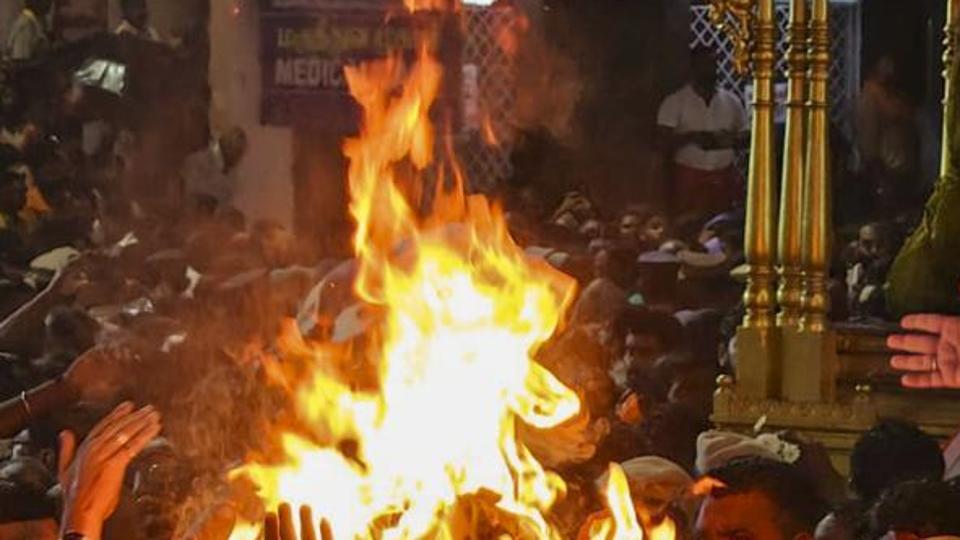
The Deepatohoon issue has become contentious after authorities refused permission for the lighting ceremony despite successive high court orders.
The development came on a day when the Tamil Nadu government also moved the Supreme Court, mentioning its special leave petition before Chief Justice of India Surya Kant, seeking urgent hearing of its challenge to the High Court’s directions permitting devotees to light the lamp.
The CJI asked the State to get its plea numbered and listed, after the petitioner’s counsel accused the State of “staging a drama” to signal to the Madurai bench that the matter had now reached the apex court.
Also Read:HC upholds nod to light TN ceremonial lamp
Back in the Madurai bench, Justice GR Swaminathan began hearing a contempt petition against the Madurai Collector, the City Police Commissioner and the Executive Officer of the Arulmighu Subramania Swamy Temple, after he was informed that district authorities and local police had blocked devotees from reaching the hill on December 4, despite his clear instructions issued on December 1 and reiterated over the following days.
Advocate RM Arun Swaminathan, appearing for the petitioner devotees, told the court that authorities had “surrounded devotees”, threatened arrests and detained more than 300 people in a marriage hall on Thursday evening, just hours after the court had directed that the lamp be lit and that adequate security arrangements be provided.
“We went as per the court order. The Deputy Commissioner violated it. They said Section 144 is still in force and that they will move the Supreme Court,” he said, accusing the State of being “adamant” and of blatantly refusing to follow the law. He sought that the State Home department also be made a party to the proceedings.
Justice Swaminathan declined to widen the scope of the contempt plea but directed the State to file its report. He also instructed the CISF commandant—who had accompanied the petitioners on December 4 in compliance with the High Court’s earlier order—to file a detailed report on how they were obstructed from lighting the lamp.
Appearing for the State, Additional Advocate General J Ravindran, and senior advocate Vikas Singh for the Madurai police commissioner, maintained that there was no intention to disobey the court, but said circumstances on the ground made compliance impossible.
Singh said he was ready to explain “why compliance was not possible” and confirmed that the State and the Commissioner had approached the Supreme Court against the division bench order that had upheld Justice Swaminathan’s December 1 direction.
Justice Swaminathan adjourned the contempt proceedings to December 9.
The Deepathoon issue, which began as a simple petition by a group of devotees seeking permission to light the Karthigai Deepam lamp, has now escalated into a political-religious flashpoint in Tamil Nadu. Justice Swaminathan permitted devotees to light the lamp on December 1, calling the ritual an integral part of Tamil culture.
The State resisted the order citing law and order concerns and the hill’s proximity to a dargah.
On December 3, he quashed the Madurai Collector’s prohibitory order under Section 144 CrPC (Section 163 BNSS), calling it an “attempt to circumvent his order”.
The same day, a Division Bench upheld his directions, describing the State’s appeal as an “attempt to pre-empt contempt”.