Extensive planning, Afghan locals’ help eased evacuation
The threat perception for the convoy was high, especially following reports that “rogue elements” and Pakistani terrorists from groups such as the Lashkar-e-Taiba and the Haqqani Network were present alongside the Taliban in Kabul.
As a convoy of 14 vehicles made its way from the Indian embassy in Shar-e-Naw area of Kabul to Hamid Karzai international airport, messages were relayed every minute to senior officials in New Delhi anxiously awaiting updates on the night-time journey by Indian diplomats and citizens through Taliban-controlled districts.
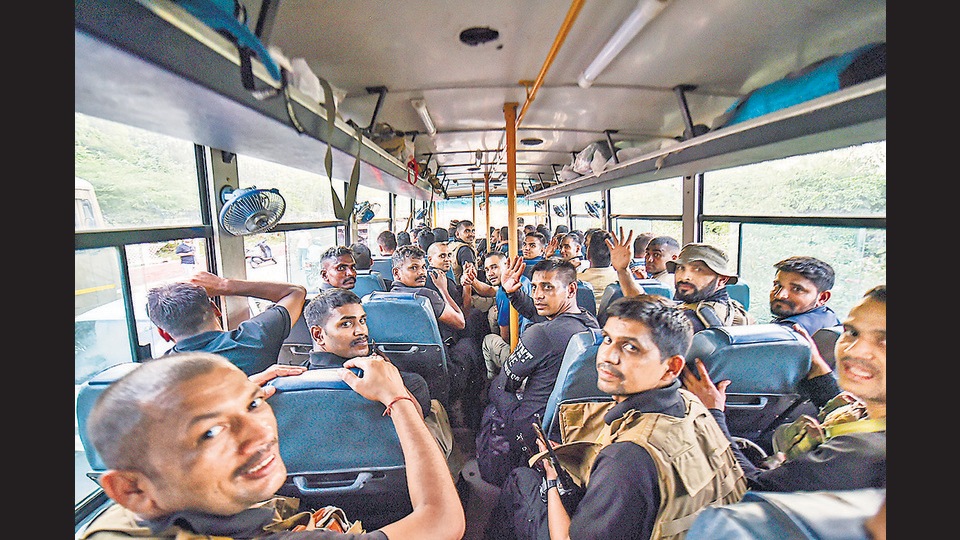
ITBP commandos arrive at Hindan Air Force Station after Indian Air Force's effort for safe evacuation from crisis-hit Afghanistan, in Ghaziabad, Tuesday (PTI)
The distance between the mission and the airport can usually be covered in about 20 minutes but the convoy with some 150 Indians, escorted by local Afghans known to the embassy staff, took nearly an hour to complete the journey on Monday night because of more than a dozen check posts set up by the Taliban.
While the Afghans occupied the lead and last vehicles in the convoy, personnel from the Indo-Tibetan Border Police were present in all the bulletproof cars carrying diplomats and other staff from the mission and a small number of Indian nationals. The threat perception for the convoy was high, especially following reports that “rogue elements” and Pakistani terrorists from groups such as the Lashkar-e-Taiba and the Haqqani Network were present alongside the Taliban in Kabul.
As the convoy travelled from Kabul’s “green zone”, the fortified diplomatic quarter with concrete blast walls and checkpoints that till recently housed many foreign missions, and passed key landmarks, messages were relayed to officials at the cabinet secretariat and external affairs ministry who were monitoring the evacuation of the ambassador and other diplomatic staff.
Adding to the concerns were reports that the Taliban, who had assumed control of the Afghan capital on Sunday after the collapse of the Ashraf Ghani government, had imposed night curfew in Kabul. Despite these reports, the decision was made to drive to the airport at night because traffic would be thin and it would be easier for the convoy to move relatively faster.
The convoy was stopped at a few Taliban check posts, where the local Afghans took care of formalities, and then made its way to the airport. It was only when all the vehicles were safely inside the military side of the airport, under the control of US troops, that officials overseeing the operation in Kabul and New Delhi heaved a sigh of relief. Any Indian nationals who made their way to the embassy were included in the convoy.
Ambassador Rudrendra Tandon, speaking to reporters after his return, said: “There are a lot of Indians who found themselves in distress because of the fast-changing situation. So, our policy was that anyone who reached the embassy was taken into the embassy. I don’t know how they managed inside the embassy but we were sure that they were safe and secure and there was an avenue for an exit.” The Indian mission in Kabul had 192 personnel, and everyone was evacuated “literally within three days”.
India began planning for the possible withdrawal of its staff more than six months ago, after the Taliban launched a major offensive in Afghanistan’s rural areas. Elaborate plans were put in place for all contingencies, with instructions from top leadership in New Delhi that the security of all Indian personnel was paramount. These plans included “red lines” that would trigger the evacuation of personnel from the embassy and two functional consulates in Kandahar and Mazar-e-Sharif, people familiar with matter said.
Once the Taliban entered Kabul on Sunday and the security situation became complicated, the decision was made to withdraw the diplomatic staff. However, the move was surrounded in secrecy even as the Indian side coordinated with the US and Afghan partners.
The C-17s flew over the Arabian Sea and Iranian airspace to avoid flying over Pakistan. “The return flight to India was the easy part. The tougher job was getting from the embassy to the airport,” said the person cited above.
External affairs minister S Jaishankar tweeted: “Movement of the Indian Ambassador and the Embassy staff from Kabul to India was a difficult and complicated exercise. Thank all those whose cooperation and facilitation made it possible.”
Rezaul Hasan Laskar is Foreign Editor with the Hindustan Times, which he joined in 2015. He began as a journalist in his hometown of Shillong in northeast India and has worked in newspapers and wire services over the years. He moved to New Delhi in 1997 and initially focused on defence, national security, Jammu and Kashmir and the northeast, while also working of foreign policy and international relations.
He has been part of the media delegation accompanying PMs on foreign visits and has reported from destinations ranging from Tibet to Ukraine. Between 2007 and 2013, he was the Press Trust of India correspondent in Pakistan, one of only two Indian journalists allowed to report from the country. He extensively covered Pakistan’s domestic politics and the life of the common people, as well as the fallout of the 2008 Mumbai attacks on India-Pakistan relations and the subsequent trial in Pakistan of the suspects involved in the attack. As part of his reportage in Pakistan, he travelled the breadth of the country, from the Swat Valley to Balochistan.
Reza’s first gig in journalism was writing a weekly music column, and music – especially classic rock – remains a keen interest. He is also a movie buff and a keen photographer.Read More

 E-Paper




 Prefer HTon Google