
 E-Paper



Eye on China, India and Japan decide to ramp up security, defence cooperation
The new arrangement pointed to the “indispensable role” of India and Japan for a free, open, peaceful and “coercion-free” Indo-Pacific region


NEW DELHI: With an eye on China, India and Japan on Friday unveiled a substantial revamp of their security cooperation, with the emphasis on contributing to each other’s defence readiness, coordination on risk assessments, collaboration between special forces and joint exercises focused on the Indo-Pacific.
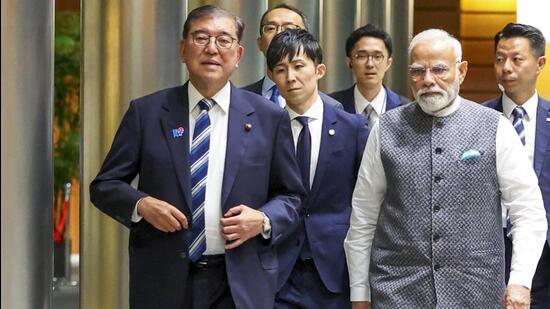
The Joint Declaration on Security Cooperation, issued after a summit meeting in Tokyo between Prime Minister Narendra Modi and his counterpart Shigeru Ishiba, provides a template for ramping up defence and security cooperation between the two sides, which has grown steadily over the past two decades. Security cooperation between India and Japan has also grown within the Quad format in this period.
The new arrangement – an update of a joint declaration adopted in 2008 – pointed to the “indispensable role” of India and Japan for a free, open, peaceful and “coercion-free” Indo-Pacific region and said the two sides will increase cooperation for their “national security and continued economic dynamism”. They will also deepen coordination on security issues of common concern in the Indo-Pacific and beyond, and uphold the international order based on the rule of law.
Also Read: At meeting with Modi, Japan says it will invest $68 billion in India over 10 yrs
A separate joint statement issued after the summit, without directly referring to China, said Modi and Ishiba expressed “serious concern” at the situation in the East China Sea and the South China Sea and strongly opposed any “unilateral actions” endangering freedom of navigation and overflight as well as any attempt to “change the status quo by force or coercion”.
In this context, the two PMs expressed “serious concern over the militarisation of disputed features” – a reference to China’s establishment of military facilities in the South China Sea – and said maritime disputes must be peacefully resolved in line with international law, especially the UN Convention on the Law of the Sea.
The Joint Declaration on Security Cooperation outlines specific activities whereby India and Japan can contribute to each other’s defence capabilities and readiness and promote interoperability and synergy between their defence forces. These activities include more sophisticated bilateral exercises between the defence forces, sharing assessments on emerging security risks, collaboration between special operations units, and enhancing the use of the Bilateral Agreement on reciprocal provision of supplies and services to share logistics.
The two sides will also work to establish a new meeting framework for a comprehensive dialogue between their joint staffs, explore tri-service exercises to prepare for humanitarian and disaster relief operations in the Indo-Pacific, cooperate in niche areas of each other’s priorities such as counter-terrorism, and cyber defence, and promote the use of each other’s facilities for repair and maintenance of defence platforms.
They will also focus on collaborating on chemical, biological and radiological defence, including detection, decontamination, and response strategies to safeguard forces and populations from these threats.
The joint declaration also focused on measures to promote naval and coast guard cooperation for a peaceful maritime environment in the Indo-Pacific, including enhanced situational awareness and cooperation for a common maritime picture through the Information Fusion Centre-Indian Ocean Region (IFC-IOR), increased law enforcement cooperation against piracy and transnational crimes at sea, and coordination on maritime law enforcement aid to third countries.
In the sphere of technological and defence industrial collaboration, the two sides will focus on resilience in sectors critical to national security by cooperating to co-develop and co-produce equipment and technology and easing export control policies to encourage collaboration in high-end technology and equipment.
India and Japan will also revamp their security cooperation to counter terrorism, radical extremism and organised transnational crimes through intelligence and experience sharing. They will build cyber resilience, including critical information infrastructure robustness, by sharing information, and expand the use of their space systems for national security, satellite-based navigation and earth observation.
Bilateral defence cooperation was hit after India carried out a series of nuclear tests in 1998, which were strongly criticised by Tokyo, though security collaboration has been driven since then by shared concerns about China and North Korea, whose nuclear programme was developed through cooperation with Pakistan.


