
 E-Paper



Fault lines emerging between partners BJP and JD(U) in Bihar
The BJP has been reluctant to touch the sensitive issue (as, indeed, any party in power in the Centre has been) for fear of a political backlash. A caste census was conducted in 2011 but its results were not released.


Signs of unease between the Bharatiya Janata Party and the Janata Dal (United) over issues including caste-based enumeration and the Pegasus snooping row have begun surfacing, nearly nine months after the parties formed a coalition government in Bihar.
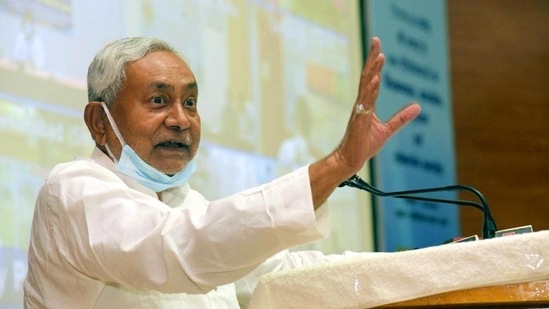
Bihar chief minister Nitish Kumar, along with a delegation of opposition leaders in the state, will meet Prime Minister Narendra Modi on August 23, to push for a caste-based census, a long-standing demand of many parties that believe the reservation system is no longer representative of the demographic split of the population across castes.
The BJP has been reluctant to touch the sensitive issue (as, indeed, any party in power in the Centre has been) for fear of a political backlash. A caste census was conducted in 2011 but its results were not released.
“Status quo-ist forces and those who are anti-change are against the decision to have a caste-based enumeration,” JD(U) general secretary KC Tyagi said, referring to the BJP’s reluctance to conduct a caste-based census. “These forces fear that if the percentage of OBCs is higher than the 52% recorded by the Mandal Commission, there might be a demand for more quota.”
He said that the JD(U) is also in favour of doing away with the present cap of 50% on all quotas.
The current reservation regime in India is based on the recommendations of the Mandal Commission dating back to the 1980s and a Supreme Court ruling capping reservations at 50%.
The Bihar assembly, in 2019 and 2020, passed a resolution seeking a caste-based census. Interestingly, the resolutions were supported by the BJP. A socio-economic and caste census was conducted by the Congress-led United Progressive Alliance in 2011. The caste data, however, was not released. India’s last caste census was conducted in 1931.
The demands for the caste-based enumeration come soon after the Bihar CM also called for a probe into the Pegasus snooping issue. “Phone tapping has been discussed for a long time. One never knows how one’s phone can be tapped these days. So, there must be a probe,” the chief minister said on August 2.
The BJP-led central government on Monday refrained from confirming or denying in the Supreme Court its use of the spyware for alleged surveillance.
The Pegasus row erupted on July 18 after an international investigative consortium reported that the phones of Indian ministers, politicians, activists, businessmen and journalists were among the 50,000 that were potentially targeted by Pegasus, Israeli company NSO Group’s phone hacking software.
Another instance of fissures between the alliance partners emerged on Wednesday when Bihar water resources minister Sanjay Jha countered the Union government’s claim that 14.6 million water connections were provided in the state under the Centre’s Jal Jeevan Mission (JJM) for rural households.
Jha said that 87% of rural households in the state have access to clean tap water and credited the state government for the achievement. “Thanks to vision of Hon CM Shri @NitishKumar, 87% of Bihar rural households have access to clean tap water,” he said in a tweet on Wednesday.
Asked if a difference of opinion on key issues would hurt the alliance, a JD(U) leader speaking on condition of anonymity said that both the parties were working to fulfil their individual commitments.
“The BJP has been working to fulfil its ideological concerns, whether it is the construction of the Ram Temple or abrogation of Article 370 to nurse its constituency. We are not a frontal organisation (of the BJP), we are a separate party that has the right to nurse our constituency without confrontation,” the leader said.
Meanwhile, there are speculations in the state that the JD(U) cadre wants the party to contest the Manipur and Uttar Pradesh assembly elections next year on its own. “There is a sense among party workers that to retain its position as a bigger partner in Bihar and to increase its presence across the country, the JD(U) should contest elections on its own and not rely on allies,” the second JD(U) leader cited above said.
To be sure, the BJP actually won more seats than the JD(U) in the 2020 assembly elections -- 74 to 43 in the 243-member assembly.
Tyagi said that the party’s priority is to continue its alliance with the BJP, even as he said that the JD(U) can contest independently in the two states in case no agreement can be reached with the BJP. “We have conveyed to the Prime Minister and the party leadership that we are keen to contest as allies and we are hopeful of a positive response. But if that does not happen, we will contest alone,” he said.
BJP’s Bihar MLC Sanjay Mayukh, however, downplayed the divergence. “Sometimes, parties that are members of the NDA contest elections independently. But as far as the NDA alliance in Bihar and at the Centre is concerned, it is unified for the development of the people,” he said.
In July, JD(U) leader RCP Singh was inducted into the Union cabinet as minister for steel.


