E-Paper



File of shame, says UN secy general as IPCC sounds now-or-never warning
The IPCC report underlined that the average annual GHG (green house gas) emissions in the past decade were higher than any previous decade and limiting global warming to 1.5°C is beyond reach without immediate deep emissions reduction across all sectors

 Prefer HTon Google


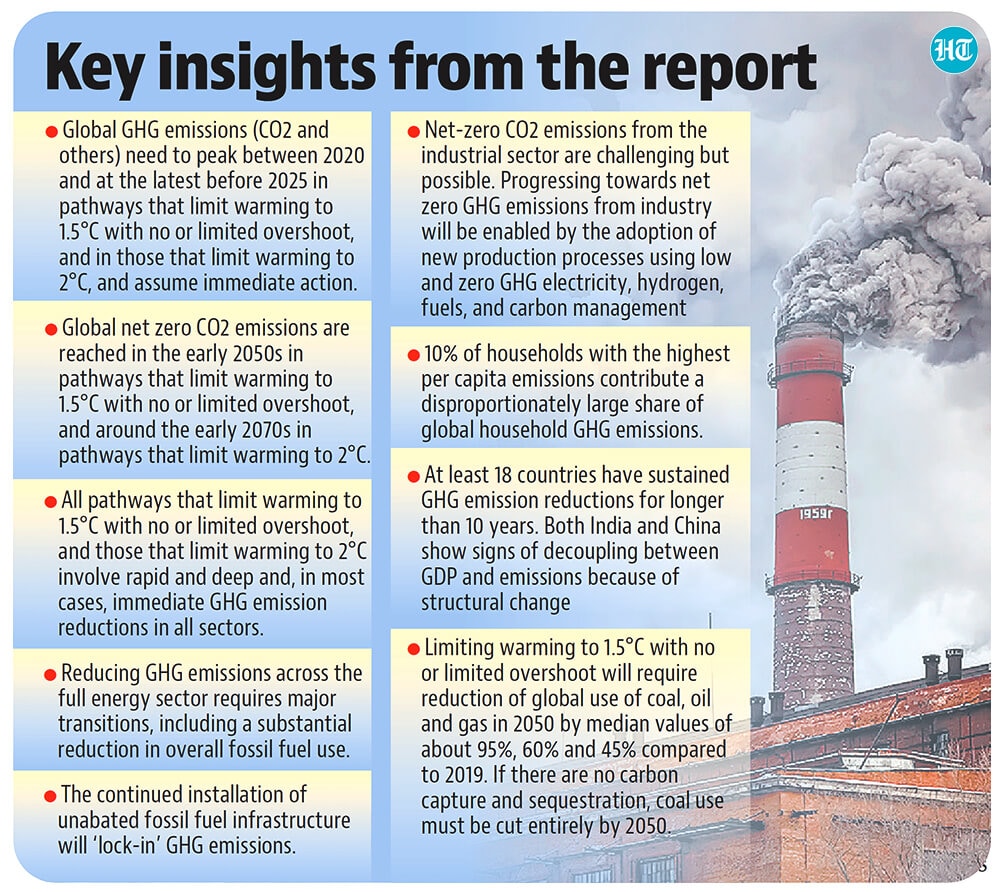
The amount of greenhouse gases like CO2 emitted by the world needs to at most peak by 2025 followed by a 43% reduction over the next 10 years in order to limit global warming to 1.5°C by the year 2100, the Intergovernmental Panel on Climate Change (IPCC) said on Monday, calling for immediate action with a warning that policies implemented till the end of 2020 will add more emissions and lead to a rise of 3.2°C by the end of the century.
The IPCC, the pre-eminent body of environmental experts from around the world working under the United Nations, released the report of its Working Group III to analyse the state of efforts and what is required to stave off the climate crisis that many experts believe is already leading to irreversible, catastrophic effects.
The report warned that average annual GHG (green house gas) emissions in the past decade were higher than any previous decade: emissions between 2010-19 were around 12% and 54% higher than in 2010 and 1990, respectively despite the IPCC’s repeated warnings that the time to limit dangerous global warming is running out.
The rate of growth of GHG emissions, however, has slowed in the past decade, the report said.
For India, some findings are particularly significant. These include the depleting carbon budget to keep global warming under 1.5°C; lack of climate finance for energy transition, and the IPCC’s stress on moving away from fossil fuel-driven infrastructure. It means that India has a very small pie of the global carbon budget to grow.
Global financial flows from developed countries are a factor of three to six times lower than levels needed by 2030 to meet the Paris Agreement goal of keeping global warming under 2°C. The IPCC, however, states that there is sufficient global capital and liquidity to close investment gaps. Access to global capital will depend on clear signalling from governments on their efforts to transition to a low carbon economy, the report said.
If global CO2 emissions continue at current rates, the remaining carbon budget for keeping global warming to 1.5 degree C will likely be exhausted before 2030.
“The next few years will be critical in scaling up mitigation action. That’s one of the key takeaways from the report. The focus should now be on limiting damage and doing as much as we can in short run,” said Navroz Dubash, professor at the Centre for Policy Research, a think tank, and coordinating lead author of the IPCC report.
GHG emissions in 2030—based on implementation of nationally determined contribution (NDCs) -- announced before COP 26 last year are unlikely to limit global warming to 1.5 degree C, the report has said.
“The jury has reached a verdict. And it is damning. This report of the Intergovernmental Panel on Climate Change is a litany of broken climate promises. It is a file of shame, cataloguing the empty pledges that put us firmly on track towards an unliveable world. We are on a fast track to climate disaster: Major cities under water. Unprecedented heatwaves. Terrifying storms. Widespread water shortages. The extinction of a million species of plants and animals. This is not fiction or exaggeration,” said UN Secretary-General, António Guterres during the launch of the report. “It is what science tells us will result from our current energy policies. We are on a pathway to global warming of more than double the 1.5-degree limit agreed in Paris,” he added.
The report, however, offers some positives. Since 2010, there has been sustained decrease of up to 85% in the costs of solar and wind energy, and batteries, it found. There are also large increases in the deployment of electric vehicles (EVs).
An increasing range of policies and laws have enhanced energy efficiency, reduced rates of deforestation and increased the deployment of renewable energy, the report highlighted. “We are at a crossroads. The decisions we make now can secure a liveable future. We have the tools and know -how required to limit warming,” said IPCC chair Hoesung Lee.
Reducing GHG emissions across the full energy sector requires major transitions, including a substantial reduction in overall fossil fuel use, the report stressed. “The continued installation of unabated fossil fuel infrastructure will ‘lock-in’ GHG emissions.”
Both the messages on the lower costs of renewable energy and moving away from fossil fuels are important for India.
Speaking at the Glasgow climate summit on November 1 last year, PM Modi announced that India’s non-fossil energy capacity will reach 500 GW by 2030, meeting 50% of the country’s energy requirements by then. He said that India will reduce its total projected carbon emissions by one billion tonnes by 2030, reduce the carbon intensity of its economy by 45% by 2030, over 2005 levels, and achieve net-zero emissions by 2070.
Modi also added in Glasgow that such ambitious action will be impossible without adequate climate finance from developed nations, calling on rich countries to make $1 trillion available as climate finance “as soon as possible.” Energy transition away from coal in India will not take place in the “foreseeable future”, the coal ministry said in the Rajya Sabha last week, although the government will promote renewable energy.
Dubash in his chapter ‘Policy and Institutions’ in the report has provided an overview of the policies countries such as India can consider, which includes setting up institutions or commissions to oversee energy transition and mitigation and consider climate legislation to ensure its implemented.
“Having the right policies, infrastructure and technology in place to enable e changes to our lifestyles and behaviour can result in a 40 -70% reduction in greenhouse gas emissions by 2050 . This offers significant untapped potential , ” said IPCC Working Group III co -chair Priyadarshi Shukla, in an IPCC statement on Monday.
The IPCC has stressed that cities and urban areas can play an important role in emissions reductions. These can be achieved through lower energy consumption (such as by creating compact, walkable cities), electrification of transport in combination with low -emission energy sources.
“The latest IPCC report is a stark reminder to all developed countries to significantly bring forward their transition to a net-zero economy. This would leave additional carbon space for countries like India to meet their development priorities on the path to achieving their net-zero target. Further, to accelerate the low-carbon transition in the Global South, developed countries should ensure higher flows of finance and technology transfer in critical areas such as renewables, electric vehicles, green hydrogen, and others. Failure to arrest the planet’s warming to 1.5 degrees Celsius is likely to cause irretrievable damage to our ecosystems, which in turn could disproportionately devastate the economies and vulnerable communities in the Global South,” said Arunabha Ghosh, CEO, Council on Energy, Environment and Water.
While recognising that the global carbon budget to meet the 1.5°C goal is now almost exhausted, the IPCC report has underlined that countries at all stages of economic development seek to improve the well -being of people, and their development priorities reflect different starting points and contexts which should be considered.
“Inequalities in the distribution of emissions and in the impacts of mitigation policies within countries affect social cohesion and the acceptability of mitigation and other environmental policies. Equity and just transitions can enable deeper ambitions for accelerated mitigation,” the report has said.
The chapter on “Investment and Finance” has also highlighted that abysmal climate finance flows from developed countries have affected energy transition in developing countries. “Finance to reduce net GHG emissions and enhance resilience to climate impacts is a critical enabling factor for the low carbon transition. Fundamental inequities in access to finance as well as finance terms and conditions, and countries’ exposure to physical impacts of climate change overall, result in a worsening outlook for a global just transition,” the report has said.
The 1.5°C target is crucial since, the IPCC said in 2018, the difference between limiting the rise by an additional 0.5°C over a previous threshold of 2°C could lead to 420 million fewer people being exposed to extreme heatwaves, cut the risk of heavy rain and extreme drought, and reduce the risk of catastrophic flooding.