
 E-Paper



Five years on, Mamata’s Krishak Bazar project finds few takers
The Krishak Bazars (farmer markets) were a dream project of the Mamata Banerjee government which came to power in 2011 while championing the cause of farmers in Singur and Nandigram.

 Prefer HTon Google


It was Saturday and the haat (weekly market) at Gosaba in South 24 Parganas district was bustling with activity, men and women from adjacent villages pouring in to buy all kinds of stuff from vegetables, fish, poultry, groceries, plants, fertilizers and fish nets to bangles, saris and cosmetics sold there.
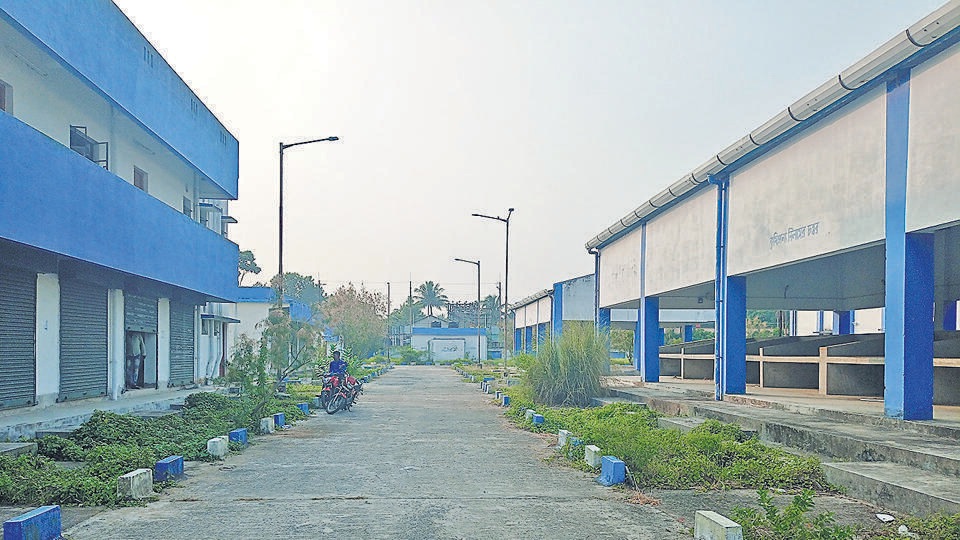
But less than a kilometre away from the main market, the Krishak Bazar that was built by the Mamata Banerjee government a few years back, wore an abandoned look. The huge iron gate was locked. The auction hall, open market shed, godown and the administrative building were also closed. The weigh bridge had started to rust and there was no security at the premises.
Except for the office of the block’s assistant director of agriculture in one building, none of the facilities wore any signs of having been utilised in recent times. Being a weekend, the government office was closed.
“The Krishak Bazar was constructed around five years back for the vendors who sell vegetables, fruits and poultry products in the Gosaba market. But none of the vendors moved there because of its odd location. Who would like to shift to a new mandi which has been built at least a kilometre away from the main market?” said Palash Das, a local shopkeeper.
Vendors of Gosaba market said that the local block administration had tried to coax and even force the vendors to shift there at least twice since 2019. But all efforts went in vain.
The Krishak Bazars (farmer markets) were a dream project of the Mamata Banerjee government which came to power in 2011 while championing the cause of farmers in Singur and Nandigram. In 2012, the West Bengal State Agriculture Marketing Board took up the project of constructing Krishak Bazars across the state.
“There are some Krishak Bazars which have remained unutilised. We are trying to form vendor and farmer committees to run the Krishak Bazars. In some cases, the Krishak Bazars have come up at a distance from the main market which is why vendors and farmers were not willing to shift there,” said Becharam Manna, the state’s agricultural marketing minister.
With all modern facilities including auction halls, weigh bridges, open sheds and store rooms, the Krishak Bazars were launched for farmers and vendors so that they could sell their products.
“Till date 186 such facilities have come up across the state in three phases at a cost of around ₹1,080 crore. But many of these facilities still remain either unused or severely underutilised as there were no takers. In most cases the bazars had come up far away from local markets and hence the vendors refused to shift,” said a senior government official.
Kamal Bansfore, Rajani Bansfore and Kabita Bansfore, the three-cleaning staff of the Salbari Krisak Bazar near Siliguri in north Bengal have been waiting for seven years for the kisan mandi to become fully operational.
The main gate of the bazar remains shut six days a week. Only for a few hours on Sunday morning, fish and vegetables are sold. Here too, people hold the odd location as the prime reason as to why no vendors moved in.
“When you already have a full-fledged regulated market in Siliguri, the idea of coming up with a kisan mandi at a distance of hardly 4 kilometres was wrong,” said Bishu Sharma, a ginger and cardamom farmer from Lava, a village in Kalimpong district.
At Suti in Murshidabad district, the Krishak Bazar houses the office of the block agriculture officer. It shifted there a few months ago. While no vendors have moved in, the vacant space is now being used to produce compost and for training civic volunteers attached with the district police.
Examples of such unutilised Krishak Bazars can be seen in other districts too, be it Howrah, North 24 Parganas, Hooghly or Burdwan. At Raina block in East Burdwan, the Krishak Bazaar now houses a tea stall, a jewellery shop, a garage and a shop dealing in automobile parts.
The state government, however, said that of the 186 Krishak Bazars only one has not been functional. The rest are functional either fully or partially such as at Singur in Hooghly or at Hanskhali in Nadia.
“Of the 186 Krishak Bazars only one facility at Kaliachak in Malda has not been operational. The rest are. At least 130 are fully functional where vendors have moved in and around 55 are partially functional. The shops and sheds have all been allotted. In some places the vendors have not moved in because of some local issues,” said A Subbiah, secretary of the state agricultural marketing department.
The agricultural marketing department is holding discussions with other departments, including food processing, animal husbandry and health, on how to utilise the facilities that have been constructed by spending crores of rupees.
“Some of the stalls would be used by the food processing department for procurement of paddy once the harvesting starts. Discussions have also been held with the animal husbandry department so that some stalls they may use for storage and other purposes,” said Subbiah.
(With inputs from Pramod Giri and Sreyasi Pal)


