
 E-Paper



Five-state electoral battle starts with 1st phase today
Assembly elections in Mizoram and Chhattisgarh have begun, marking the start of a crucial round of elections in five states in India.

 Prefer HTon Google


A crucial round of assembly elections across five states will commence on Tuesday with voting in the northeastern state of Mizoram and in 20 constituencies in Chhattisgarh, marking the beginning of an exercise billed as a virtual semi-final before the general elections next summer.
Also Read | 60,000 troops deployed for Chhattisgarh polls; 50 CAPF companies in Mizoram
Elections will be held on November 17 in Madhya Pradesh and the other 70 seats in Chhattisgarh. Rajasthan will go to the polls on November 25, and Telangana on November 30. Results for all five states will be declared on December 3. Apart from deciding who will govern these five states, which together send 83 representatives to the Lok Sabha, the results will also have a bearing on how the Bharatiya Janata Party (BJP), the national political hegemon approaches the national elections in 2024, and on seat-sharing negotiations between members of the opposition INDIA bloc.
Twelve of the 20 seats going to the polls in Chhattisgarh are in the Maoist-infested Bastar region, with polling officials, state police personnel and additional paramilitary staff being transported to sensitive booths since last Saturday. Election Commission of India (ECI) personnel said that given the risk attached, polling in 10 constituencies will end at 3pm, and at the usual 5pm in the rest.
Also Read | Chhattisgarh election Phase 1: Key constituencies and candidates
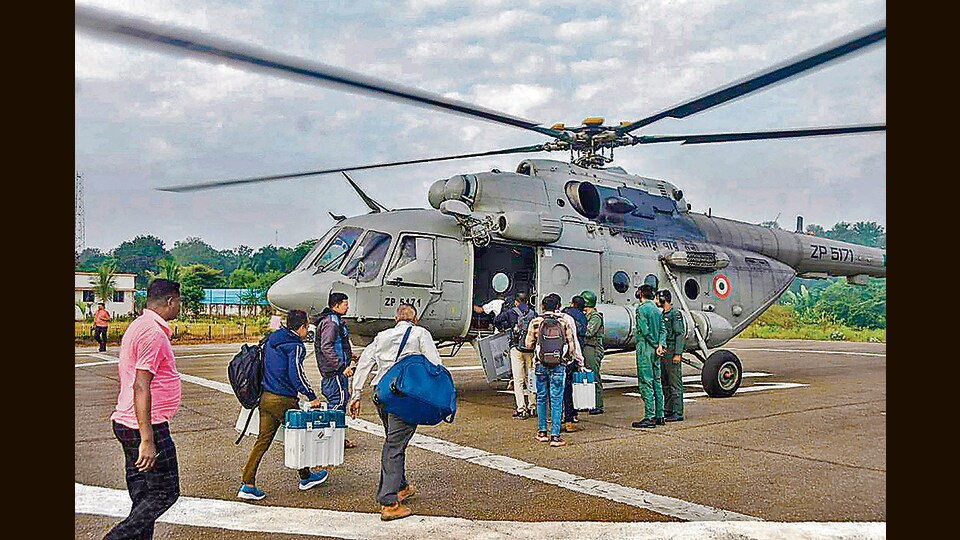
Officials said that over the past two days, helicopters were pressed into service to airlift electronic voting machines, poll personnel and other paraphernalia to 158 booths in five districts. Senior police officials also said these polls have 126 new polling booths in areas that were inaccessible before due to Maoist influence.
“To detect the influence of Maoists in the worst-hit areas, drones will also be used extensively, particularly in the four districts of Dantewada, Bijapur, Sukma and Narayanpur,” said Bastar inspector general of police P Sundar Raj.
Also Read | Mizoram Assembly election: A look at key candidates and constituencies
In 2018, the Congress won 17 of the 20 seats on offer in the first phase, eventually winning 68 of the 90 seats in the assembly in a landslide victory. Former chief minister and BJP leader Raman Singh is among the key candidates in the first phase, fighting from Rajnandgaon seat. Among other important candidates are state Congress chief and member of Parliament Deepak Baij and state ministers Mohammad Akbar and Kawasi Lakhma.
The Congress has replaced six sitting lawmakers in these 20 seats that have 223 candidates in the fray, 5,304 polling booths and 4.78 million voters.
Senior Congress leaders said that they were confident of repeating their 2018 performance. “We are banking on our work in the last five years and the promises we have made in our manifesto,” said RP Singh, Congress spokesperson.
The BJP said that the Congress will lose 15 seats in the phase. “We feel we are ahead in most seats, and have the clear edge in terms of candidates,” said Sacchidanand Upasane, senior BJP leader and spokesperson.
In Mizoram, a total of 857,063 people will vote across 1,276 polling stations, with 174 candidates in the fray.
“Around 6,000 poll personnel, 3,000 policemen of state police plus 50 companies of paramilitary personnel will be on duty,” said Madhup Vyas, chief electoral officer, Mizoram. Officials said that they expected poll percentages to be high. The voter turnout was 81.31% in 2018, slightly higher than 80.82% in 2013.
The contest in the state is between the ruling Mizo National Front, the Zoram People’s Movement (ZPM), the Congress and the BJP.
In 2018, the MNF returned to power in Mizoram after a decade, defeating the Congress in its last bastion in the Northeast, winning 26 of the 40 seats with a voteshare of 37.70%. The Congress came third with five seats and 30% of the votes. The ZPM, which was formed in 2017, pipped the Congress as the second-biggest party with eight seats, and the BJP won one seat.
The MNF — a constituent of the BJP-led National Democratic Alliance (NDA) and North East Democratic Alliance (NEDA) — has contested the polls on its own, with chief minister Zoramthanga hitting out at the Centre for its alleged mishandling of the violence in neighbouring Manipur. While the MNF, Congress and ZPM are contesting all 40 seats, the BJP has put up candidates in 23. “We need 21 seats to form the government. It is my expectation that we will win at least 25 and even more,” Zoramthanga said.
The Opposition is also confident. “The response we have got from voters gives us confidence of returning to power,” Congress state chief Lalsawta said.
ZPM president Lalduhoma said, “Our main contest is with the MNF, which I think will come second. Congress is a spent force in Mizoram and BJP is not a force to be reckoned with in our state.”
BJP Mizoram president Vanlalmuaka said that his party would be part of the next government.

-kW0H-U20214218012MgB-250x250%40HT-Web.jpg)


