E-Paper



For nursing colleges in Madhya Pradesh, hospitals without patients
HT’s on-ground reporting found at least 12 nursing colleges seemingly operating without an attached and functioning hospital

 Prefer HTon Google


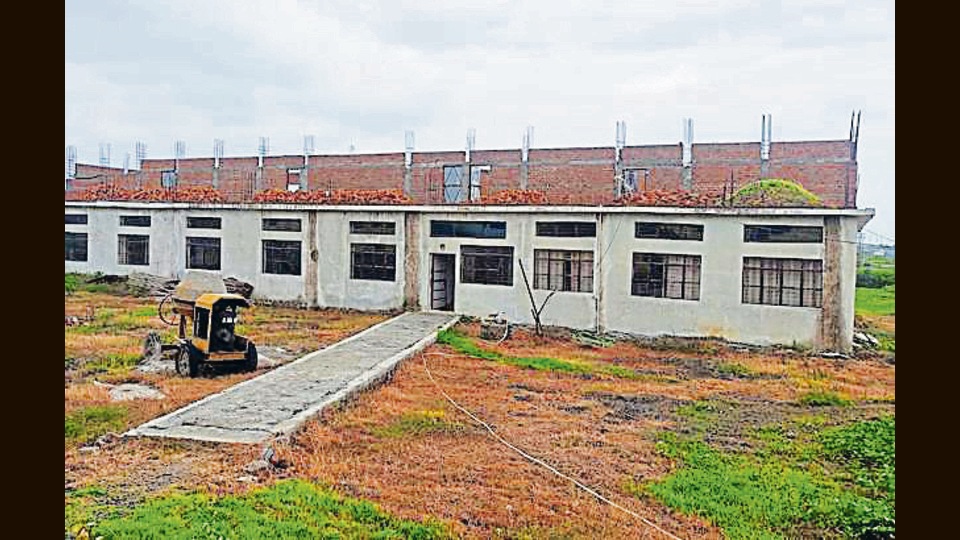
In Athakheda village of Jabalpur, 350km east of Bhopal, stands the Mahakaushal University. The structure is imposing, painted white, with three floors, and a green campus. Started in 2021, the university offers 55 courses across 11 streams, and has a total of 250 students. One of the courses is a Bachelor’s course in nursing. To fulfil government regulations, the university also has a 100-bed hospital, complete with an OPD, operation theatre, and a 10-bed intensive care unit – all at least on paper. There is just one problem. The hospital is deserted, no people are allowed to enter, and all the rooms, including the ICU, are all locked.
The Madhya Pradesh Nursing Sikshan Sansthan Manyata Adhiniyam 2018 has prescribed guidelines which say that all nursing colleges in the state must have at least a 100-bed hospital to get recognition. According to rule 4(3), the minimum requirement for both a General Nursing and Midwifery course and a BSc (Nursing) course is a 100-bed hospital. Clause 3(c) of the rules, however, provides relaxation from this provision if the colleges are in notified Scheduled Tribe (ST) areas in the state, spread across 89 development blocks in 10 districts of Madhya Pradesh.
On January 11, 2022, Vishal Baghel, president of the Law Student Association, approached the Madhya Pradesh high court alleging widespread fraud in nursing colleges in Madhya Pradesh. Specifically mentioning the lack of hospitals in nursing colleges in contravention of the rules, Baghel said that 70% of nursing colleges in the sate were operating without hospitals. On May 12, based on directions of chief justice Ravi Malimath and justice Purushaindra Kumar Kaurav of the high court, the Madhya Pradesh Nursing Council was asked to produce records of all 453 nursing colleges in the state.
In the second part of a three-part investigative series on the spread of nursing colleges in Madhya Pradesh, HT’s on-ground reporting found at least 12 nursing colleges in the state seemingly operating without an attached and functioning hospital across the districts of Sagar, Jabalpur, Gwalior and Morena.
On August 5, HT visited the Mahakaushal University Hospital and found it locked, with no patients and no doctors. The person in-charge of the nursing college and hospital, Shirish TiwarI, said, “There is a hospital present inside the university but I will show you later as today the vice chancellor has come on a visit.”
And so HT went back, on August 18, and found the hospital’s doors open – but just that. There was a reception, a general ward, an operating theatre, and an ICU. There were monitors and beds. The OT had beds, but no lights. All the rooms, however, were locked.
In the building, there were four people, all residents of a neighbouring village, working as a caretaker, sanitation worker, and guards. There were no patients and no doctors. Asked if there was anybody other than them in the hospital, a guard, who did not want to be named, said, “What hospital? A hospital needs doctors and many other things. This is just a dummy structure.”
Confronted with this information on August 18, Tiwari said, “The hospital is located in a rural area so hardly any patients come, which is why the hospital is not operational. We have staff and doctors, but in the absence of patients, they are not being summoned. In the first batch (2021-22), 22 students enrolled and online classes are being conducted. The students are being sent to private hospitals and government hospitals for practice. I cannot tell the name of every hospital where they are going. There is a doctor we have, whose hospital is in the city, and we are converting it into a 100-bed hospital.”
Rampant problem
It’s a story that’s common – 514km away from Jabalpur, in Baraua, which has nine nursing colleges in a 5km radius, 23-year-old Ranjeet Singh, who has lived in the village all his life, said there are buildings, but no hospitals. “We do not know what happens in these closed buildings, but there is no hospital here. We go to the Morar district hospital or GRMC for treatment if anyone falls unwell in our village, which are 17km and 23km away respectively.”
The owner of the Awadh Nursing college in Baraua Anand Singh said that they do have a hospital inside the building but it is not functional, and students go to the district hospital, and a PHC (primary health centre) in Dabra to practice. The other functional college in town, VIPS Gwalior, which has more than 200 students and runs three courses of nursing including a post graduate degree, also said it has no “parent hospital.” Principal Dileep Singh Parmar said, “The college doesn’t have any parent hospital. The students practice at the district hospital in Morar.”
HT found one hospital in Baraua, on AB road with a board that says “SBM Hospital 24x7”. The hospital, which has 100 beds, and trauma and emergency facilities, is deserted. It is owned by Jitendra Singh Bhadoriya, and was opened in March .The manager of the hospital, Brijesh Singh, said that it was this hospital that served two nursing colleges together, Aditya School of Nursing and MPS College, both of which he owns. MPS College lost recognition of the state Nursing Council earlier this month. “The hospital is for the practice of nursing students but they are not willing to come as they are practising on their own so it is closed,” he added.
Singh also said that there was a staff crunch. “We are not getting enough staff to run the hospital. We started hiring in April this year but hardly anyone has shown interest.”
A private hospital owner from Gwalior, whose hospital is attached to a private nursing college to provide training and equipment, told HT: “Nursing colleges tie up with us for money – ₹8 lakh to ₹10 lakh for a year. The students never come to our hospital, but we are attached to them so they get recognition. Some colleges even take machines, beds and other materials on rent for 10 to 15 days.” He asked not to be named.
HT found several colleges that claim they use the government district hospital as their attached hospital. This is not against the rules; according to a letter released by the registrar of MP Nurses Registration Council on October 12, 2021, beds in government hospitals can be allocated for training to nursing colleges, if they are available. But there is an important caveat – none of these colleges can claim they are solely dependent on government institutions for their affiliation. They still need attached hospitals.
Only, these often exist only on paper.
Violations unchecked
At Lidhora Hat village in Sagar, the two-floor campus of Sagar College of Nursing, which started five years ago, seems deserted and parts of it are still under construction. Records and the college website show that it has 60 nursing students as well as a hospital within its campus. HT, however, found no hospital building on a visit on August 2. College director, Colonel RSP Selvan, said, “I don’t have any hospital. Our students practice at the Sagar district hospital.”
Sagar district hospital civil surgeon Jyoti Chouhan denied this claim. “Only students of one college, Ojaswani College, are allowed to practise in the district hospital. Whoever told you that students of any other college practise here is lying,” she said.
Sagar district collector Deepak Arya said, “The nursing colleges come under the medical education department. If they direct us to inquire or we receive any complaint, only then do we take action. As of now, we haven’t received a complaint against Sagar Nursing College.”
Former president of the state private colleges association and owner of four nursing colleges, JN Chauksey, said, “A large number of bogus nursing colleges have been created in Madhya Pradesh. They neither have staff nor do they have an attached hospital. This is important because in the nursing syllabus, 80% is practical training, but these colleges only provide degrees.”
Amulya Nidhi, health expert and convener of Jan Swasthya Abhiyan, said, “Where are the parent and affiliated hospitals of these registered nursing colleges? What is the health department doing about these bogus hospitals? District Chief Medical and Health Officers (CMHOs) who give recognition to these hospitals must be probed. This is a scam that should be probed by a central agency.”
MP Nurses Registration council and medical education department director, Jiten Shukla, said, “The council experts hold inspections regularly but now we will change the way we conduct it. We will also hold the inspection committee responsible if any irregularities are reported.”
Health minister Prabhuram Choudhary said, “Our teams inspect these hospitals. If we find any problem as you are saying, we will take action.”
Choudhary added that after the death of eight people in a fire at the New Life Multispeciality Hospital in Jabalpur on August 1, the health department had decided to inspect all hospitals before August 31. “We will cancel the recognition in case of any violation of rules.”