
 E-Paper



‘Forced conversions affect nation’s security’: Supreme Court urges Centre to step in
Forced religious conversions are “dangerous” and they affect the security of the nation, the Supreme Court emphasised on Monday, as it urged the Union government to “step in” and apprise the court of the measures being taken to prevent such occurrences.

 Prefer HTon Google


Forced religious conversions are “dangerous” and they affect the security of the nation, the Supreme Court emphasised on Monday, as it urged the Union government to “step in” and apprise the court of the measures being taken to prevent such occurrences.
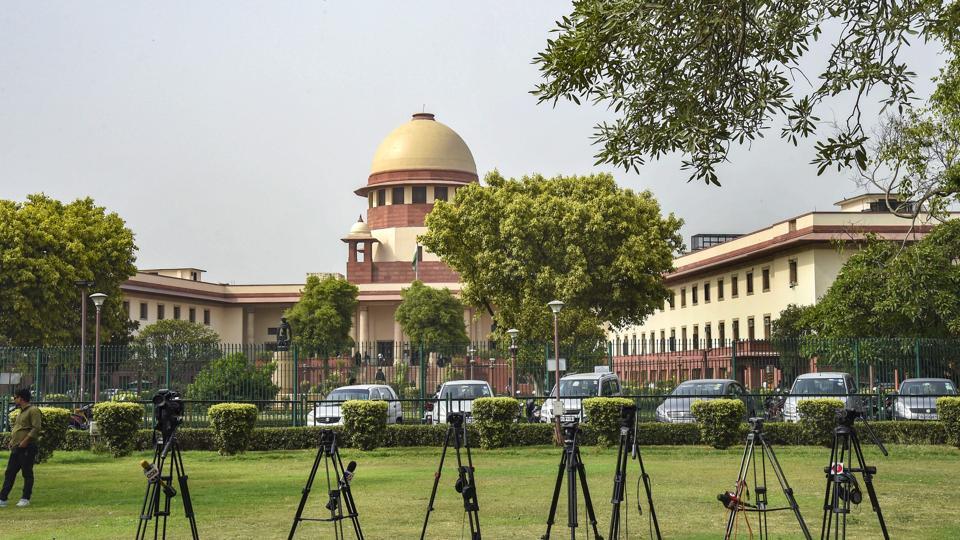
A bench of justices MR Shah and Hima Kohli gave the Centre one week to finalise its stand on the issue of forced conversions and submit an affidavit, detailing the steps taken so far, and also those being contemplated to rein in the menace.
“This is a very serious matter. It is seriously against interest of nation. Everybody has right to choose religion but not by force or by giving some temptation. It is a very dangerous thing,” observed the bench, as it took up a public interest litigation (PIL) filed by advocate Ashwini Upadhyay, who has sought stringent steps to control religious conversion through fraud and intimidation.
On September 23, the court issued notices to the Union ministries of home affairs, and law & justice, to file their counter affidavits. However, there was no affidavit filed by the Centre when the matter was taken up by the bench on Monday.
“Why have you not filed your counter? This is a very serious matter and sincere efforts are to be made,” the bench asked solicitor general Tushar Mehta, who appeared for the Centre.
On his part, Mehta pointed out that there have been state legislations to prevent forced conversions and the Supreme Court affirmed them when such laws were challenged.
“There may be a freedom of religion, but no freedom on forced conversion. What steps have been taken by the Union of India? Otherwise, it is very difficult...please, make your stand very clear. What action you propose to take? Conversion is under the Constitution but not forcible conversion,” retorted the bench.
At this point, the SG gave instances where allurements are made to convert one’s conscience by offering rice and wheat in certain parts of the country. “In tribal areas, this is rampant,” he added.
The bench replied: “So, now you step in.”
The court then issued a short order, seeking the government’s affidavit by November 22 and fixing the matter on November 28.
“The issue with respect to alleged conversion of religion, if it is found to be correct and true, is a very serious issue which may ultimately affect the security of the nation as well as the freedom of religion and conscience of the citizens. Therefore, it is better that Union government may make their stand clear and file counter on what further steps can be taken by Union and/or others to curb such forced conversion maybe by force, allurement or fraudulent means,” stated the bench in its order.
Upadhyay, in his petition, contended that the central government has failed to control the incidents of forced conversions, which are rampant among the economically under privileged people, particularly those belonging to the scheduled castes and scheduled tribes. This, he said, not only offends constitutional rights of equality, life and liberty, religion but is also against the principles of secularism, which is integral part of basic structure.
History of anti-conversion law in IndiaIndia has a long history of anti-conversion laws which can be dated back to pre-Independence era. While the British did not enact any law, many princely states did so to restrict the missionary activity. Some of the examples of such legislations are: Raigarh State Conversion Act, 1936, Patna Freedom of Religion Act, 1942, Sarguja State Apostasy Act, 1945, Udaipur State Anti-Conversion Act, 1946. Further, specific laws against conversion to Christianity were enacted in Bikaner, Jodhpur, Kalahandi and Kota.
After Independence, in 1954, Parliament took up for consideration the Indian Conversion (Regulation and Registration) Bill. Six years later, another law, the Backward Communities (Religious Protection) Bill, 1960, was proposed to stop conversion. Both bills failed in parliament want of support. The last attempt made at a central legislation was in 1978 when an All India Freedom of Religion Bill was introduced in Lok Sabha by Morarji Desai’s Janata Party government. However, it was never discussed, and was dropped after the government fell in July 1979.
Orissa, Madhya Pradesh and Arunachal Pradesh passed anti-conversion laws in 1967, 1968 and 1978 respectively. Later, similar laws have bene passed by at least seven more states, including Gujarat, Himachal Pradesh, Chhattisgarh, Jharkhand, Uttarakhand, Uttar Pradesh and Karnataka.
A Constitution bench in Rev Stainislaus Vs State of Madhya Pradesh (1977) upheld the anti-coversion laws of Orissa and Madhya Pradesh, saying freedom to propagate one’s religion, as stipulated under Article 25 (1), did not grant a fundamental right to convert another person. The bench ruled that a “purposive conversion” would impinge on the “freedom of conscience” guaranteed to all citizens.



