E-Paper



HT@Belem: Fossil fuel exit road maps take centre stage at COP30
Brazilian President, Luiz Inácio Lula da Silva is expected to attend COP30 on Wednesday to see through the processes and meet negotiators from various blocs

 Prefer HTon Google


The Brazilian COP30 Presidency is sprinting. It is now implementing a new dynamic in negotiations, to bring parties to agree on the most contentious, political texts by the middle of the week. Normally, COP decisions happen late in the week, with extension by a day or two being the norm.
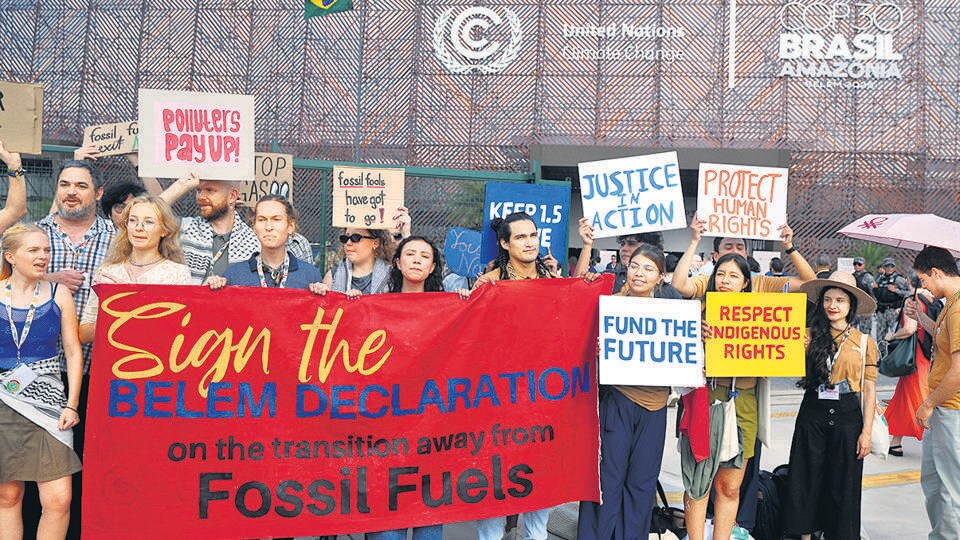
New iterations of several texts – the cover text or the Mutirao text (collective effort), on adaptation, just transition, mitigation, etc., – were to be released later Wednesday at the time of this writing, and were to be agreed upon the same night, according to officials. Belem is 8.5 hours behind IST.
This follows a hectic Tuesday night when negotiators stayed up, thrashing out their differences.
Brazilian President, Luiz Inácio Lula da Silva is expected to attend COP30 on Wednesday to see through the processes and meet negotiators from various blocs. President Lula is pushing for the provision of roadmaps for moving away from fossil fuels to be in Belem package. He is likely to also push for a decision on deforestation, according to negotiators. These issues are not a part of negotiations though. They are big ticket announcements that the Lula administration wants to achieve out of Belem, outside the negotiations.
Over 80 countries who support Lula were represented in a press conference on Wednesday demanding a plan to help countries get off fossil fuels fairly and faster. Among them were France, Germany, the Marshall Islands, Sierra Leone, the UK, Kenya and Colombia. Lula is also expected to meet ministers from India, Indonesia, China and Latin American countries after his arrival.
At COP28, it was agreed that countries will transition away from fossil fuels.
EU has said they support the call for a roadmap for a just, orderly and equitable transition away from fossil fuels, as part of the urgent response to accelerate implementation and alignment of Nationally Determined Contributions (national emission reduction targets) with the 1.5 degrees C limit. “EU will be pushing for a fossil fuel phase out roadmap,” Wopke Hoekstra, European Commissioner for Climate, Net Zero and Clean Growth, said.
Developing countries, however, have demanded something concrete on article 9.1 which mandates that developed countries provide financial assistance for mitigation and adaptation, and a tripling of adaptation finance. For EU, article 9.1 is a red line. “It was decided last year. I do not think we should open the decision on New Collective Quantified Goal here,” Hoekstra said on Wednesday.
But, COP 30 President, André Corrêa do Lago said several developing countries are yet to come on board on the proposal for roadmaps. Indian delegates said they are not aware of such a decision and pointed out that it is outside of the negotiations.
On forests, HT reported on November 8 that India will join the Brazil-led Tropical Forests Forever Facility (TFFF) only as an observer, citing the comments of India’s ambassador to Brazil, Dinesh Bhatia, on the second day of the Belém Leaders’ Summit.
TFFF is an initiative that incentivises the conservation and expansion of tropical forests by making annual payments to tropical forest countries that maintain their standing forest.
It was endorsed by 53 countries — both those with rainforests and those without — on the day of its launch, including China, Canada, UAE, Finland, the United Kingdom, Japan, Australia, Indonesia, Germany, Antigua and Barbuda, Armenia, Bolivia, Ecuador, Colombia, the Democratic Republic of the Congo, Rwanda and Peru. In total, 34 tropical forest countries endorsed the TFFF Declaration, covering over 90% of the tropical forests in developing countries.
Both of these issues, deforestation and fossil fuels may be a difficult call for India which is the world’s largest source of energy demand growth according to the International Energy Agency.