
 E-Paper



Full statement: How India responded to Pakistan PM Shehbaz Sharif's ‘absurd theatrics’ at UNGA
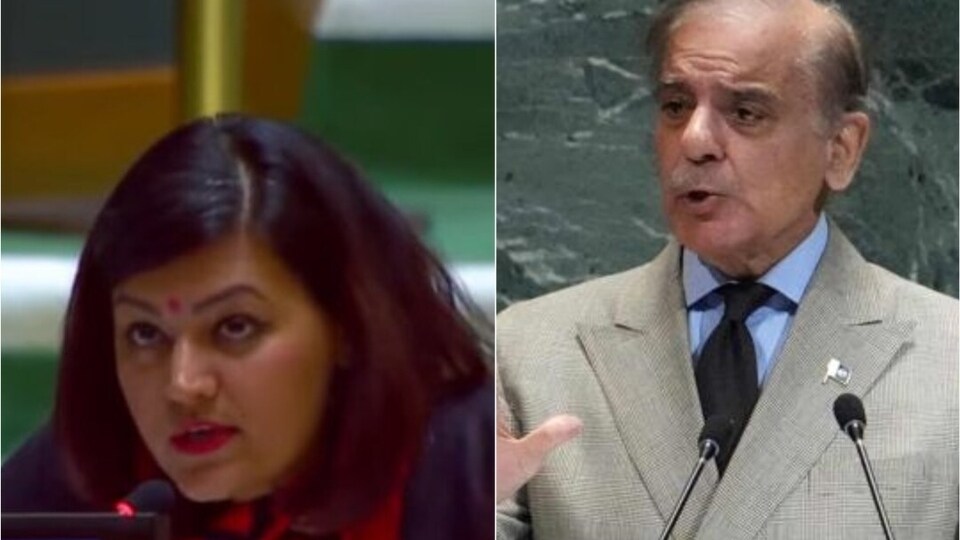
India's Permanent Mission to the UN, Petal Gahlot, said Pakistan must immediately shut down all terror camps and hand over to us the terrorists wanted in India.


India on Friday slammed Pakistan Prime Minister Shehbaz Sharif for glorifying terrorism through his speech at the United Nations General Assembly. In the statement, the first secretary in India's Permanent Mission to the UN, Petal Gahlot, said no lies can conceal the facts that Pakistan at the UN Security Council on April 25, shielded ‘The Resistance Front’, a Pakistani-sponsored terror outfit.
Here is India's response: Full text
Mr. President,
This Assembly witnessed absurd theatrics in the morning from the Prime Minister of Pakistan, who once again glorified terrorism that is so central to their foreign policy.
However, no degree of drama and no level of lies can conceal the facts. This is the very same Pakistan which, at the UN Security Council on 25 April 2025, shielded ‘The Resistance Front’, a Pakistani-sponsored terror outfit, from the responsibility of carrying out the barbaric massacre of tourists in the Indian Union Territory of Jammu and Kashmir.
Also read: India slams Shehbaz Sharif's UNGA speech: 'No shame… Pakistan sheltered Osama bin Laden'
Mr. President,
A country long steeped in the tradition of deploying and exporting terrorism has no shame in advancing the most ludicrous narratives to that end. Let us recall that it sheltered Osama bin Laden for a decade, even while pretending to partner in the war against terrorism. Its Ministers have just recently acknowledged that they have been operating terrorist camps for decades. It should come as no surprise that once again, this duplicity continues, this time at the level of its Prime Minister.
A picture speaks a thousand words, and we saw many pictures of terrorists slain in the Bahawalpur and Muridke terror complexes by Indian forces during Operation Sindoor. When senior Pakistani military and civilian officials publicly glorify and pay homage to such notorious terrorists, can there be any doubt about the proclivities of this regime?
The Prime Minister of Pakistan also advanced a bizarre account of the recent conflict with India. The record on this matter is clear. Till 9 May, Pakistan was threatening more attacks on India. But on 10 May, its military pleaded with us directly for a cessation to the fighting. The intervening event was the destruction caused to multiple Pakistani airbases by Indian forces. The pictures of that damage are, of course, publicly accessible. If destroyed runways and burnt-out hangars look like victory, as the Prime Minister claimed, Pakistan is welcome to enjoy it.
The truth is that, as in the past, Pakistan is responsible for a terrorist attack on innocent civilians in India. We have exercised the right to defend our people against such actions and have brought the organisers and perpetrators to justice.
The Pakistani Prime Minister has spoken about wanting peace with India. If he is indeed sincere, the pathway is clear. Pakistan must immediately shut down all terrorist camps and hand over to us the terrorists wanted in India.
It is also ironic that a country which wallows in hate, bigotry and intolerance should preach to this Assembly on matters of faith. The political and public discourse of Pakistan reflects its true nature. Clearly, a look by them at the mirror is long overdue.
Mr. President,
India and Pakistan have long agreed that any outstanding issue between them will be addressed bilaterally. There is no room for any third party in that regard. This is our longstanding national position.
Where terrorism is concerned, we are making it clear that there will be no distinction between the terrorists and their sponsors. Both will be held accountable. Nor will we allow terrorism to be practised under the cover of nuclear blackmail. India will never bow to such threats. India’s message to the world is clear: there must be zero tolerance for terrorism.
I thank you, Mr President.
During his address at the General Debate of the 80th session of the UN General Assembly on Friday, Shehbaz Sharif referenced 'Operation Sindoor' and claimed that "seven Indian jets" were damaged during the four-day conflict in May. The Pakistani leader also mentioned India’s decision to suspend the Indus Waters Treaty following the Pahalgam terror attack, calling it an act of war.


