
 E-Paper



Gandhis lose SPG cover, to get Z+ security
The decision to remove the SPG security to Congress president Sonia Gandhi and her two children – Rahul Gandhi and Priyanka Gandhi Vadra — the family of members of former prime minister Rajiv Gandhi who was assassinated in May 1991 —was taken after a security review.

 Prefer HTon Google


The Special Protection Group (SPG), an elite force that protects prime ministers and their immediate families, will stop guarding Congress president Sonia Gandhi and her two children – Rahul Gandhi and Priyanka Gandhi Vadra – who will now be provided Z-plus security by the Central Reserve Police Force (CRPF), officials said on Friday.
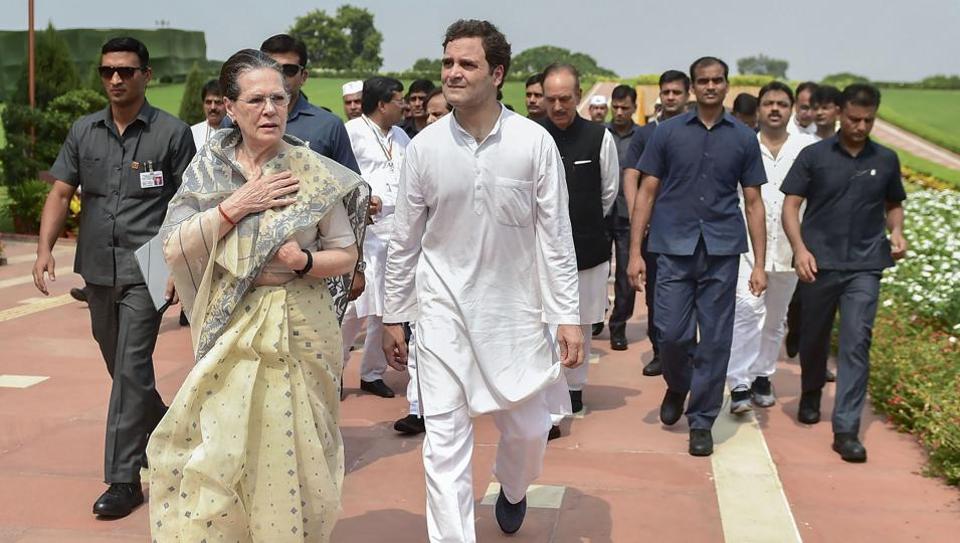
The decision to remove the SPG security to the family of members of Rajiv Gandhi, the former prime minister who was assassinated in May 1991, was taken after a security review, a senior home ministry official said on condition of anonymity. “The threat perception of each of those protected by the SPG is reviewed every year,” he added.
With the move, Prime Minister Narendra Modi will become the only person currently protected by SPG.
The decision triggered strong reactions from Congress leaders, and prompted the party’s workers to stage a protest outside Union home minister Amit Shah’s residence.
A third official, who did not wish to be named, said the Gandhi family’s SPG cover was getting extended by the central government annually for the past 28 years. After this year’s review, it was decided to replace the SPG security with Z-plus security for the Gandhi family, the official said.
In addition to the Z-plus security, they will have the facilities of all-India Advanced Security Liaison (ASL), bullet-proof cars and jammers, and stringent anti-sabotage measures, he added.
In a way, there are no changes in security measures, only the agency is changed, the third official said, adding that it was advised that since the SPG comes to know of the PM’s movements and other sensitive information, it should be used only for the PM’s protection.
The elite force was set up to provide security to PMs and then former PMs. The rules were later amended to provide SPG cover to the families of former PMs.Former PM Rajiv Gandhi’s family was provided security by the force in October 1991, months after he was assassinated by the Liberation Tigers of Tamil Eelam (LTTE).
The latest move by the government invited sharp reactions from the Congress. The party accused the Bharatiya Janata Party (BJP)-led government of personal vendetta and endangering the life of the Congress chief and her children.
Congress spokesperson Anand Sharma said the decision was “shocking and vindictive”. “It makes the family vulnerable. Not to forget that two members of the family, former prime ministers Indira Gandhi and Rajiv Gandhi, were assassinated. The state has a duty to protect and the SPG cover was not a favour,” he said.
Congress leader KC Venugopal said that the government was playing with the lives of the Gandhi family members.
Reacting to reports of the government move, Rahul Gandhi tweeted: “A big thank you to all my brothers & sisters in the SPG who worked tirelessly to protect me & my family over the years. Thank you for your dedication, your constant support & for a journey filled with affection & learning. It has been a privilege. All the best for a great future.”
The government recently changed former PM Manmohan Singh’s security from SPG to Z+ after a similar security review. The CRPF now protects him.
The SPG Act, enacted by Parliament in 1988, was initially supposed to provide security to only the prime minister and his or her immediate family members and to the former prime ministers of the country for 10 years. In 2003, the Act was amended and the time frame of 10 years was reduced to one year.
SPG provides what is called “proximity security” to protectees. The outer security ring comprises the local police. Apart from this, restrictions are imposed on traffic when an SPG protectee such as the PM moves from one place to another. Under ASL, venues are scrutinised and cleared before the visit of a protectee.
(With inputs from PTI)


