
 E-Paper



Govt blames Cong panel for school textbook controversy
The Karnataka government on Thursday tried to corner the Congress over the school textbook controversy, stating it was the Congress-led revision committee that had tried to “hide atrocities under Muslim rulers, glorify them and remove references of Hindu kings and kingdoms”


The Karnataka government on Thursday tried to corner the Congress over the school textbook controversy, stating it was the Congress-led revision committee that had tried to “hide atrocities under Muslim rulers, glorify them and remove references of Hindu kings and kingdoms”.
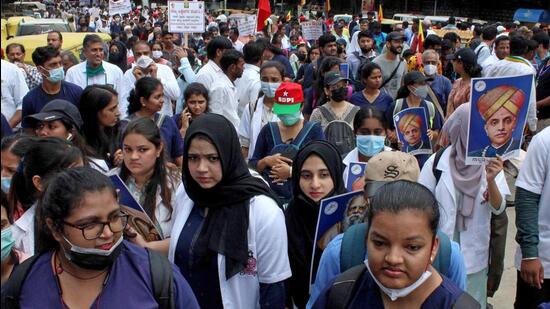
Interestingly, a nearly two-hour-long press conference here was addressed by revenue minister R Ashoka and not education minister BC Nagesh.
Ashoka said the response was from the “government” and not from any single department or minister.
Ashoka, who took two days to prepare for the press conference, said a textbook revision committee set up by the BJP-led government had placed all right aspects of history to be taught to children during its rule between 2008-2013.
He said during the Congress rule between 2013-18, then chief minister Siddaramaiah formed another committee under noted writer Prof Baraguru Ramchandrappa, to “remove all references of Hindu kings and culture in order to appease the minorities”.
“The reason for this change was that there were several mentions of Hindu... Like the mention of Hindu Mahasagara which has been changed to Indian Ocean. From the times of Ramayana and Mahabharatha, it has been referred to as Hindu Mahasagara. They wanted to remove this word Hindu. There were several mentions of Gods like Rama, Krishna, Eshwara, Rajuts, Shivaji but none of these that the Congress liked and named a committee to remove them. There has been a constant feeling to appease minorities that they (Congress) made changes to the textbooks which is now clear,” Ashoka said.
The minister refused to answer any question on Rohit Chakrathirtha, who headed the latest textbook review committee. He said there were just seven to eight mistakes in the latest textbook while there were over 150 mistakes during the Congress era books.
The statements come at a time when the textbook row in Karnataka continues to burn with new revelations of “errors, exclusion and distortions” coming out every day. A HT analysis and comparison of school textbooks for Kannada medium students from 6th to 10th grades reveals nuanced editing, a carefully-crafted effort to selectively remove references to various historical personalities and events that have shaped young and impressionable minds for generations across India.
The now disbanded Rohit Chakrathirtha-led revision committee has come under sharp criticism for offending almost every major community and pro-Kannada groups among other sections for the “distortions” made to school textbooks and an effort to saffronise them.
Activists and academics say there was an attempt not just to remove factual references to historical personalities but also to change the meaning of these references with careful editing that only a trained and fluent academic eye can pick up.
So contentious has been the changes that almost every large community representative has raised objections to the portrayal, omission or distortion of specific personalities who are revered by the state.
Former prime minister HD Deve Gowda and several influential seers, writers and the civil society at large have raised objections to new textbooks and contents, which they add has been done to “distort” history and teach only aspects which the Rashtriya Swayamsevak Sangh, the ideological parent of the BJP, believe.
The textbook also replaced the map of Indian states and its capitals in the 8th grade textbooks. A chapter on the principles of India’s foreign policy has been removed from the 10th grade social science textbook.
Though religion and Dharma, the vernacular version of the same word, is deliberately used to create a clear distinction in school textbooks, activists allege. “Religion is a European concept. The belief is that this starts with one defined person and about one person and one community. Every religion has a sacred text,” according to the new 8th grade textbooks.
“In Bharata (India) Jews, Christian and Islam are the only ones that can be called a religion. Buddhism, Jainism and various traditions (Sampradaya) are different from religion. They can be distinguished and identified as believers and non-believers in them. Those traditions (Sampradaya) who believe in Vedas are called theist traditions. Those who do not believe in Vedas are non-believers or atheists. Dharma refers to a concept of a way of life,” the book reads.
There are also references in which Buddhism and Jainism are referred to as “Muth” (in Kannada) meaning sect to project the same as coming under the umbrella of Hindu or Sanatana Dharma or Hinduism. The appropriation of all “Dharmas” under Hindus and all “religion” as foreign, experts said, was part of the “saffronisation” process that attempts to isolate communities based on their identities.
“This is the RSS notion of Dharma which is being fed to children by creating these concepts. In some places Buddhishm and Jainism is referred to as Muth than a religion and isolating Christianity, Islam and Jews as foreign and not native to India is mischievous. There are also false narratives spun around Buddhism and Jainism which is an attempt to distort history,” Harshakumar Kugwe, a Bengaluru-based social activist, said.
“We are not against any review, the idea of which should be progressive and newer ways of scientific temperament should be groomed. Let us say that we (Congress) have made mistakes (during its textbook review) but where have we disrespected people? That means that they are agreeing that Buddhism, Jainism, Sikhism are a part of Hinduism and that there is something wrong with the constitution. They are ok with the fact of disrespecting Tirthankaras by calling them ‘Ivanu and Avanu’ (singular tone),” Priyank Kharge, Congress legislator, told HT on Thursday.
A cursory glance, inputs from activists and others show that around 27 writers, mostly who belong to backward, Dalit and minority communities, have been replaced by largely Brahmin writers.
Ashoka said the edited versions of its mistakes will be circulated to schools in a separate booklet within a fortnight.


