
 E-Paper



‘Greater responsibilities’ in focus as Modi, Xi, Putin get together at SCO meet amid US tariff tension
PM Modi was warmly welcomed by President Xi Jinping as both said they are committed to improving ties; plan to expand investments in backdrop of tariffs

 Prefer HTon Google


Prime Minister Narendra Modi attended the official reception of the Shanghai Cooperation Organisation (SCO) Summit in Tianjin, China, on Sunday evening, amid renewed bonhomie between the Asian giants.
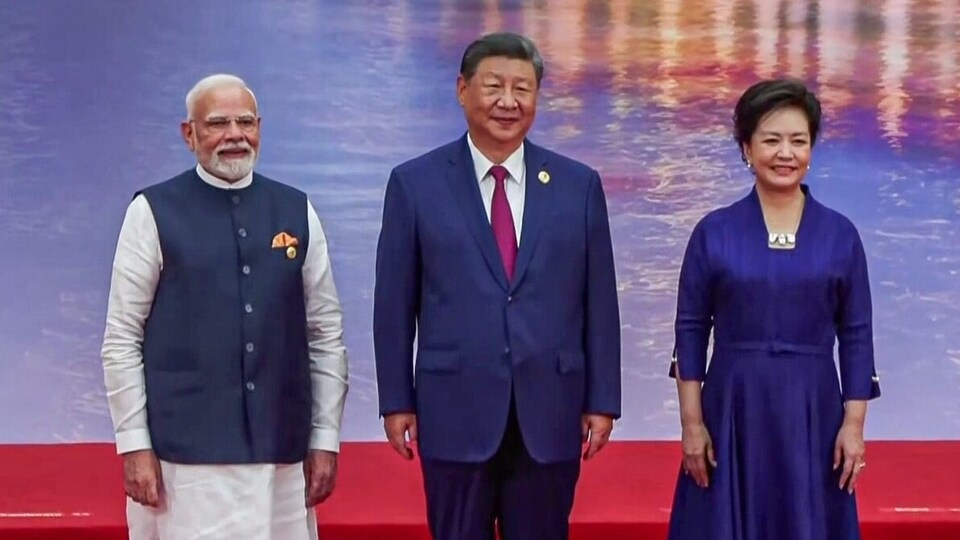
He was warmly welcomed by Chinese President Xi Jinping as both have said — having held one-on-one talks too — that they are committed to improving ties. They also plan to expand trade and investments against the backdrop of US trade tariffs imposed by President Donald Trump.
At the reception, Xi told leaders that the SCO now bears "greater responsibilities" for safeguarding regional peace and stability, and for boosting development of various countries, Chinese state news agency Xinhua reported.
PM Modi is in China for the first time in seven years to attend the two-day meeting of the SCO.
Russian President Vladimir Putin and other leaders from Asia and the Middle East — including India's western neighbour Pakistan with whom there were serious hostilities earlier this year — are in attendance in a show of Global South solidarity.
On his social media handles, PM Modi posted a series of photos with leaders from some of the member nations and invitees.
These included President Mohamed Muizzu of the Maldives who had originally come to power on an anti-Indian influence plank but has since acknowledged the importance of the ties. “India’s developmental cooperation with Maldives is greatly beneficial for our people,” Modi wrote in the caption for their photo together.
Shehbaz Sharif and Modi stand far apart
Among other leaders from the immediate neighbourhood, PM Modi posted photos with Nepal's KP Oli, calling the two countries' ties “deep-rooted and very special”; and with Senior General Min Aung Hlaing of Myanmar. Modi said he hopes there are free and fair elections soon in Myanmar.
There was no immediate report of any interaction with Pakistan's Shehbaz Sharif as India has stuck to its position of “no talks until terrorism is stopped”. In the official group photo, too, Modi and Sharif were seen standing quite far apart, with at least persons between them.

Modi also met Mostafa Madbouly of Egypt, Alexander Lukashenko of Belarus, Emomali Rahmon of Tajikistan, Kassym-Jomart Tokayev of Kazakhstan, Pham Minh Chinh of Vietnam, Thongloun Sisoulith of Lao PDR, Nikol Pashinyan of Armenia, and Serdar Berdimuhamedow of Turkmenistan.
Founded in 2001, the SCO originally had China and Russia as the main members, along with four Central Asian states of Kazakhstan, Kyrgyzstan, Tajikistan and Uzbekistan. It was originally seen as a foil to US influence in Central Asia. India and Pakistan were added to the original group in 2017; Iran in 2023, and Belarus in 2024. Leaders of other states are invited too.
Progress in India-China ties after Modi-Xi meet: Key points
The Modi-Xi meeting, the highlight of the summit, came just days after Washington imposed an additional 25% tariffs as penalty on India for buying Russian oil, on top of the 25% that came into effect early August. This massive 50% rate visibly pushed Modi and Xi to align against western pressures.
Modi has said the India-China ties should not be seen through the lens of a third country. "We are committed to progressing our relations based on mutual respect, trust and sensitivities," Modi told Xi during the meeting on the sidelines of the summit, according to a post on his official X account.
According to an Indian foreign ministry press release about the meeting, Modi said an atmosphere of "peace and stability" has been created on the Himalayan border. This area saw a prolonged military standoff after deadly clashes in Galwan in 2020. Since then, the ties were frozen in many areas of cooperation.
Modi added that an agreement had been reached between both nations regarding border management, without giving details. The neighbours share a 3,800 km (2,400 miles) border that is disputed since the 1950s.
"We must ... not let the border issue define the overall China-India relationship," Xinhua reported Xi as saying.
Direct flights between both nations, which have been suspended since 2020, are being resumed, Modi added. And China had agreed to lift export curbs on rare earths, fertilisers and tunnel boring machines during a key visit to India by its foreign minister Wang Yi.
China opposes Washington's steep tariffs on India and will "firmly stand with India," Chinese Ambassador to India Xu Feihong has said.
"Both India and China are engaged in what is likely to be a lengthy and fraught process of defining a new equilibrium in the relationship," said Manoj Kewalramani, a China-India expert at the Takshashila Institution think tank in Bengaluru, told Reuters.


