
 E-Paper



Gwalior car's kiss marks, tinted glass, loud silencers: Which violations can invite trouble for Delhi-NCR motorists
The Gwalior incident has highlighted motor vehicle laws, especially in the national capital, and the modifications that can land vehicle owners in trouble.

 Prefer HTon Google


In a bizarre show of love, a woman spent hours leaving 3,400 lipstick marks on her partner’s car, leading him to pay a ₹5,500 fine and receive an order to remove the marks in Madhya Pradesh's Gwalior.
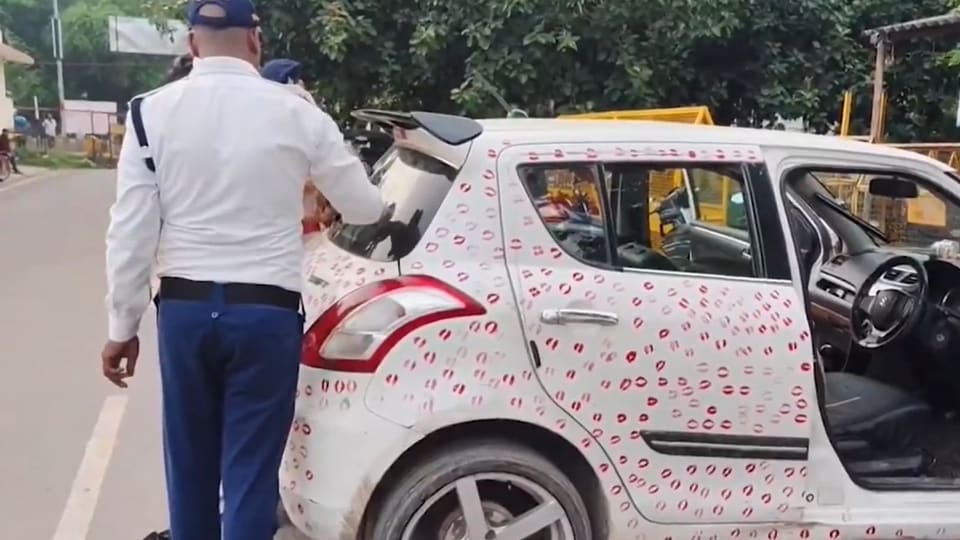
Car owner Aditya Sikarwar told local media that his girlfriend did it as a part of a “foreign trend” and social media stunt. However, none of them was aware that it was illegal.
Traffic police traced the vehicle after it had been on the road for two days and imposed a fine on its owner under the Motor Vehicles Act.
The incident has highlighted motor vehicle laws, especially in the national capital, and the modifications and practices that can land vehicle owners in trouble.
‘Owner cannot freely alter vehicle’
A senior Delhi Traffic Police officer said a vehicle owner cannot freely alter a vehicle after purchasing it from a manufacturer, news agency PTI reported.
"When someone buys a vehicle from a showroom, it complies with the prescribed traffic and motor vehicle guidelines. For any further changes, one has to take permission, which will be examined by the competent authority. Whether the permission should be granted or rejected is decided after verification and on the basis of the reason for which the owner wants to make the change," the officer said.
Under Section 52 of the Motor Vehicles Act, vehicle alterations are subject to regulations, particularly when they result in the vehicle differing from the specifications recorded in the registration certificate or those provided by the manufacturer. In cases where an alteration is permitted, prior approval from the registering authority may be required.
The officer added that owners could face action for modifications that significantly alter a vehicle’s appearance or deviate from its original specifications.
"Any modification that changes or hides the original identity or make of the vehicle, changes its entire colour without the required permission, or involves prohibited fittings such as tinted glass can land the owner in trouble under the Motor Vehicles Act. Depending on the nature of the violation, enforcement authorities can also take action against or impound the vehicle as permitted under law," he said.
Tinted glass prohibited
Among the most common violations of the Motor Vehicles Act is tinting of glasses. According to Delhi Traffic Police, black films or extra tinting are prohibited.
Provisions say that factory-fitted glass must allow at least 70 per cent visible light transmission through the windscreen and rear window and 50 per cent through side windows, according to news agency PTI.
‘Loud aftermarket silencers another concern’
The officer further flagged loud aftermarket silencers as a common violation, particularly among motorcycle owners.
Under the Central Motor Vehicles Rules, vehicles must be equipped with silencers and adhere to prescribed noise limits. Owners cannot treat a modified exhaust as a permissible alteration simply because the motorcycle remains otherwise roadworthy.
‘Additional lights, improper use of high beams’
Similarly, vehicle owners can face enforcement action for installing excessively powerful headlights, unauthorised additional lights or using high beams improperly. In densely populated urban areas, high-beam lights can dazzle other road users and are therefore subject to traffic regulations.
The officer also pointed to pressure horns and multi-toned horns as prohibited modifications. Vehicle owners are not permitted to install horns that produce excessively loud, harsh, shrill or alarming sounds, according to PTI.
‘Use of Press’
The use of “Press” stickers or other official-looking markings on private vehicles can also invite scrutiny, particularly when they falsely imply an official status or breach prescribed vehicle-marking rules.
Similarly, owners cannot change the registered colour of a vehicle or carry out major structural alterations at will. Such changes may require approval from the relevant authorities and corresponding updates to the vehicle’s registration records.
The officer said motorists should not assume that a modification is legal simply because it does not interfere with the vehicle’s mechanical performance.
“Every vehicle owner must follow the prescribed traffic and motor vehicle rules. Before making any alteration, they should check whether permission is required rather than making the change first and approaching the authorities later,” he said, as per PTI.
‘Delhi Traffic Police enforcement drive’
Recently, the Delhi Traffic Police conducted a week-long citywide enforcement drive targeting violations that pose a serious threat to the safety of motorists, pedestrians and other road users.
During the drive, 7,675 challans were issued for wrong-side driving, while 22,992 motorists were fined for riding without helmets and 1,568 for triple riding.
The enforcement campaign also focused on e-rickshaws operating at congestion-prone locations. Traffic police issued 7,298 challans to e-rickshaw drivers for various violations and impounded 63 vehicles for offences warranting such action.
The traffic police said it would also launch a citywide operation to identify and take action against vehicles that fail to comply with prescribed norms.
(With inputs from PTI)


