
 E-Paper



HC puts Assam-Meghalaya border agreement on hold
On March 29, Meghalaya chief minister Conrad K Sangma and his counterpart Himanta Biswa Sarma signed an agreement to end the disputes by erecting boundary posts to demarcate the disputed areas. Home minister Amit Shah had described the development as “historic”.

 Prefer HTon Google


The Meghalaya high court has ordered an interim stay on an agreement between the state and Assam to demarcate the border in at least six of the 12 contested locations that often raised tensions between the two states. The stay order will stay in effect till the next date of hearing on February 6 next year, the court said.
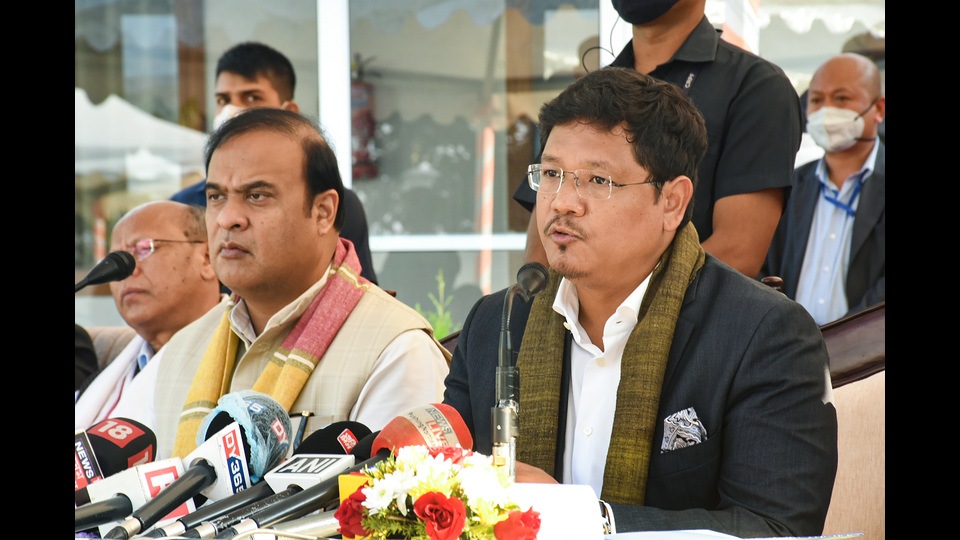
On March 29, Meghalaya chief minister Conrad K Sangma and his counterpart Himanta Biswa Sarma signed an agreement to end the disputes by erecting boundary posts to demarcate the disputed areas. Home minister Amit Shah had described the development as “historic”.
Hearing a petition against the agreement on Thursday, Justice H S Thangkhiew said: “It is however understood that during the intervening period, no physical demarcation or erection of boundary posts on the ground, pursuant to the MoU dated 29.03.2022 shall be carried out, till the next date (February 6, 2023).”
In their petition, four “traditional chiefs” of Meghalaya -- Syiem of Hima Jirang R Hamberly Wahlang, Acting Syiem of Hima Mylliem Ainam Manik Syiem, Sirdar of Nonglang Sirdarship Phoslasly Nianglang and Acting Syiem of Hima Nongspung Erald Jyrwa -- have alleged that the MoU was signed “without consulting or taking the consent of or involving the constitutionally recognised native chiefs and their durbars”. They said the MoU violated provisions of the Sixth Schedule as the Khasi Hills Autonomous District Council has been conferred powers on subjects such as land, water, soil, local customs and culture.
The Sixth Schedule deals with special provisions for administration of tribal areas.
The petitioners also alleged that the pact was “in-principle contrary to the provision of Article 3 of the Constitution under which Parliament exclusively is competent to alter the area or boundaries of existing states”.
Meghalaya was carved out of Assam in 1972 and the states share a 733-km boundary. Over the years, the two neighbouring states have witnessed several skirmishes between various communities inhabiting the border areas. The two sides decided to resolve the areas of dispute in a phased manner.
In the first phase earlier this year, the two governments decided to resolve the dispute in Gizang, Tarabari, Boklapara, Khanapara-Pilingkata, Ratacherra and Hahim.
The governments ultimately agreed that Assam would retain 18.51 sq km of the total 36.79 sq km disputed land in the disputed areas.
The two states preferred to resolve these six “relatively less complicated” areas in the first phase before moving to resolving the remaining six “complicated” points of discord in the second phase.
In the second phase, the two sides were looking forward to resolving differences in Langpih, Borduar, Deshdoonreah, Block-I-II, Pisar-Khanduli and Nongwah-Mawtamur (Garbhanga) areas.
In the agreement signed between the two states in March this year, it was decided that the Survey of India will conduct a survey, after which the demarcation would take place.
On Thursday, advocate P Sharma, appearing for the petitioners, argued that if the demarcation is done as per the agreement, the plea to stop the exercise would become infructuous.
The high court then directed the Union government to file an affidavit on the petition on the next date of hearing.
“Looking into the nature of the matter and the submissions made by the learned AG, it appears that an objection in the form of an affidavit is necessary to be filed to enable this court to consider the interim prayer as prayed by the applicants/petitioners... The learned AG is accordingly permitted to file objections to the interim prayer and to the maintainability of the writ petition,” it said.


