
 E-Paper



Hindi is mask, Sanskrit is the hidden face: Stalin on govt spending on languages
Tamil Nadu chief minister M K Stalin highlighted a Hindustan Times report on the government spending on Sanskrit and the five other classical languages

 Prefer HTon Google


Chennai: Tamil Nadu chief minister M K Stalin on Tuesday alleged that the Bharatiya Janata Party (BJP)’s real intention is to impose Sanskrit and Hindi is only a facade, while highlighting a Hindustan Times report which revealed that Sanskrit had got the lion’s share of language promotion funds from the Centre.
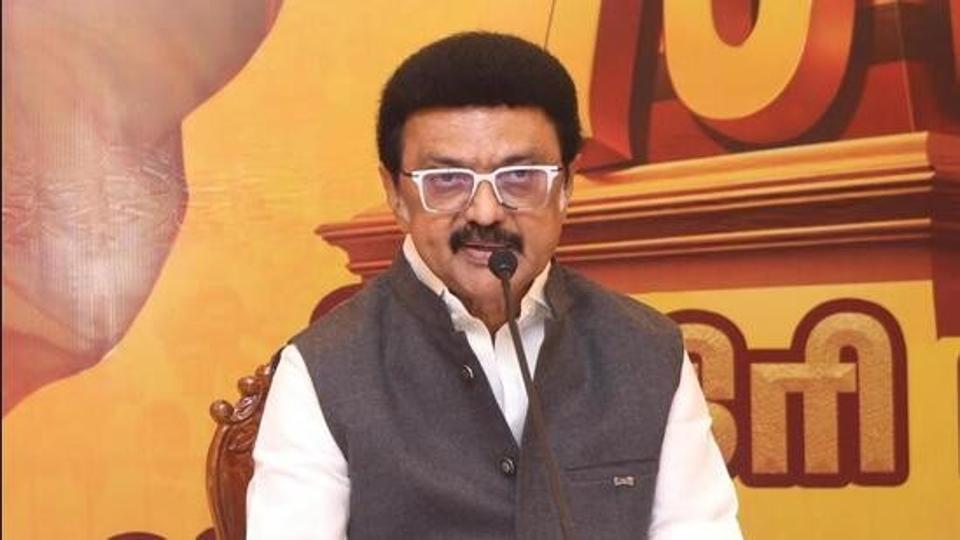
“Sanskrit gets the crores; Tamil and other South Indian languages get nothing but crocodile tears,” the Dravida Munnetra Kazhagam (DMK) leader said on X, sharing the HT report.
The HT report, based on data obtained through a Right to Information (RTI) application and from public records, revealed the Union government had spent ₹2532.59 crore on the promotion of Sanskrit between 2014-15 and 2024-25, 17 times the combined spending of ₹147.56 crore on the other five classical Indian languages–– Tamil, Telugu, Kannada, Malayalam and Odia. That works out to ₹230.24 crore every year (on average) for Sanskrit and ₹13.41 crore every year for the other five.
Tamil, the highest-funded among the five classical Indian languages, received less than 5% of Sanskrit’s total funding, Kannada and Telugu each received less than 0.5%, and Odia and Malayalam each received under 0.2% of Sanskrit’s total allocation.
Also Read | Sanskrit got lion’s share of language promotion funds: RTI data
Tamil, the first language to be designated as ‘a “classical” language in 2004 received ₹113.48 crore under Grants for Promotion of Indian Languages (GPIL) scheme, 22 times less than the amount spent on promotion of Sanskrit which was given the same status in 2005. The combined funding of the remaining four Kannada, Telugu, Malayalam, and Odia, which received classical language status between 2008 and 2014, was ₹34.08 crore.
HT had reached out to the Ministry of Education but did not receive a response till the filing of the report.
Earlier in March, in a letter to DMK party cadre, Stalin had said, “We will oppose Hindi imposition. Hindi is the mask, Sanskrit is the hidden face.”
The Tamil Nadu government has been opposing the National Education Policy (NEP), which mandates a three-language formula. The DMK government wants to continue its two-language formula of English and Tamil, which has been in practice since 1968 in the state, and sees the three-langugage formula as a move by the BJP-led Union government to impose Hindi in the state. The DMK has been locked in a language battle with the BJP since February, which is expected to become a key issue in the state ahead of the 2026 assembly elections.


