
 E-Paper



Hindustan Times Leadership Summit 2022: Moving beyond gender pay gap in Indian cricket
Hindustan Times Leadership Summit 2022: Mithali Raj and Jhulan Goswami welcomed a recent decision by the Indian board to give women players equal match fees as their male counterparts in international cricket.


Mithali Raj and Jhulan Goswami, the two torchbearers of Indian women’s cricket for two decades, retired from international cricket within four months of each other – the record-breaking batter in June and the celebrated pace spearhead in September. While Indian women’s cricket enjoys a fair amount of prominence now, it wasn’t the case when Raj and Goswami began their international journeys in 1999 and 2002, respectively.
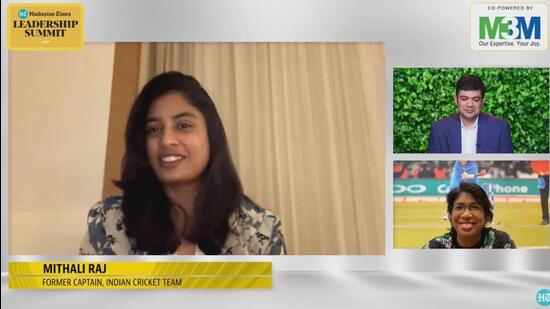
Speaking at the 20th Hindustan Times Leadership Summit, Raj and Goswami reflected on how far Indian women’s cricket has come in the last two decades, welcomed a recent decision by the Indian board to give women players equal match fees as their male counterparts in international cricket, but called for steps to make cricket a viable profession for women across domestic competitions.
“Equal match fee is a huge step. It’s a milestone in Indian women’s cricket and also globally. From where women’s cricket has come, it has evolved and so many talented players are coming up,” Raj said in a session moderated by HT’s Ashish Magotra.“The team has been doing well since 2017. Many of you have become part of the fanbase of women’s cricket. There has been a huge growth in women’s cricket. This has come at the right time. If we aim to see women’s cricket reach the level of men’s cricket, this is a step in that direction,” she added.
Goswami, who ably shouldered the burden of leading the Indian bowling attack for many years, felt pay equity will result in a change in mindset in the society too.
“This moment will have a lot of impact on our society. We come from a background where sport has always been secondary for a girl child. Now people will start thinking in a different way and encourage people to go and play. This is one small step towards gender equality. In terms of facilities, women’s teams in a lot of sports did not get good facilities. This decision by BCCI will encourage all other federations to give the same amount of respect and facilities. This talk (about pay equity) was going on for a long time. Both of us have had a lot of conversations. Everything takes time. This is the right time,” Goswami said.
Centrally contracted women cricketers will now get ₹15 lakh for a Test, ₹6 lakh for an ODI, and ₹3 lakh for a T20I. But there still remains a big gap in payments in terms of annual contracts, and for domestic matches. The players said that bridging this gap should be the next step.
Raj and Goswami have gone through the struggles that come with women cricketers not having financial independence. While they persisted, many of them may have chosen to quit the sport because it wasn’t monetarily viable.
“The thought of stopping crossed all of us at some point,” said Raj. “Not just us players, but also our parents. We were not able to sustain ourselves because there was absolutely no money. Even when we were national players, most of the financial help we got was from our parents,” she said.
The Indian women’s team’s second-place finish in the 2017 ODI World Cup in England has played a crucial role in propelling the game across the country, and has set the platform for the launch of the women’s IPL next year.
“The women’s IPL will be a huge bonus for budding cricketers. It will encourage girls to take up cricket professionally. We have been asking for this for the last 5-6 years,” said Goswami. “That is how Australia and England developed. We also need our domestic cricketers to get decent facilities. It will make them feel confident when they play international cricket – we need to bridge that gap in terms of mindset. Those are the key elements for me to have women’s IPL.”
Raj and Goswami both captained India for considerable periods, with contrasting management styles.“As a captain, you have to maintain that distance because you don’t want them to be talking about bias towards a certain section of players. I let my guard down sometimes, but most of the time, there are too many other things as a captain that you need to look into,” Raj said.
Goswami, on the other hand, said: “I am a person who loves to talk and mingle with others. Everybody has some good qualities. If I can take something from them, and share a few things, it will help both. In whatever way possible, I just wanted to switch off from the game. There was a series we were playing against Sri Lanka where I was bowling horribly. One of the youngsters quietly came to me after the match and asked me why I didn’t bowl yorkers. I wouldn’t have done it in my time but that was a good point, and it was important to have that open communication.”
During their illustrious careers, Raj and Goswami scaled many significant milestones. Raj finished as the leading run-getter in women’s ODIs with 7,805 runs in 232 matches, including seven centuries and 64 half-centuries. She also scored 2,364 runs in 89 T20Is and 699 runs in 12 Tests. Goswami has the most wickets in women’s ODIs – 255 in 204 matches. The 39-year-old from Bengal claimed 44 wickets in 12 Tests and 56 scalps in 68 T20Is.


