HistoriCity: From sacred waters to shrines, the Kanwar Yatra’s spiritual trail
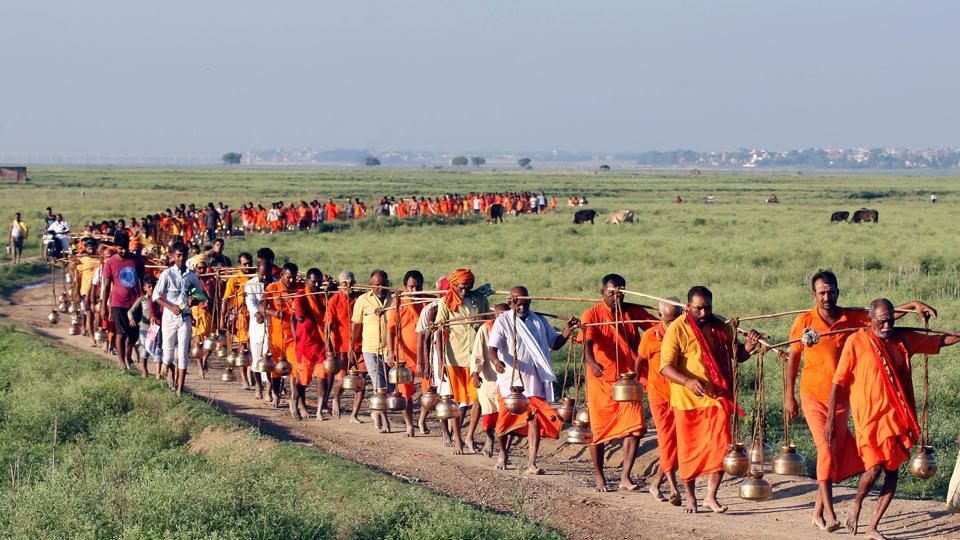
Kanwar Yatra involves walking to a holy river to bring back sacred water to ritualistically bathe either personal idol of Shiva or one at highly revered temple
The annual Kanwar Yatra, which began on July 13, reminds us how water has been venerated throughout history and across religions.
The annual Kanwar Yatra began on July 13. (ANI)
Water, the elixir of life, has been worshipped universally and eternally. Temples and shrines have come up around water bodies and hot springs considered to have healing properties—from lesser-known examples such as the nearly 300-year-old Parsi Bhikha Behram sweet water well in Mumbai, to the 16th-century Amrit Sarovar (water tank) at Amritsar, Sikhism’s holiest site. Bathing, as a ritual, is a prerequisite for religious ceremonies such as sacrifice, consecration, daily worship, and even before more mundane tasks such as the consumption of food.
Its importance is elemental, and both its indispensability to life and its capacity to destroy accord it divine status. There exist a plethora of myths and tales surrounding it, paying homage to both its life-giving and destructive capacities—the apocryphal story of a great deluge being a prominent legend across cultures and religions, from Hinduism to Christianity. Mythology also covers narratives of gods, kings, and sages mitigating the catastrophic powers of Himalayan rivers such as the Ganga through their own special austerities and strengths.
According to the most prevalent Hindu legend, the Ikshvaku king Bhagiratha appeased Shiva to ensure that when Ganga descends from heaven (read: the Himalayas) to earth (the Gangetic plains), the river’s force doesn’t destroy everything in its course. Shiva obliges, his matted hair acting as a series of check dams to slow down the mighty river.
The collective trauma of times when there was water scarcity is also so deep in the human psyche that its sources have been sought to be controlled, and its use bound by strict codes. The powerful elite have therefore historically controlled riverfronts, wells, springs, and lakes to pacify populations and subjects. One of the earliest recorded instances of rulers constructing a dam comes to us from Saurashtra, a historically arid region of western India. A rock inscription dated to 150 CE records the commissioning of Sudarshan Lake by Rudradaman of the Western Satraps dynasty. Even more interestingly, it contains references to the contributions of two previous kings—the lake’s original builder, Chandragupta Maurya (reigned: 321–297 BCE), and his grandson, Emperor Ashoka (reigned: 268–232 BCE).
The association of ritual purity with the waters of sacred rivers set in during the later Vedic period (1000–500 BCE) and, by the time of Buddha, had acquired the form of full-fledged water cults who believed that ritually bathing in holy waters had expiatory power. This belief remains strong among millions of Hindus who throng pilgrim spots along rivers to wash their sins. Interestingly, Buddha rejected the idea that sins could be expiated by bathing in sacred rivers like the Ganga and instead claimed that this could only be achieved by ‘inner washing’—that is, morality and meditation.
Kanwar Yatra
Given that neither medieval-era records nor documents from British colonial rule allude to a mass pilgrimage like the Kanwar Yatra, it’s hard to establish its historicity.
The Kanwar Yatra involves walking to a holy river to bring back its sacred water to ritualistically bathe either a personal idol of Shiva or one at a highly revered temple. Several other Yatras have mushroomed in Hindi-speaking regions of India since the 1990s.
Two Kanwar Yatras are considered the biggest and oldest in India. Both are along the Ganga; while the one that starts from Garh Mukteshwar—from where devotees carry water in pots to a famous temple near Baghpat—is better known as one of its routes passes through Delhi, the national capital, the other takes place in Jharkhand, which was previously a part of Bihar, and is less known.
Both are also associated with epic legends — the one in the north with sage Parashurama, who exterminated numerous Kshatriya clans; the one in Bihar with Lord Rama, who, it is believed, worshipped at the Ajgaivinath temple on the Ganga before going to war with Ravan.
Buddha’s copper statue discovered at Kanwar site in 1861
Interestingly, the Ajgaivinath temple, situated in Sultanganj district (earlier a part of Bhagalpur district), is also an extremely important Buddhist site where a finely sculpted solid copper statue of the Buddha was discovered while the British East India Company was carrying out digging work for the local railway station.
The statue has been dated to the 3rd century CE, and its weight (500 kg) and size (seven feet) show that Buddhism once thrived in this region. There are numerous other rock-cut sculptures of the Buddha and other Bodhisattvas at Ajgaivinath. It appears from Hindu sculptures of Vishnu, Uma and Parvati, and Shiva that after the 5th century, both Shaivite and Vaishnavite adherents had a presence at the site.
British civil servant J. Byrne wrote in the 1901 Gazetteer of Bhagalpur, “the place was originally esteemed holy by the Buddhists. As both Buddhist and Hindu carvings are found, it is safe to conclude that the Hindus appropriated this sacred place on the downfall of Buddhism.” However, it is quite possible that both Buddhism and Brahminical gods were patronised by the laity and the ruling class.
HistoriCity is a column by author Valay Singh that narrates the story of a city that is in the news, by going back to its documented history, mythology and archaeological digs. The views expressed are personal.
Get the latest India News, breaking headlines and real-time updates from across the country. Stay informed about politics, government policies, crime, weather major national developments and Karnataka Bandh LIVE.
Home/India News/HistoriCity: From Sacred Waters To Shrines, The Kanwar Yatra’s Spiritual Trail

 E-Paper