E-Paper



Hopeful of new India-Australia trade pact to be finalised this year: PM Albanese
PM Narendra Modi and Australian PM Anthony Albanese said the two sides are moving ahead with negotiations on a comprehensive economic cooperation agreement (CECA) to upgrade an interim trade deal finalised last year.

 Prefer HTon Google


NEW DELHI: India and Australia discussed the finalisation of a comprehensive trade deal and a migration pact as well as ways to boost defence cooperation at the first annual summit between Prime Ministers Narendra Modi and Anthony Albanese, reflecting the growing strategic and commercial ties between the two countries.
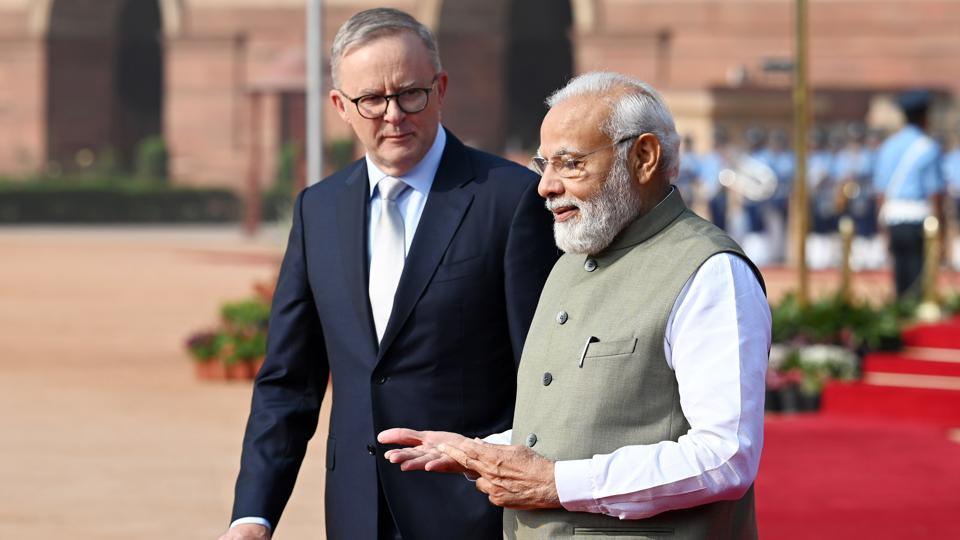
Against the backdrop of strategic convergences and shared interests in the Indo-Pacific, including challenges posed by China’s aggressive actions, the two sides also focused on ways to ramp up cooperation in maritime security and create resilient and reliable supply chains.
Modi and Albanese told a joint media interaction after their talks that the two sides are moving ahead with negotiations on a comprehensive economic cooperation agreement (CECA) to upgrade an interim trade deal finalised last year, and a migration and mobility pact to benefit students and professionals.
Last year’s Economic Cooperation and Trade Agreement (ECTA) opened better opportunities for trade and investment for both sides, Modi noted. “And our teams are also working on the CECA,” he said, speaking in Hindi.
Renewable energy, including joint efforts in clean hydrogen and solar power, was an area of priority, Modi added.
Albanese appeared more bullish about the speedy conclusion of talks on CECA, saying ECTA eliminated tariffs on more than 85% of Australian exports to India, benefiting consumers and providing cheaper inputs for the industry.
“We also agreed on an early conclusion of our ambitious CECA as soon as possible. And I’m hopeful that we’ll be able to finalise that this year,” Albanese said, describing it as a “transformational deal” that will create new employment opportunities and raise living standards for people on both sides.
India and Australia recently finalised a mechanism for recognising each other’s educational qualifications, and Modi said the two sides are “moving forward” on the mobility agreement that will benefit students, workers and professionals.
Albanese too welcomed the agreement on educational qualifications and said he is keen to expand the presence of Australian universities in India.
“I am also pleased to report that officials have made significant progress on a new migration and mobility partnership arrangement. This arrangement will...support the mobility of students, graduates, academic researchers, businesspeople and other professionals from the emerging and hi-tech sectors now and into the future, while also enhancing cooperation on issues pertaining to irregular migration. We hope to have more to announce on this new initiative the next time we meet in Australia,” he said.
Also read: ‘Very worrying’: PM Modi flags temple attacks at India-Australia summit
Modi described security cooperation as an important pillar of the bilateral partnership and said the two sides discussed maritime security in the Indo-Pacific and increasing mutual defence and security cooperation.
Albanese said both sides are committed to strengthening the defence and security partnership to address shared challenges and work towards an open, stable and prosperous Indo-Pacific in an “increasingly uncertain global security environment”.
Modi noted the two sides signed important defence-related agreements in recent years, including one on the reciprocal provision of logistics support between their armed forces. He said both sides had discussed ways to strengthen the regular exchange of information between security agencies.
Foreign secretary Vinay Kwatra sought to play down China as a factor in the growing India-Australia strategic relations, telling a media briefing that such cooperation should be seen as part of the “bilateral eco-system of engagement and partnership and not as a derivative of what a third country does”.
Albanese, who is set to visit India again in September for the G20 Summit, invited Modi to Australia for the Quad Leaders’ Summit in May.
The two sides signed four agreements on cooperation in sports, audio-visual co-production to support skilled jobs and development of film projects, creation of two task forces on solar power and green hydrogen, and cooperation between India’s Atal Innovation Mission and Australia’s Commonwealth Scientific and Industrial Research Organisation.
Tim Thomas, a former vice president of Prudential Financial, was named the first CEO of the new Centre for Australia-India Relations, which will work across government, industry and academia to support new opportunities for collaboration. It will also administer the Maitri programme of scholarships and grants.
Albanese arrived in Ahmedabad on March 8 for a three-day visit. Besides participating in Holi celebrations on Wednesday, he joined Modi to watch the first day of the final Test match of the Border-Gavaskar Trophy on Thursday. Albanese and the high-power business delegation accompanying him interacted with leading Indian CEOs in Mumbai on Thursday.
He also visited the aircraft carrier INS Vikrant in the waters off Mumbai and announced Australia will host this year’s edition of the annual Malabar naval exercise that features the navies of India, Japan and the US.