E-Paper



How a tribal woman’s battle for land left her battling for life
Rampyari and Arjun were among the beneficiaries – but, as it turned out, only on paper.

 Prefer HTon Google


A little past 2pm on July 2, Rampyari Sehariya lay writhing in pain as smoke rose from the saree draped on her. Around the 48-year-old tribal woman was a fallow field measuring six bighas – land that has seen her family harassed, assaulted, and abused for over 22 years despite multiple police complaints; land that Rampyari sought to protect on Saturday, when she was doused with diesel and set on fire, leaving her with 80% burns and in a battle for her life.
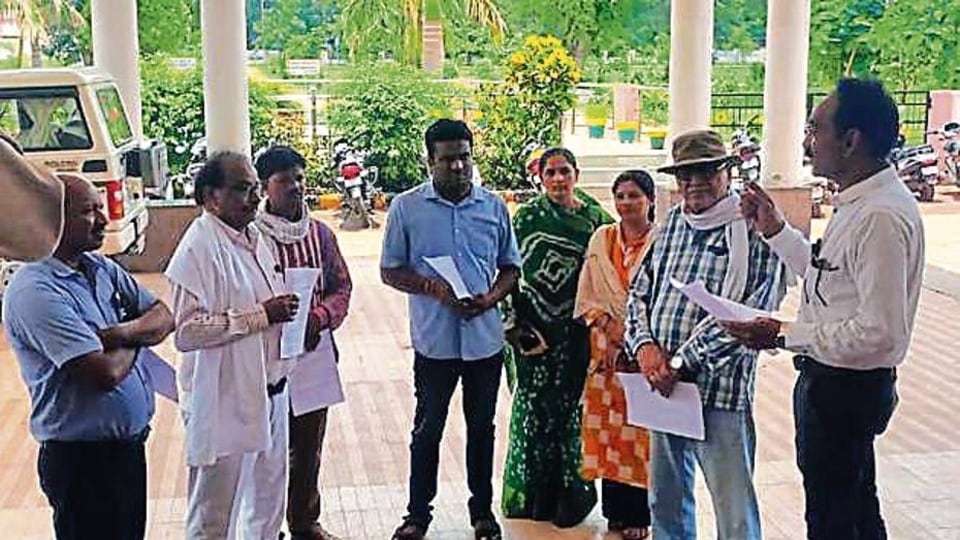
Rampyari and her husband Arjun Sehariya, 54, live in the hamlet of Dhanoriya in Madhya Pradesh’s Guna district. They belong to the Sehariya tribe, classified as a particularly vulnerable tribal group (PVTG). The ministry of tribal affairs defines PVTGs as communities that have “declining or stagnant population, low level of literacy, pre-agricultural level of technology, and are economically backward”. According to the ministry’s classification, there are 75 such groups across India – seven of them in Madhya Pradesh, including the Sehariyas.
In the year 2000, under the Chief Minister’s Welfare Scheme during the Digivijaya Singh-led Congress government in the state, 35 Sehariya families were given allotted government land. Each family got six bighas (one bigha is 0.625 acres).
Rampyari and Arjun were among the beneficiaries – but, as it turned out, only on paper.
“At the time, I worked as a labourer in Rajasthan, and would leave my village for several months on end. Even then, I tried to get possession of my land. But it was encroached upon by the Dhakad family. They used to sow crops on it, and refused to allow us to farm on it,” Arjun said.
Pratap, Hanumant, Shyam, Avanti and Sudama Dhakad, all OBC’s, are the prime accused in the attack on Rampyari. They have been apprehended by the police.
The village of Dhanoria has a population of around 1,100 people, close to one-third of whom are Sehariyas. Members of the tribe live in one segregated corner of the village, and work as either migrant labour, or on the fields of the Dhakad community, the dominant caste in the village.
Instances of discrimination are not uncommon, and the power balance between the OBCs and the Sehariyas impossibly skewed. Narendra Singh, a local activist that works on tribal welfare in Guna, said: “Sehariyas live in a terrible state, and are constantly bullied. Two months ago, Sehariya women from multiple villages in the area met the district collector, and handed over a memorandum alleging that local musclemen were forcing one person from each family to work on the fields by banning those who didn’t comply from the use of water sources in the villages.”
Property lost
Singh said that, like with Rampyari and Arjun, a majority of the land given to the Sehariyas under the government scheme was taken over. “The land was given to the Sehariyas under a scheme for the landless, but perhaps up to 80% of it has been encroached. Given the lack of influence and the discrimination they face, the tribals have been unable to do anything about it. Two years ago, Vijay Sehariya, a resident of Ukavad Khurd village in Bamori, was killed after he was set on fire by a local muscleman for refusing to work as a labourer on his own field. We have, therefore, been requesting the government to declare Bamori as a special development block,” he said.
In 2018, Rampyari and Arjun were given a pukka home under the Prime Minister’s Awas Yojana, and having a place of their own gave them more reason to stay in Dhanoria instead of travelling to other states in search of work.
“The house was there but we needed to generate our own income, our food. So we decided to fight for our land. We attempted to get our land assessed, but the Dhakads were influential, and did not allow that to happen,” Arjun said.
This put the family in direct confrontation with the powerful landowning family in the village that collectively owns close to 20 acres of land, and ran a PDS shop until two years ago. Locals say that while Pratap and Hanumant stay in the village and take care of the fields, Shyam Dhakad lives in Narsinghgarh town, where his wife works as a government schoolteacher. A local official at the Bamori police station said that the family did not have an extensive criminal history, “but two years ago there was a fight between the brothers and another OBC family, and FIRs were filed from both sides”.
In December 2021, Arjun finally decided to sow crop on the land for the first time, in a half bigha sliver that was fallow at the time, since it was the beginning of the crop cycle. “But in February 2022, Hanumant, Shyam and Pratap cut the crop and took it with them. They beat me up, and abused me. I filed a complaint at Bamori police station but nothing happened,” he said.
This account, however, is not unanimous in the village. Hemraj Kirar, who is from the same OBC caste as the Dhakad family, said: “I don’t believe this is true. The Dhakads were the ones that had planted the crop as usual, which Sehariya claimed because he said it was on his land. That led to the argument.”
But what is clear is that, in February, Sehariya filed a police complaint against the Dhakad family.
“Arjun Sehariya did file a complaint in February 2022 against the Dhakad brothers. All three, Pratap, Hanumant and Shyam, were booked for voluntarily causing hurt, causing loss of more than ₹50, and under relevant sections of the SC/ST (Prevention of Atrocities) Act. They were not apprehended as the Supreme Court has ordered that there should be no arrest of accused persons in a case that has a maximum imprisonment of seven years or less,” said Sriniwas Verma, additional director general of police, Guna.
A notice was served to the three brothers, but a challan is yet to be filed in court, another senior police officer said.
Around the same time, Arjun Sehariya also filed a complaint with the district administration against the illegal possession of his land. In May, the naib tehsildar went to the plot, carried out an assessment, and awarded the land to the Sehariya family, district officials said.
But the harassment continued.
“The accused belong to an influential family. Pratap Dhakad used to claim that they have possession over the land since 1986, and that Sehariya had the wrong papers. But yes, even after the government allotted the land to the Sehariyas, the tensions continued unabated,” said a former sarpanch of the village who asked not to be identified.
On May 23, Arjun went to the local police, alleging that he was threatened against ever setting foot on the land. The district police called the Dhakad brothers, and got them and the Sahariya couple to sign a “peace bond” under section 117 of the Code of Criminal Procedure.
“I sent my son and daughter away to Indore to work as labourers because I was afraid for our lives. Not everyone had to face what we were going through. On June 23, I even met the SP of the district. But they said that because I had signed a bond, it was all taken care of and no further action was needed,” Arjun said.
The incident
On July 2, Rampyari left home early, close to the crack of dawn. The barren land was hard earned, and before they could attempt another round of sowing, the field needed to be demarcated. As she was digging trenches around the periphery, at around 2pm, she suddenly got company. Five members of the Dhakad family arrived, intending to plant soyabean, with a tractor in tow. A argument broke out, leading to a fight, and then an act of unmitigated violence.
The three brothers allegedly doused Sehariya with diesel, set her ablaze, and one of them, Pratap Dhakad, allegedly shot a video of the incident that has since gone viral across the state.
Arjun said that when he heard the commotion, he rushed to the fields to see his wife set ablaze, lying on the ground in pain. “I doused the fire and dialled the police. She was rushed to the district hospital, from where she was referred to the Hamidia Hospital in Bhopal. She has 80% burns. I blame both, the Dhakad family for doing this, and the police for their inaction,” he said.
In her declaration given to the subdivisional magistrate in Bhopal, Rampyari said that the family burnt her alive, hoping to kill her and to pass off the incident as self-immolation.
Police said that four of the five accused have been arrested under section 307(attempt to murder) of the IPC and provisions of the SC/ST Prevention of Atrocities Act. The fifth, Pratap Dhakad, is in police remand and is being interrogated. “The incident is unfortunate but we have acted on each occasion according to the law. All the main accused signed a peace bond on May 23, and therefore they will also be booked under section 122 of the CRPC, which deals with the breach of the bond,” Verma said.
Guna SP Pankaj Srivastava said police were also investigating on who shot the videos, including one where Pratap Dhakad is heard saying that the woman set herself ablaze. “The accused are yet to confess but the declaration of the woman, where she said she was set on fire by five people, is a key part of the evidence. Arjun also saw the accused running away from the farm land on a tractor. We are investigating all aspects,” he said.
The incident has set off a political slugfest in Madhya Pradesh, with senior Congress leaders meeting Sehariya in Bhopal and demanding ₹10 lakh in compensation for the family, as well as free treatment for Rampyari from the government. “Incidents of atrocities against tribals are increasing by the day and the government is busy making fake promises. The role of officers of the area police station must also be investigated,” Rajya Sabha MP Digvijaya Singh told reporters.
BJP spokesperson Rajnesh Agarwal defended the police action. “The police moved swiftly and arrested the accused within 24 hours. It is an unfortunate incident, but the Congress shouldn’t politicise such crimes to rekindle the ground they have lost.”
(With inputs from Yogendra Lumba from Guna)