
 E-Paper



HT Archive: Another oil field discovered off Mumbai’s shore
In August 1976, Hindustan Times wrote about the announcement of a subsequent discovery two years later in an adjoining area in Bassein and detailed exploration and production plans for the country that, at the time, raised hopes of a transformation in India’s energy sources

 Prefer HTon Google


India’s reliance on imports for much of its crude oil requirements has landed the country in the cross-hairs of US President Donald Trump, who has penalised the country with tariffs of 25% for its trade with Russia, over and above a previous 25% levy.
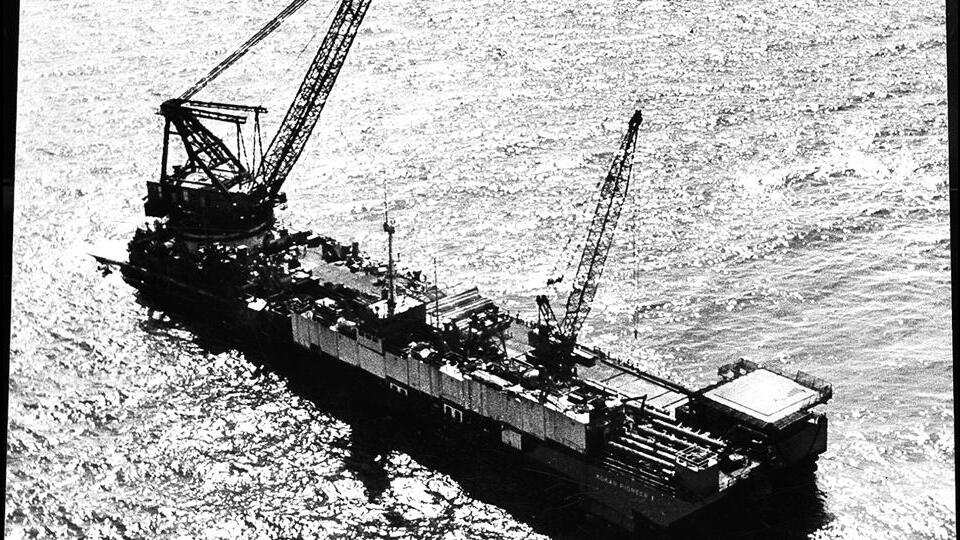
But more than 50 years ago, hopes of cutting this dependence on imported oil received a fillip when explorers discovered oil reserves at Bombay High in 1974, 160km off the west coast of India’s financial capital, Mumbai.
In August 1976, Hindustan Times wrote about the announcement of a subsequent discovery two years later in an adjoining area in Bassein and detailed exploration and production plans for the country that, at the time, raised hopes of a transformation in India’s energy sources.
“Petroleum minister KD Malaviya on Wednesday announced that oil had been discovered on a ‘fault’ structure between the offshore areas of Bombay High and Bassein,” HT wrote on its front page on August 3, 1976.
“While commercial exploitation of oil has already begun in Bombay High, production is likely to commence in Bassein from next year. Mr Malaviya told the Ministry’s Parliamentary Consultative Committee that the discovery of yet another offshore oil source had brightened the prospects of finding more oil and gas in the country.”
“After Bombay High, oil had been found on the north Bassein followed by a gas strike on the Bassein south structure. Now that oil had been found in the “fault” structure lying east of Bombay High, it was reasonable to assume, Mr Malaviya hoped, that ‘the pools of oil around Bombay High might be stretching for quite a long distance.’”
Bassein wasn’t to be the only one. Over the next few years, the basin yielded multiple commercial accumulations (Heera-Panna-Bassein block, Ratna & R-Series, Tapti, among others), establishing it as India’s most prolific find.
Malaviya informed the committee that the ministry was experiencing “some financial constraints” in exploring oil, and that it was for the Planning Commission and the Finance Ministry to organise the resources.
The Ministry and ONGC during the time grappled with insufficient capital and limited autonomy. The Oil Industry Development Board received only a small fraction of the cess levied for exploration and production activities. Moreover, banks were reluctant to lend for risky offshore ventures, and ONGC relied heavily on foreign loans and government support for costly drilling and pipeline infrastructure. HT wrote further on what Malaviya said on this.
Malaviya admitted that oil exploration of the magnitude undertaken by the Oil and Natural Gas Commission (ONGC) on land and offshore required huge investment. Also money had to be found for laying pipelines and other installations to transport oil.
As an example, he pointed out that about ₹100 crore would be needed to build pipelines to carry additional oil from Assam. Intensification of search for oil would necessarily be proportionate to money available to carry on this work, he said.
Eminent geologists had estimated India had a great potential for oil and gas. But it had been possible to establish a recoverable reserve of only 123.05 million tonnes at the beginning of 1975. Oil exploration therefore needed to be intensified. Mr Malaviya emphasised.
That call for intensification prefigures the regime changes that followed—New Exploration Licensing Policy (formulated in 1997) and more recently, the Open Acreage Licensing Policy—to widen exploration beyond ONGC/OIL. The official histories explicitly link Mumbai High’s 1974 boost to later policy liberalisation. HT further wrote on India’s oil exploration and production ambitions.
Mr Malaviya said oil had been found at various onshore locations in Gujarat and Assam. In the last three years ONGC had raised its production from 3.72 million tonnes to 4.5 million tonnes in Gujarat and from 0.39 million tonnes to 1.12 million tonnes in Assam.
During this period, ONGC discovered oil at Asjol, Sanaokhurd Siswa, Nandasan and Bhandut in Gujarat and at Charali in Assam.
With the discovery of fresh but small oil reservoirs in Gujarat, it would be possible to maintain the present quantum of oil production from that region, despite the natural depletion of the Ankleshwar oil field which was currently producing around three million tonnes annually.
An extensive programme of drilling in the eastern region of Assam had been drawn up. Oil production from Assam had been increased by 1.3 million tonnes.
Oil exploration will be resumed in the North Himalayan region where drilling would be undertaken after the monsoon. The locations in this region included Ramshehar near Kasauli and Jawalamukhi and in the Pilibhit area.
The search for oil in the Delta region of West Bengal will be intensified. Geologists agreed that river deltas had generally very good prospects for oil. But on the Deltaic region, Malaviya was spot on.
The Himalayan foothills were geographically tricky to explore, but no large commercial oil fields were discovered. However, in subsequent decades since this report, deltaic/east-coast basins (Krishna-Godavari, Cauvery, Mahanadi) delivered the most talked-about discoveries (from KG-D6 to ongoing Mahanadi/Cauvery finds), validating the delta thesis.
The concluding line of the HT report hinted at the reform plans that culminated in the dismantling of the Administered Pricing Mechanism, ending government-controlled “cost-plus” pricing for petrol and diesel and transitioning toward market-linked pricing based on import parity.
The Government would soon decide on restructuring the country’s entire petroleum refining and distribution system.
In the years since the Bassein discovery, oil was found in Rajasthan (Barmer), reserves of gas were found in KG basin, India’s refining capacity has now reached 256.8 million metric tonnes per annum, and the nation became a net exporter of refined petroleum products. But India’s domestic oil production peaked in 2011-12 and the country has become increasingly dependent on imported oil to fuel its expanding economy.


