
 E-Paper



HT insight: Decoding India’s second wave and vaccine strategy
With record cases reported almost daily, the second wave of Covid-19 is surging at a much faster rate than the first. Hindustan Times has been covering the pandemic and its escalation through a series of reportage, data, commentary, and analysis-driven pieces


India reported 63,689 Covid-19 cases on Tuesday, taking the tally of active cases to 1,264,698 as infections continued to surge months after the country was thought to have brought the situation under control. With record cases reported almost daily, the second wave of Covid-19 is surging at a much faster rate than the first. At least 60,000 daily cases have been reported since April 8.
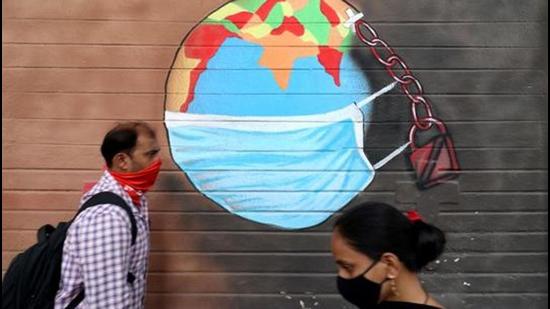
Hindustan Times has been covering the pandemic and its escalation through a series of reportage, data, commentary, and analysis-driven pieces. As the numbers surge, here are some of the pieces covering myriad aspects of the pandemic:
What is driving India’s second Covid-19 wave?
Why did this happen now? Why did the numbers escalate beyond what India had at its peak the first time? And what’s the way out? Gagandeep Kang, professor, Christian Medical College, Vellore, discusses how the lack of appropriate behaviour that could prevent the virus’ spread has increased, and potentially been amplified, because of viruses that are more transmissible than the ancestral version of the virus that we had last year.
The future is here
The patterns have been predictable for a while. In any susceptible population that is not making strong efforts to reduce transmission, Sars-CoV-2 will rapidly transmit with exponential growth until a combination of recovered people with immunity and heightened precautions slow the spread, says director, Institute of Genomics and Integrative Biology (CSIR) Anurag Agrawal.
How India can overcome the Covid-19 surge
While India has to successfully battle the second wave, it is important not to create panic, but to stay calm. The surge will settle soon—but for that, a mix of scientific, administrative and behavioural changes are essential. According to the honorary emeritus scientist of ICMR and former Dean of AIIMS, New Delhi, Narinder Kumar Mehra, it is important to identify reasons associated with the unprecedented rise in numbers and examine measures that must be taken to halt the upsurge.
Five questions about vaccination
Facile comments about making the Covid-19 vaccine available to those who need it, rather than those who want it, hide the fact that India’s vaccine strategy needs an urgent reboot, one that requires honest answers to five questions. Last week, in an editorial, HT asked five questions—Is India staring at a vaccine supply crunch? Why, if there was going to be an imminent supply crunch, did the government engage in vaccine diplomacy? Why are other vaccines not being approved? Is an age-based criterion the best way to determine priority for vaccination? How serious is India’s political leadership about the Covid-safety protocol?
India’s vaccine strategy is based on science
In less than three months, we have managed to provide more than 100 million doses across the country, which is more than the population of Germany. The country has already achieved one of the highest daily vaccinations per day across the globe with 4.3 million vaccinations, which is close to the population of New Zealand. India has also achieved the fastest rate of reaching the 100 million vaccination milestone, ahead of the US and China. Our daily vaccination rates are also among the highest in the world, says Vijay Chauthaiwale, in-charge, foreign affairs department, BJP, and a senior scientist, in a response to the HT editorial.
As vaccination drive picks up pace, challenges remain
As India crossed the milestone of 100 million doses on Saturday, data indicated that it would take some doing to maintain a pace that could help India turn the tide against the surging second wave of infections. The case trajectory of the second wave has long surpassed the first wave peak both nationally and in at least six states, according to HT’s dashboard. However, the best news for India right now is that the country-wide pace of administering doses is the fastest it has ever been recorded—Jamie Mullick analyses.
Exclude Maharashtra, and India’s second Covid wave is still frightening
The outbreak in the western state, which is by a far margin the worst-hit in the country, has (rightfully) dominated headlines over the past month-and-a-half. But is the outbreak in Maharashtra magnifying the severity of India’s second wave? Do India’s current Covid numbers look better if we remove Maharashtra’s numbers from the national tally? The answer to both is: not really. Indeed, the magnitude of the outbreak in Maharashtra may have actually masked the march of the viral disease in other states—Jamie Mullick looks at the figures.
How bad is the current wave of Covid in India?
The story of India’s Covid-19 battle has changed (for the worse) in the past month. For almost eight months after September, when India’s first wave peaked, the country saw a steady decline in daily cases and deaths -- but a second wave that started mid-February is now undoing months of progress made against the outbreak. How bad is the second wave? Are things as bad as fast as they were during the rise of the first wave? As India races to vaccinate enough people amid fears of mutant strains of the virus, here’s a quick look at how the second wave of infections is playing out—Jamie Mullick writes.
UK, California, Manaus: What they suggest about the Covid crisis in Maharashtra
The deviation in Maharashtra’s trajectory (and to some extend Punjab’s) resembles examples from three other regions where mutations have in fact been implicated: United Kingdom (UK)’s London and south-east, Brazil’s Manaus, and California in the United States (US). All three are believed to be the ground zero for variants that make the coronavirus spread more readily or cheat immunity from a previous infection (or both)—Binayak Dasgupta analyses.
In Maharashtra, mutation raises infectivity concerns
One of the two mutations feared to have spread rapidly in Maharashtra may have the ability to make the Sars-Cov-2 more adept at infecting humans, improve its ability to multiply within a host, and possibly escape a more complex part of the human immune response, a new study awaiting peer review suggests. The findings relate to the mutation known as L452R, which is one of the two “double mutations” the Indian government said was detected in large numbers in parts of Maharashtra. The state is by far the worst-hit region in India, with an exponential rise in infections that has forced authorities to bring back lockdown-like curbs, writes Binayak Dasgupta.
One year of Covid-19: How India fought the virus
There are several ways to look at India’s Covid-19 year. On the face of it, it’s the story of a country battered by the world’s second-highest number of infections. But it is also a story of intrigue and, often, surprise. It has one of the lowest deaths rates seen in any large country and, leaving out trends that have become visible only in the latest fortnight, gone through only a single, gigantic wave of infections that appeared to be well-controlled by the country’s precarious health infrastructure. Binayak Dasgupta and Anonna Dutt analyse.
Covid-19: What you need to know today
In the seven days to Sunday night, India added an average of 133,918 coronavirus disease cases a day. India has overtaken Brazil to the second spot in terms of overall cases (since the start of the pandemic) and is surging ahead. It is also the country that’s adding the most cases a day right now. The current weekly average national positivity rate (based on Sunday’s number) is 9.9% and rising—far higher than the 5% (and declining) level which indicates that things are getting better.


