
 E-Paper



HT This Day: December 17, 1947 -- Orissa and Chhattisgarh rulers sign merger agreement
8 million people to benefit from Dominion rule; the way to progress and democracy, says Sardar Patel as integration essential for small states

 Prefer HTon Google


New Delhi: What Dalhousie failed to achieve and what the Political Department did not feel strong enough to do in spite of the recommendations of the Attlee Committee of the Simon Commission, Sardar Patel has achieved during his two-day visit to Cuttack and Nagpur. The Rulers of Orissa and Chhattisgarh States have voluntarily handed over to the Indian Dominion the administration of their 56,000 sq. miles of territory rich in minerals with a population of eight million and a gross revenue of about Rs. 2 crores.
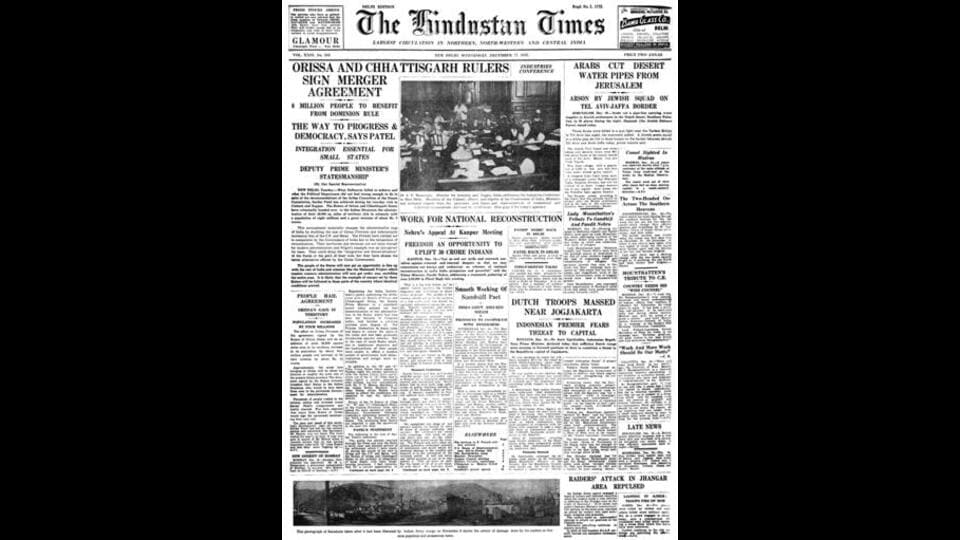
This arrangement materially changes the administrative map of India by doubling the size of Orissa Province and substantially increasing that of the C.P. and Berar. The Princes have yielded not to compulsion by the Government of India but to the compulsion of circumstances. Their territories and revenues are not large enough for modern administration and Nilgiri’s example was an eye-opener for them. They could delay the “integration and democratisation” of the States at the peril of their rule; but they have chosen the better alternative offered by the Union Government.
The people of the States will now get an opportunity to line up with the rest of India and schemes like the Mahanadi Project which require common administration will now get under way, enriching the entire area. It is likely that the example of merger set by these Rulers will be followed in those parts of the country where identical conditions prevail.
Explaining the India Government’s policy underlying the settlement with the Rulers of Orissa and Chhattisgarh States, the Deputy Prime Minister in a statement issued today pointed out that democratization of the administration in the States, which had long been the keynote of Congress policy, had become a pressing problem since August 15. The Princes themselves in many cases had begun to realize the spirit of the times and had been gradually introducing popular reforms. But in the case of small States which, due to inadequate resources and the backwardness of their people were unable to afford a modern system of government, both democratization and merger were inevitable.
In addition to the “B” and “C” Class Orissa States which signed on Sunday night the merger agreement with the Indian Union Government, seven out of the 11 ‘’A” Class Rulers today signed a similar agreement after holding hurried consultations with Mr V. P. Menon. Secretary of the Indian States Ministry. Four other States, whose Rulers were unable to attend the conference, are expected to sign the agreement shortly.
Eleven of the 14 Rulers of Class “A,” “B” and “C” Chhattisgarh States in the Central Provinces have also signed the same agreement with the Dominion Government following yesterday’s conference between Sardar Patel and the Rulers of these States. The remaining three Rulers are expected to sign the agreement in the next few days.
Patel’s statement
The following is the text of Sardar Patel’s statement:
“The public has already received through the Press and over the Radio a fairly clear and detailed picture of the settlement which I have reached, during the course of my visit to Orissa and the C.P. and Berar, with the Rulers of Orissa and Chhattisgarh States on the problem of integration of those States with their neighbouring provinces. I feel. however, that for a correct appreciation of this important event, it is necessary for me to explain the background and the policy underlying that settlement.
“Democratization of the administration which has long been the keynote of Congress policy towards the States has become a pressing problem since August 15. The Princes themselves have in many cases begun to realize the spirit of the times, and have been gradually introducing measures in accord with that spirit. The progress has been in some States slow, in others it has been swift, but everywhere it has been sure.”
“It should be obvious to everyone, however, that even democracy and democratic institutions can function efficiently only where the unit to which these are applied can subsist in a fairly autonomous existence. Where, on account of smallness of its size, isolation of its situation, the inseparable link with a neighbouring autonomous territory, be it a province or a bigger State, in practically all economic matters of everyday life the inadequacy of resources to open up its economic potentialities, the backwardness of its people and the sheer incapacity to shoulder a self-contained administration, a State is unable to afford a modern system of government, both democratization and integration are clearly and unmistakably indicated.”
Democratisation Inevitable
“In the world of today where distances are fast shrinking and masses are being gradually brought into touch with the latest administrative amenities, it is impossible to postpone for a day longer than necessary the introduction of measures which I would make the people realize that their progress is also proceeding at least on the lines of their neighbouring areas.”
“Delays inevitably lead to discontent, which in its turn results in lawlessness; the use of force may for a time check the popular urge for reform, but it can never succeed in eradicating it altogether.”
“Indeed, in many of the States with which I had to hold discussions during the last two days large-scale unrest had already gripped the people; in others the rumblings of the storm were being heard. In such circumstances, after careful and anxious thought, I came to the conclusion that for smaller States of this type, placed in circumstances which I have described above, there was no alternative to integration and democratization.”
“At the same time I felt that their Rulers had acquired by heredity and history certain claims on the people I which the latter must honour. Their dignities and privileges and their means of subsistence on a reasonable standard must be assured. I have always held to the belief that the future of the Princes lies in the service of their people and their country and not in the continued assertion of their autocracy.”
“In conformity with those ideas, I felt that on release from an increasingly onerous and awkward responsibility, but at the same time with their personal position and that of the ruling family fully safeguarded, they would have opportunities of service which have hitherto been denied to them and which many of them are genuinely longing for and genuinely anxious to secure, and they would cease to be targets of continuous bitter attacks and ill-will.”
“The settlement which we have reached at Cuttack and Nagpur is , actuated by these motives, prompted by these considerations and governed by these principles. I have no doubt that it is in the best interests of the Rulers, the people and the country at large. I am particularly grateful to the Rulers of the States who showed a commendable appreciation of the realities of the situation and a benevolent regard for public good.”
“To all of them, undoubtedly, the decisions they have taken have involved considerable sacrifice of powers and fortune. They have accepted this sacrifice cheerfully and voluntarily in the interests of their people and the country at large. I am sure their people will react favourably to this generous response to public interests.”
“Throughout my discussions with the Rulers I was careful to emphasize that the solution which we suggested for the difficult problems with which we and they were equally faced was for them to accept or reject of their own free will. There was no compulsion save that of events and of the circumstances and peculiar problems of their States.”
“I also told them that in offering this solution we were actuated by nothing but the friendliest disposition towards them and had nothing but the ultimate good of the Princes and their people at heart.”
“I also maintained that their voluntary surrender of most of the powers that they wielded so far would increase and not reduce the prestige that they have enjoyed and would create in the hearts of their people a place of lasting affection and regard which would redound to their glory. I am very glad that they all responded to these sentiments and would ask the people of these States to play their own part and to extend to each one of them unfailing cordiality and unstinted goodwill.”
People’s responsibilities
“In future if the people of these States have any grievances they can only be against the popular representatives and leaders who would be charged with their interests and welfare and not against the Princes. These Princes have by their act of abnegation purchased in perpetuity their right to claim the devotion of their people.”
“I am sure that very soon the provincial Governments, who would be acting for the Dominion Government in discharging administrative functions in these States, will turn their thoughts and energies to ameliorating the conditions of the people and to devising ways and means of associating representatives of States with the fashioning of administrative measures.”
“Let them all realize the stakes involved-some 56,000 sq. miles of territory with a population of about eight million, a gross revenue of about Rs. 2 crores and immense potentialities for the future.”
“It is the undisputable right of the people in these territories to modern amenities of Government which should be the governing consideration in everything that we do for them. It will also be the duty of the people concerned to help and cooperate wholeheartedly with, the respective provincial administrations in this process of unification and amelioration so that they may derive the full benefit of this great achievement.”


