
 E-Paper



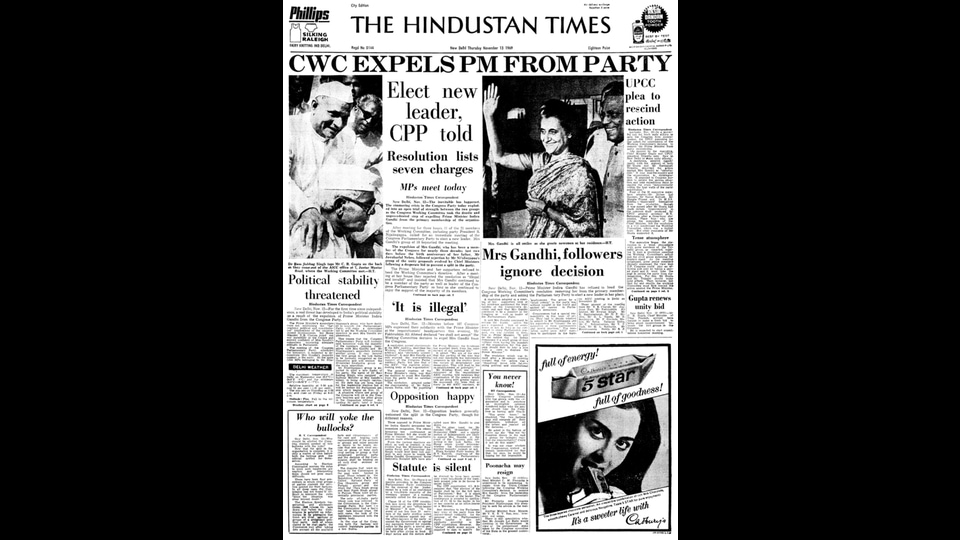
HT THIS DAY: November 13, 1969 —CWC expels PM Indira Gandhi from Congress, elect new leader, CPP told
The expulsion of PM Indira Gandhi followed rejection by Niialingappa’s group of the unity proposals evolved by Chief Ministers following a desperate bid to prevent a split in the party.

 Prefer HTon Google


New Delhi- The inevitable has happened. The simmering crisis in the Congress Party today (November 12) exploded into an open trial of strength between the two groups as the Congress Working Committee took the drastic and unprecedented step of expelling Prime Minister Indira Gandhi from the primary membership of the organization.
After meeting for three hours, 11 of the 21 members of the Working Committee, including party President S. Nijalingappa, called for an immediate meeting of the Congress Parliamentary Party to elect a new leader. Mrs. Gandhi’s group of 10 boycotted the meeting.
The expulsion of Mrs. Gandhi, who has been a member of the Congress for nearly three decades just two days before the birth anniversary of her father, Mr. Jawaharlal Nehru, followed rejection by Mr. Niialingappa’s group of the unity proposals evolved by Chief Ministers following a desperate bid to prevent a split in the party.
The Prime Minister and her supporters refused to heed the Working Committee’s directive. After a meeting at her house they rejected the resolution as “illegal and invalid” and insisted that Mrs. Gandhi continued to be a member of the party as well as leader of the Congress Parliamentary Party so long as she continued to enjoy the support of the majority of its members.
Within hours of the announcement of her expulsion which sent groups of student demonstrators shouting pro-Mrs. Gandhi slogans around the city, hundreds of baton-carrying policemen were posted outside the residences of Mr. Nijalingappa and his supporters in the Working Committee to provide them adequate security.
PM backed
Reacting with anger to the CWC’s decision - 167 Congress MPs, said to constitute the bulk of the party members now in the Capital, gathered at the rival AICC headquarters and pledged their support to Mrs Gandhi to save “democracy and socialism’ and called upon “democratic and progressive forces” to fight reaction.
Two of them Mr M. V. Krishnappa and Mr Randhir Singh Chandhary, gave notice to the Congress Parliamentary Party office seeking the expulsion of Mr Morarji Desai, Mr S. K. Patil, Mr S. N. Mishrg and seven others from the party for contravening the constitution and acting against its declared policies.
This will come up at the meeting of the Congress Parliamentary Party convened by Mrs Gandhi tomorrow for securing a vote of confidence. Acting on Congress President’s instructions, Mr S. N. Mishra, deputy leader of the Parliamentary Party from the Rajya Sabha, announced cancellation of the meeting scheduled for tomorrow. Mr Nijalingappa’s supporters among them Mr Kamaraj and Mr Morarji Desai, will boycott tomorrow’s meeting convened by the Prime Minister.
The Working Committee itself acknowledged that it was the “saddest moment” in the history of the 84-year old organisation which had spear-headed the movement for independence and ruled at the Centre uninterruptedly since 1947.
The charges
Another resolution said that the CWC was “regretfully obliged to remove Mrs Gandhi from the party for her “patent and grave” acts of indiscipline.
While the ACC general secretary, Mr Sadiq Ali, had claimed that the resolutions were passed unanimously, another source said that there had been no voting and that Uttar Pradesh Chief Minister C. B. Gupta had expressed himself against it.
The Working Committee’s action has been criticized by a large number of Congressmen but supported by some.
The charges listed by the Working Committee against Mrs Gandhi were
(1) Opposing the party nominee for the Presidency.
(2) Launching a signature campaign for ousting Congress President Nijalingappa and using pressure tactics to obtain signatures on the requisition.
(3) Questioning the authority of the “legally constituted ‘ Working Committee and refusing to abide by its decisions
(4) Constantly denigrating the organisation,
(5) Sponsoring a rival Working Committee and a rival AlCC in violation of the party constitution.
(6) Trying to divide Congressmen among those who, are her supporters and those who are not.
(7) Her basic and overriding desire to concentrate all power in her hands, all of which “spell grave danger” to the democratic functioning of the Congress.
As regards the Prime Mintster’s contention that there is greater need for harmony between the parliamentary wing .and the Congress organisation, the resolution said the word “harmony is a misnomer for dominance and the desire to capture the Congress machinery first at the top level and then at other levels.”
Unhappy events
By another resolution, the Committee referred to the continuous chain of unhappy events since the Bangalore AICC causing anxiety and pain to millions of Congressmen. The Working Committee chose “between Mrs Gandhi and everything that the Congress stood for, and it has rightly decided in favour of the latter.
It asked Congressmen not to falter and remain loyal to the organisation. This was clearly meant for the Prime Minister’s, supporters, who are organising , a rival AICC meeting. It ended with the declaration: “Le? Act the I future historians say of us that, I in the hour of peril both to the Congress and the nation we wavered and faltered in our loyalty to the great organisation to which we all have the honour to belong.”
The first indication of the Working Committee’s decision came from Mr S. K. Patil, who while coming out of the meeting remarked: “It is not suspension. It is expulsion.” The AICC , General Secretary, Mr Sadia Ali, said both the resolutions were passed “unanimously.” Those who attended the meeting besides Mr Nijalingappa were Mr Sadia Alf. Mr P. Venkatasubbiah. Mr Morarji Desai, Mr S. K. Patil, Mr Atulya Ghosh, Mr K. Kamataj. Mr Hitendra Desai, Mr C. B. Gupta, Mr K. C. Abraham and Dr Ram Subagh Singh.
The Chif Ministers had already abandoned their unity efforts after a meeting at U.P. Nivas which continued till the small hours of the morning.
CM’s Formula
According to Mr Sukhadia, the proposal envisage:
(1) The general AICC meeting agenda will include a review of the Faridabad Working Committee resolution on organisational elections and a decision by the AICC on the future course of action in this matter.
(2) In view of the above, the requisitioned meeting of the AICC will be given up and no step shall be taken either at the organisational level or at the parliamentary level which is likely to adversely affect the unity of the party.
(3) Charges against the Prime Minister contained in the letter of Oct. 28. Nov. 2 and Nov. 3 shall be withdrawn.
(4) There shall be mutual discussion between the two sides to smoothen out difficulties and remove misunderstanding.
Mr Sukhadia said this formula emerged as the most acceptable one even though three of the Chief minister- of Uttar Pradesh, Mysore and Gujarat-had some reservations regarding the third point in the proposal.
The formula was put to the Congress President and his colleagues through Mr C. B. Gupta with an earnest appeal that this proposal be accepted by both the sides. “Unfortunately this has been turned down by the Congress President and his colleagues.”
Mr Sukhadia added: “Our only satisfaction is that we tried our best to avoid a crisis.”
He said the formula emerged after protracted meetings yesterday and fresh constitutions today to resolve the crisis in the party.
He drew a parallel between the demand for withdrawal of the ‘ charge-sheet and the exoneration of Mr Nijalingappa of the charges I against him at the Aug. 28 Working Committee meeting which adopted the “unity” resolution. Although Mr C. B. Gupta appreciated the point, he could not persuade his colleagues in the Working Committee to accept it.
Mr Nijalingappa, however, explained that the demand, for the withdrawal of the charge-sheet was not part of the Chief Ministers’ formula as originally brought to the Working Committee in the morning. The Committee had already approved of the formula as thought by Mr Hitendra Desai and Mr C. B. Gupta when a telephone call was received asking addition of the demand for withdrawal of the charge-sheet against, Mrs Gandhi and later also, of the Prime Minister’s letter to Mr Nijalingappa in reply. He declined to identify the caller.
According to Mr Nijalingappa, instead of having unity on paper the need was for the two sides to have a heart o-heart talk and to remove the various prejudices. If the charge-sheet was withdrawn, there was nothing to discuss although the formula referred to mutual discussions between the two sides.
He said the letter did not contain any charges against Mrs Gandhi. But they were only “complaints” listed chronologically about what had happened in the recent months.
He parried a question whether the withdrawal of the charges and the counter-charges would not have been in keeping with his assertion of goodwill. He did not think that the CWC decision would affect the stability of the State Governments. “What about stability at the Centre?” Mr Nijalingappa replied: “We shall wait and see.”
Mr Gupta and Mr Hitendra Desai came out of the Working Committee meeting and made a dash to U.P. Nivas where some Congress Chief Ministers were in session and apprised them of the Working Committee’s view. The unity efforts were thereupon abandoned. Mr Gupta and Mr Desai returned to the Working Committee meeting to inform the Nijalingappa group that the unity move was finally off.
To demonstrate its support for the stand taken by Mr Nijalingappa, the Working Committee made some changes in the draft resolution and said it was “grateful” to the Congress President for his letter to the Prime Minister dated Oct. 28. The ‘ Committee endorsed “what has been said in that letter because it puts the case of the Working Committee in its proper sequence and perspective.
“ The hard-liners were tho first to emerge from the meeting. Mr C. B. Gupta, who was involved in the unity efforts, was the last to leave. He looked visibly depressed and was helped out by an aide. Mr K. C. Abraham was standing behind the door as newsmen made a beeline for the AICC Secretary to snatch copies of the resolutions.


