
 E-Paper



Balakot proof air power can be used under nuclear overhang: IAF chief
“This is very important given the nature of our adversaries. The response options available to the leadership have suddenly increased, and increasingly, air power has become an option of choice due to inherent flexibility and unmatched precision strike capability,” Chaudhari said


Indian Air Force chief Air Chief Marshal VR Chaudhari on Tuesday said that the 2019 air strikes against a terror facility in Pakistan’s Balakot demonstrated that if political will is there, air-power can be effectively used in a “no war, no peace” scenario, under a nuclear overhang, without allowing the situation to escalate into a full-blown conflict.
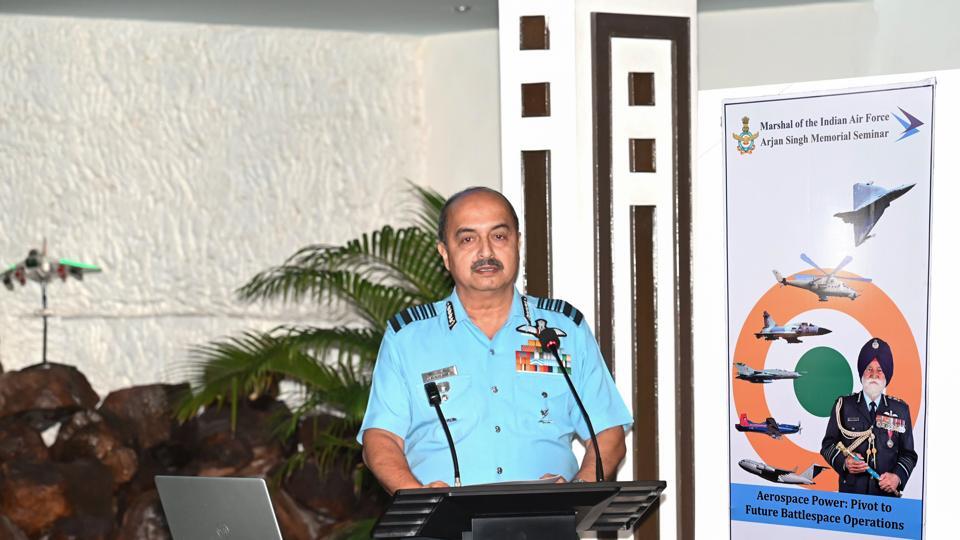
“This is very important given the nature of our adversaries. The response options available to the leadership have suddenly increased, and increasingly, air power has become an option of choice due to inherent flexibility and unmatched precision strike capability,” Chaudhari said in his inaugural address at the Marshal of the Air Force Arjan Singh Memorial seminar on Aerospace Power: Pivot to Future Battlespace Operations.
The air strikes against the Jaish-e-Mohammed terror base were India’s response to the Pulwama suicide car bomb attack in which 40 Central Reserve Police Force (CRPF) men were killed on February 14, 2019. Twelve days later, the IAF’s Mirage fighter jets hit three targets in Balakot, with five Israeli-origin Spice 2000 bombs with penetrator warheads that allowed them to pierce through the rooftops before exploding inside to cause maximum damage.
The Balakot air strikes were significant as they were IAF’s first peacetime, cross-border strikes. Pakistan air force fighters made a failed attempt to bomb Indian military installations on February 27, 2019, leading to an aerial engagement along the Line of Control during which Wing Commander (now Group Captain) Abhinandan Varthaman scripted military aviation history by downing an F-16, seconds before his own MiG-21 Bison was hit by a missile forcing him to eject. He was captured after he bailed out of his aircraft, but Pakistan returned him to India on March 1 after holding him captive for almost 60 hours.
India’s security concerns require that it puts in place adequate military power to achieve deterrence, ensure information dominance, coerce when needed, and provide multiple response options, Chaudhari added.
“Attributes of aerospace power enable the leadership to formulate an appropriate strategy with due cognizance given to the desired end state, conflict termination criteria and escalation matrix.”
High speed, reduced response time, long reach, increased mobility, technological intensity, precision firepower, shock effect, ability to operate across domains, and network centric operations have made aerospace power a formidable component of India’s military might, Chaudhari said.
Considering the advantages that aerospace power offers, aerospace control and dominance will become a crucial factor in future battlespace operations, the IAF chief said.
Chaudhari added that the foremost lesson that can be drawn from developments in the 20th century and early 21st century is that no war can be successfully prosecuted without aerospace power, quoting legendary British commander Field Marshal Bernard Law Montgomery who said “if we lose war in the air, we lose the war and lose it quickly.:
The traditional battlefield has long vanished from the lexicon of modern strategists, and what is increasingly being used is battlespace in the land, sea, air, cyber and space domains, he said.
“We must acknowledge that the wars of the future will be fought differently. Adversaries will use lethal as well as non-lethal weapons, wars will be fought across multiple domains and will not distinguish between combatants and non-combatants,” the IAF chief said.
He said the future battlespace will be increasingly complex and characterised by heavy dependence on technology, asymmetric nature of threats, expanded battlespaces, high tempo of operations, enhanced lethality, compressed sensor-to-shooter cycles, and media scrutiny.
“To see first and see clearly, to reach first and reach farthest, and to strike first and strike with precision will be the mantra for fighting modern wars,” he said.
Aerospace power will dominate all surface and air operations of the future, said Air Marshal Anil Chopra (retd), director general, Centre for Air Power Studies. “Air and space will become a single domain, and near space (20 km to 99 km) capabilities is what the world is beginning to exploit,” he added.


