E-Paper



IIMA launches redesigned website with new logo, to reconstruct buildings
HT first on March 31 reported about the institute’s plans to change the logo and the criticism it faced, especially from the faculty members


The Indian Institute of Management Ahmedabad (IIMA) has launched a redesigned website with a new logo, and announced the reconstruction of parts of the old campus, citing the safety of residents on campus and expansion of the infrastructure as part of its growth plans.
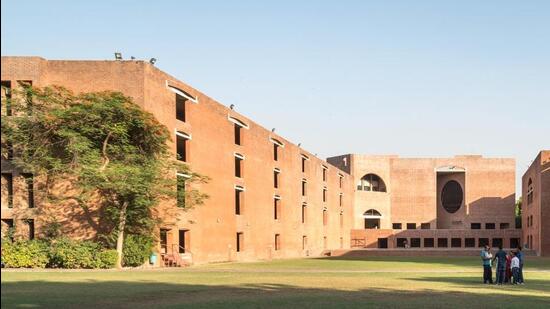
The decisions were earlier put on hold following a huge outcry, particularly over the demolition of buildings designed by renowned American architect Louis Kahn to rebuild them. Forty-five faculty members protested against the new logo. IIMA students and alumni also started an online petition against the new logo.
“...the institute felt the need to re-envision the IIMA website and renew its visual identity, which is represented by its logo. The new website embodies the IIMA brand philosophy of ‘Simple, Bold, and Global.’ After consulting with and incorporating feedback from relevant stakeholders, the logo refresh was also completed,” the institute said, quoting the IIMA ’s Board of Governors (BoG).
BoG said the logo aims to convey a more vivid and vibrant brand identity while retaining the elements of the existing one.
The new logo retains the Sanskrit words “Vidya Viniyogadvikasa [development through the distribution or application of knowledge]” whose removal from it earlier triggered much outcry.
The previous logo with the motif of “tree of life” was inspired by a carved stone latticework grille of Ahmedabad’s 16th century Sidi Saiyyed Mosque. The logo was finalised in 1964 three years after the institute was founded. The Sanskrit part was added in 1967.
HT first on March 31 reported about the institute’s plans to change the logo and the criticism it faced, especially from the faculty members.
IIMA said the institute takes pride in its antecedents and rich legacy including iconic architecture. It said they are pivotal to its growth into a premier world-class institution. The institute said some of the buildings have been facing structural damage, and deterioration and have become uninhabitable, posing a safety concern for the residents.
“The deterioration of the structures was raised first at a Building Committee meeting in July 1982. Most importantly, the Board considered all relevant reports, especially the ones that were undertaken in the last year. This included meetings and presentations by two groups of experts who were tasked with the assessment of the conditions and structural status of the buildings and who visited campus to conduct a study first-hand,” it said.
The institute said after careful consideration, a process will be initiated for the reconstruction of the faculty blocks, classroom complex, and the peripheral dorms 16 to 18 with, the same exterior façade, a seismically safe structure, and non-major renovation of the internal space to improve its functionality to suit the needs of the users.
Dorms will be remodeled in line with Kahn’s vision and keeping in mind the functional needs of residents of the campus. “The safety of our people is our primary responsibility, and with that in mind, the Board felt there was a need to address this issue rather than opt for temporary solutions such as restorations, which had been attempted but were not as effective.”
It said the board consulted industry experts and discussed the issue for months before taking the decision regarding the reconstruction of parts of the old campus. “All reports indicate that most structural elements have insignificant residual life, and thus restoration will be technically impractical and ineffective despite [the] investment of time, effort, and funds.”
On January 1, 2021, the institute withdrew an expression of interest put out a month earlier inviting architects and designers to propose plans for demolishing dormitories on the campus designed by Kahn and replacing them with new structures.
Architects, historians, and academics urged the institute to abandon plans for demolishing the structures. In a letter dated January 1, 2021, BoG chairman Kumar Mangalam Birla and other members said that they “are sensitive to the feedback from some stakeholders who are not in agreement with this approach.”