
 E-Paper



Impose costs on nations that back terror, says Modi
Prime Minister Narendra Modi on Friday called for penalising countries that support terrorism as part of their foreign policy by providing political, ideological, and financial support, making an indirect reference to Pakistan, which has harboured terror camps and outfits for decades.


Prime Minister Narendra Modi on Friday called for penalising countries that support terrorism as part of their foreign policy by providing political, ideological, and financial support, making an indirect reference to Pakistan, which has harboured terror camps and outfits for decades.
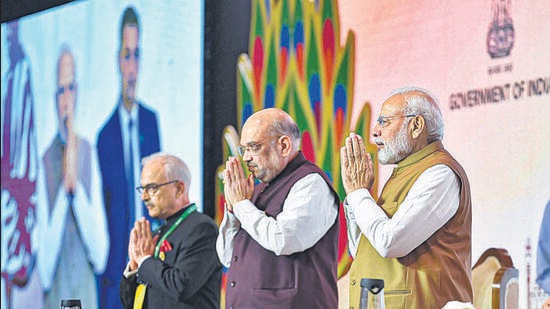
Speaking during his inaugural address at the No Money for Terror (NMFT)’s third ministerial conference in New Delhi, Modi also hit out at attempts to block action against terrorists in what appeared to be criticism of China that has thwarted efforts by India to get Pakistan-based terrorists blacklisted at international forums.
“It is well known that terrorist organisations get money through several sources. One source is state support. Certain countries support terrorism as part of their foreign policy… international organisations must not think that the absence of war means peace. Proxy wars are also dangerous and violent,” Modi told the gathering of 450 delegates from 77 countries and 16 multilateral agencies.
“There must be a cost imposed upon countries that support terrorism. Organisations and individuals that try to create sympathy for terrorists must also be isolated. There can be no ifs and buts entertained in such matters,” he added.
In his nearly 25-minute speech, Modi said India is helping build momentum against terror funding and said the intensity of the reaction to different attacks cannot vary based on where it happens.
“There are still certain mistaken notions about terrorism… sometimes, there are indirect arguments made in support of terrorism to block action against terrorists. There is no place for an ambiguous approach while dealing with a global threat…only a uniform, unified and zero-tolerance approach can defeat terrorism,” he said.
The PM’s comments assume significance in the context of the terror threat India faces. Pakistan has long sheltered anti-India terrorists such as Jaish-e-Mohammed chief Maulana Masood Azhar and Lashkar-e-Taiba chief Hafiz Saeed. China has also used its power as a permanent member of the United Nations Security Council to veto India’s attempts to list several Pakistan-sheltered terrorists as global terrorists. The latest such move by China was in June, when it blocked the listing of Abdul Rehman Makki, a close aide and brother-in-law of Hafiz Saeed. However, India registered a major diplomatic win in May 2019, when the UN labelled Masood Azhar as a designated terrorist.
The two-day conference is being attended by delegates from 77 countries. India sent an invite to China but Beijing didn’t send any representatives. Pakistan and Afghanistan were not extended an invite. The annual meeting was first held Paris in 2018 and then in Melbourne in 2019.
Asserting that the tactical gains against terrorism will be lost without a larger strategy to stem its finances, Modi asked the international community to work together. “Fighting a terrorist and fighting terrorism are two different things. A terrorist may be neutralised with weapons. Immediate tactical responses to terrorists may be an operational matter. But tactical gains will soon be lost without a larger strategy aimed at hurting their finances.”
“Uprooting terrorism needs a larger proactive response. If we want our citizens to be safe, then we cannot wait until terror comes to our homes. We must pursue terrorists, break their support networks, and hit their finances,” he further said.
Modi said the Indian government’s intention is to bring the world together in taking the war against terrorism to the next level.
“At this No Money For Terror Conference, India is helping build global momentum against terror funding. Our intention is to bring the world together in taking the war against terrorism to the next level,” he said, highlighting India’s role in war on terrorism.
“The delegates have a chance to interact with a country and people who have been firm in tackling terror. ...even a single attack is one too many. Even a single life lost is one too many. So, we will not rest till terrorism is uprooted,” the PM added.
He said the dynamics of terrorism were changing. “Rapidly advancing technology is both a challenge and a solution. New kinds of technology are being used for terror financing and recruitment. Challenges from the dark net, private currencies and more are emerging. There is a need for a uniform understanding of new finance technologies. It is also important to involve the private sector in these efforts. From a uniform understanding, a unified system of checks, balances and regulations can emerge. But we must be careful about one thing. The answer is not to demonise technology. Instead, it is to use technology to track, trace and tackle terrorism,” he added.
At least 450 delegates from 77 countries other than India and 16 multilateral agencies such as Interpol, Financial Action Task Force (FATF) and Europol are attending the conference, the third since 2018. Delegates are expected to discuss global trends in terror financing, terrorism, the use of social media, the dark web for funding terror organisations, and the nexus between terrorists and organised crimes.
Ministers of 20 countries are taking part in the two-day conference.


